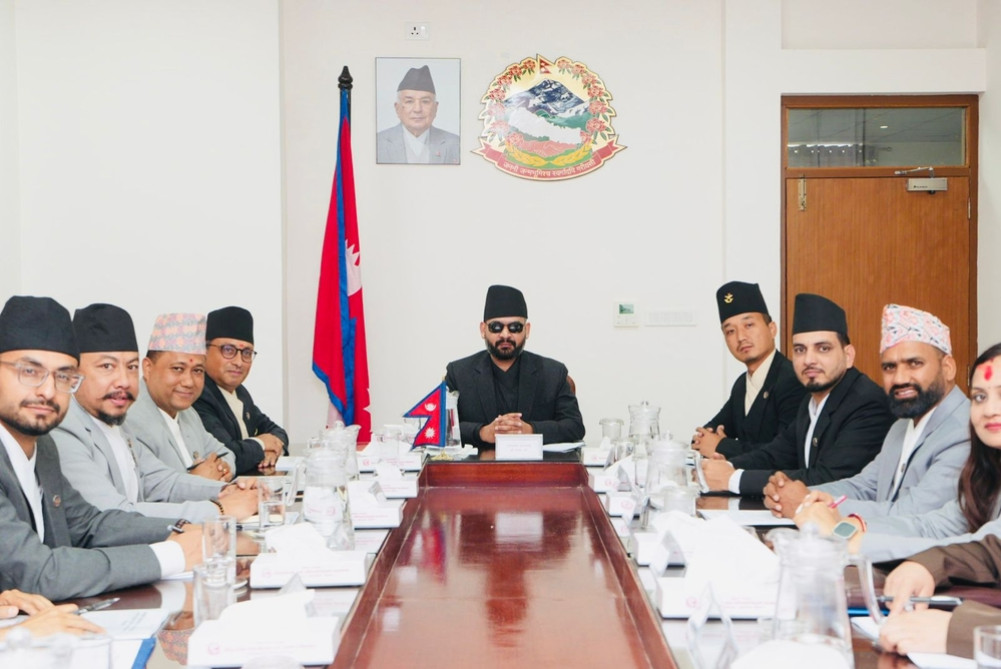
Even if the characters change, it takes time for trends and working styles to change. Since politics is a reflection of society, a change in political culture is inevitable.
We use Google Cloud Translation Services. Google requires we provide the following disclaimer relating to use of this service:
This service may contain translations powered by Google. Google disclaims all warranties related to the translations, expressed or implied, including any warranties of accuracy, reliability, and any implied warranties of merchantability, fitness for a particular purpose, and noninfringement.
The long-standing belief that Nepal's electoral system cannot give a clear majority to any one party and that a stable government is not possible has been proven wrong by the voters this time. But it has also exposed another reality, that the problem lies more in the political culture than in the electoral system. The elections have given rise to the Rashtriya Swayamsevak Sangh (RSS) and Balen.
For the Balen-led government, the five-year term is not just a period of governance, but also a test of establishing a new political culture. Prime Minister Balen's biggest challenge will be to provide stable and effective governance for five years. There are many examples in history where even strong governments have not been able to last a full term, the main reason for which has been internal conflict and power struggle.
Therefore, maintaining a balance between government and party governance will be extremely important. On the other hand, the RSS, which was formed by integrating various groups and subgroups in a short time, is itself a combination of people from diverse backgrounds. In such a situation, the question of how the internal balance of power is managed is important. The solution to this must be sought through the rule of law, institutional strengthening, and a clear policy framework.
If individualistic tendencies start to dominate, there is a possibility of another political crisis in the near future. If such a situation occurs, it could seriously affect the Federal Democratic Republic of Nepal and create a situation where it will have to pay a heavy price.
Politics now should not be limited to the means of gaining power or remaining in power, but should focus on institutional strengthening, effective implementation of constitutional arrangements and deep reform of political parties. Even though Nepal has been practicing the Federal Democratic Republic for a long time, the institutions have not yet become fully capable, independent and effective.
Therefore, the main priority now is to make the parliament, judiciary, executive and constitutional commissions strong, accountable and people-oriented. The system of rights, structures and balances envisaged by the constitution should not be limited to paper only. Only if they are implemented in practice can the real meaning of democracy be established. Otherwise, the constitution will remain limited to a formal document and frustration will start to grow among the people.
On the other hand, the government should prioritize good governance and service delivery. The people have placed the greatest expectations from the government on this matter – ease in daily life, fast service and accountable governance. The government should pay attention to this.
Looking at the social structure of Nepal, about 25-30 percent of the population belongs to the lower class, 40-50 percent to the lower-middle class, and 20-30 percent to the middle class. The lives of all three classes are directly linked to government services, policy decisions, and the economic system.
Therefore, the impact of the government's performance will be most visible on these classes. The biggest challenge for the lower class citizens is ensuring basic needs such as food, shelter, and clothing. They struggle to earn a living on a daily basis. Ensuring social security, job creation, and easy availability of essential goods is very important for this class.
The lower-middle class is a group that is in a vulnerable situation even though it is above the poverty line. A small economic shock can cause them to fall back into poverty. Education, health, job stability, and easy access to government services are very important for this class. Similarly, the middle class is the class most directly linked to service delivery. They are directly affected by government offices, tax systems, administrative processes, and policy implementation.
Therefore, this is also the main category for evaluating the effectiveness of good governance and service delivery. The daily problems faced by the people - delays in government offices, complex procedures, unnecessary paperwork - should be improved. The situation where citizens have to visit multiple offices for the same work should end. Making the service process simple, fast and transparent should be the primary responsibility of the government. It is unrealistic to expect that all problems will be resolved immediately when there is a change of power.
Even if the characters change, it takes time for the attitudes and working style to change. Since politics is a reflection of society, a change in political culture is inevitable. If government services are made online, integrated and citizen-friendly, many problems can be solved automatically. For example, if there is a system in place where citizens can avail various services from a single platform, time, cost and hassle will be reduced.
Ultimately, the success of the Balen government will depend on how much convenience it can bring to the daily lives of the citizens. If the government can ensure social justice and equal opportunities while making service delivery effective, the trust placed in it by the people will be maintained for a long time.
Similarly, amending the constitution will now also become a major agenda. This notion was widely established during the election campaign. But the reality is much more complex than expected.
The union has a bicameral parliament—the House of Representatives and the National Assembly. A two-thirds majority in the House of Representatives alone is not enough to amend the constitution; two-thirds support is also required in the National Assembly. Moreover, some provisions require the approval of the provinces. Such a complex process makes it clear that amending the constitution is not an easy or immediately possible task.
In the context of the lack of representation of the RSVP in the National Assembly, the possibility of amending the constitution seems even weaker. But a deeper issue than constitutional/legal complexity is its political and social nature. The Constitution of Nepal is not just a simple legal document, it is the result of a long political struggle, Constituent Assembly elections, conflicts, and people's movements. Therefore, it is also a balanced agreement between different social groups, ethnic identities, regional aspirations, and political forces.
It is necessary to prioritize plurality and national consensus rather than changing such a document solely on the basis of majority. If the constitution is tampered with in the frenzy of the majority, it could open a ‘Pandora’s box’, where various interest groups could become active, suppressed grievances could surface, and new conflicts could arise. In the context of Nepal, constitutional amendment is not just a technical process; it could re-raise sensitive issues such as secularism, federalism, identity, demarcation, and distribution of powers. These issues have not yet been fully resolved. Therefore, hasty steps could push the country towards instability.
Especially in the case of new political forces and new parliamentarians, whose institutional experience may be limited, extreme caution is required on sensitive issues such as the constitution. In this context, if the RSVP-led government wants to succeed, it would be appropriate to focus on good governance, service delivery, and solving the daily problems of the people, rather than on constitutional amendment. It would be wise to elevate a serious issue like constitutional amendment above emotional slogans and move forward on the basis of national consensus, deep dialogue, and long-term thinking.
The Rashtriya Swayamsevak Sangh (RSS) has pledged to accept the Gen-G movement, but now that it has reached the government, it is necessary to move forward its working style in line with the spirit of the movement. The essence of the movement is not just a change of power, but also to reform the system, establish good governance and public accountability. The 10-point agreement has presented a clear roadmap to make the operation of the state transparent, accountable and citizen-friendly.
Corruption control, service delivery reform, strengthening the rule of law, digital administration and youth participation are at its core. It is necessary to implement the reform agenda by implementing the Karki Commission report. Overall, this agreement is not just a guideline but a basis for systemic transformation. Therefore, it is imperative to put these commitments into practice.