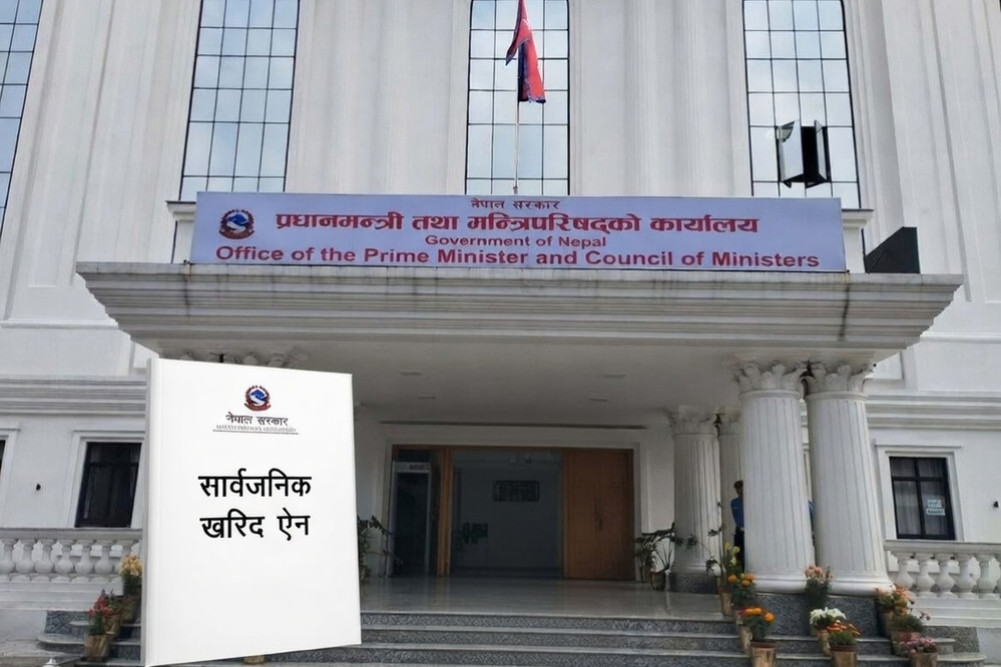
Just as a farmer can buy his plow and harrow with ease and confidence, the government must create an environment where it can operate in the same transparent manner when awarding contracts worth billions.
We use Google Cloud Translation Services. Google requires we provide the following disclaimer relating to use of this service:
This service may contain translations powered by Google. Google disclaims all warranties related to the translations, expressed or implied, including any warranties of accuracy, reliability, and any implied warranties of merchantability, fitness for a particular purpose, and noninfringement.
The country has been bound by an invisible chain for decades, which is commonly called the ‘Public Procurement Act’. This act is said to prevent corruption, but in practice it is punishing the honest and rewarding the dishonest. From the fertilizer a common farmer puts in his field to the path his children walk on, they have fallen prey to this act.
In today's environment, our Public Procurement Act has created such a situation that a ‘market price’ has been set for every person. The price of someone who seems a little more honest may be a little higher, the price of someone who is less honest may be a little lower. However, the price of someone has been fixed somewhere or the other. This is not just a character flaw of some person, it is a product of our Procurement Act. As long as the law gives employees and decision-makers room to deal in a dark room in the name of discretionary rights, people will continue to be sold. We need such a strict and transparent law that does not make people sellable. In developed countries, any employee thinks a hundred times before accepting a bribe, because the system there links his honesty not with money, but with his future and existence. In our country, honesty has become a burden, which is always at risk due to weak laws.
Another weakness of our procurement law is that the work is awarded to the one who offers the ‘cheapest price’. If a farmer buys a bull in the market and only looks at the cheapest one, he is sure to bring home a sick or dying bull. Which neither plows the field nor protects his investment. This is exactly what is happening in our country. Be it building a road or a bridge, the law awards the work to the contractor who accepts the lowest price. But that contractor offers such a low price to get the job that he cannot use quality cement and rods. As a result, the bridge washes away in the first rain and the road becomes a pothole that could be used to plant rice. Developed countries have long understood that ‘cheap’ always turns out to be expensive. He looks not only at money, but also at the ability, skill, strength, machines, and history of the worker. Until we too break the shackles of 'minimum price', our development will always be like pouring water on the sand.
Not all construction entrepreneurs or contractors are corrupt in their intentions. There are also some such entrepreneurs who want to do some quality work for the country even amidst these confusing and cumbersome laws. But the irony is that our procurement act itself is so confusing and unjust that it is strangling the ethics of honest contractors day by day. When a well-intentioned contractor sees that another fraudulent contractor is embezzling crores from the state by arranging 'settings', arranging papers, and doing shoddy work and is being rewarded, then his inner morality slowly begins to die. Due to unfair competition and unfair comparison, even honest people are forced to choose the path of dishonesty to survive. This is exactly the case, where a farmer tries to grow organically without using pesticides in his field, but the government only gives a market and price to the rotten produce grown after using pesticides. In such a situation, how long will that farmer continue to cultivate organically while maintaining his morality?
Imagine, what a strange irony one has to face when buying an ordinary pen at a government office? When a farmer is in a hurry to sow seeds in his field, he goes to the market in the morning, buys seeds, and uses them until the next day. But our government has to make a week-long 'paper pilgrimage' to buy a pen. Nepal's procurement law requires that a demand form be filled out for a pen, sent to knock on the boss's door, and then asked for quotations from three stores after cutting out the documents that the store does not have. Let's say, it is not a pen, but a precious gem.
Running from one room to another carrying a file wears out the soles of the employee's shoes and wastes time more than the value of the pen. The pen is an image, but there are safe tunnels of corruption at every step of this process. Where the more files are stopped, the more bribery increases. But on the other hand, in countries like Singapore and Japan, where the digitalized procurement process is, employees do not have to run around carrying a file to buy the same pen, data runs there. Government employees open a portal like 'Amazon' on their office computer, choose the pen they need and order it with one click. The money goes directly from the bank to the shopkeeper's account and the pen arrives on the table the next day. There is no law based on distrust and suspicion, there is technology based on accountability and speed. Until we too break this cumbersome 'file culture' and create a digital market where even an ordinary farmer can see every penny of government expenditure from his mobile, our development will continue to slow down.
The tangle of the procurement act must be broken to build a country. Just as a farmer can buy his plow and harrow with ease and confidence, the government must create an environment where it can work in a transparent manner even when it signs contracts worth billions. As long as the state does not protect honest contractors and does not eliminate the corrupt from the system, no matter how many new faces come, the situation in the country will not change. The Prime Minister removed the physical barrier by using a dozer, now break down this invisible wall of law, which is preventing Nepal from developing. History will remember you on the day when the value of any person in Nepal's procurement system will stop being determined and only the value of the nation's progress will be paramount.
(Ghimire is an engineer)