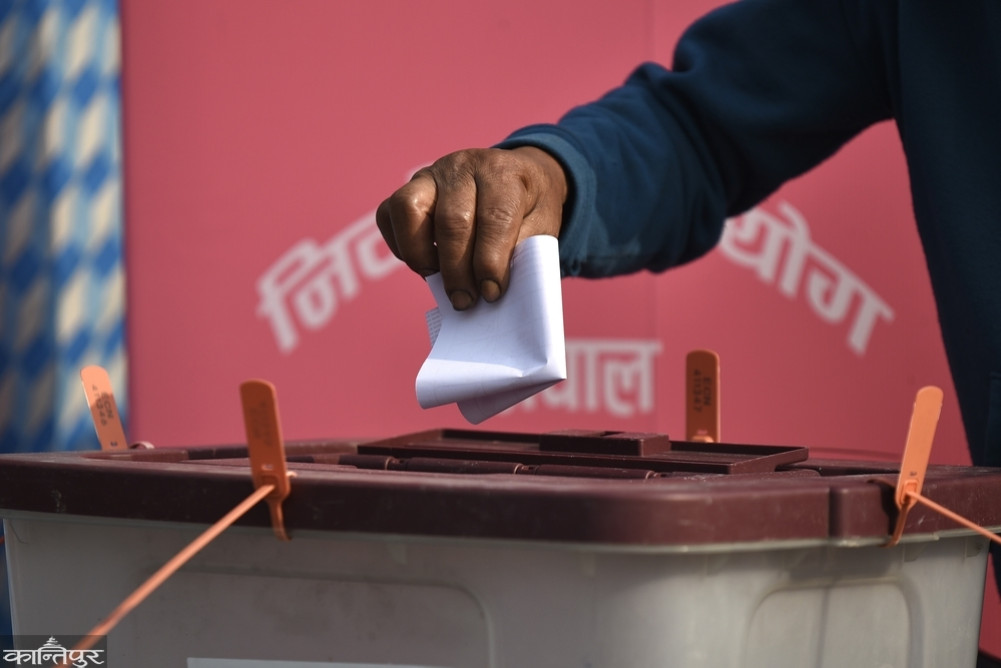
Voter education was conducted with the aim of getting as many voters to participate in the elections held on 21 Falgun and reducing invalid votes.
We use Google Cloud Translation Services. Google requires we provide the following disclaimer relating to use of this service:
This service may contain translations powered by Google. Google disclaims all warranties related to the translations, expressed or implied, including any warranties of accuracy, reliability, and any implied warranties of merchantability, fitness for a particular purpose, and noninfringement.
There are some methods to make democracy work, one of which is elections. Through elections, citizens elect representatives for the right to govern themselves for a certain period of time. The most important element of democracy is periodic elections, which is not possible without citizens. And, democracy is not possible without periodic elections. After the promulgation of the Constitution of Nepal, 2072, two periodic elections at the provincial and local levels have been held, while three federal elections have been held.
Voter education was conducted in the elections held on 21 Falgun with the aim of getting as many voters to participate in the vote and reducing invalid votes. Various organizations and stakeholders had conducted various public awareness programs to conduct the elections. But invalid votes could not be reduced.
More than 5 percent of votes were invalid in the 21 Falgun House of Representatives elections. 5.06 percent of votes were invalid in the House of Representatives member elections held in Mangsir 2079. 5.18 votes were invalid in 2074. According to the final list, there were a total of 18.9 million 3 thousand 689 voters. In which the number of female voters was 92,40,131 and the number of male voters was 96,63,358. The number of voters of other genders was 200. Despite the specific circumstances and geographical challenges, if we look at the significant participation of citizens in this election, it is found that citizens took the election as a celebration.
There are other reasons for invalid votes than geographical structure and literacy rate, which can be analyzed through regional comparison. Because, a significant number of votes are invalidated in urban areas as well. According to the Election Commission, an average of 4 to 5 percent of votes in urban areas are invalidated in past elections. Not knowing how to stamp the ballot is not the only reason for invalidation. Experts say that it may have been invalidated intentionally.
Generally, there are some reasons why more votes are invalidated in elections than expected –
a) Not knowing how to exercise the right to vote, i.e. lack of awareness.
b) Knowingly invalidating votes when there is an electoral alliance and not being able to vote for the candidate of the party you want.
c) Deliberately invalidating the vote because the candidate is not satisfied.
d) Deliberately invalidating the vote by individuals, groups, and parties who boycott the election because they do not have the right to vote for 'NOTA' (the option to vote for no symbol).
In many countries that practice democracy, it is established that if it is the right of citizens to vote, it is also the right to say no. Therefore, some democratic countries have provided such a facility to citizens so that 'NOTA' can be used. This is considered a feature of democracy. Its main purpose is to recognize the right of citizens to reject candidates just as they can vote in a democracy.
Currently, voting is seen as a citizen's right and duty. People are encouraged to participate in the election by completing the time, place, and process specified by the state. Where even if they do not like the candidates and parties that have participated in the election, they are forced to vote for one of them or mark it as invalid. In addition, parties with ideological principles that do not participate in the election, their workers or supporters tend to invalidate the vote even if they participate in the election. Therefore, even though the awareness of the citizens has increased, more votes are invalidated than expected.
Therefore, in order to ensure the rights of citizens who do not like any candidate who has contested the election and to reduce the number of invalid votes, the law should be amended and a provision for 'NOTA' should be made in the upcoming elections. The votes cast in it should not have any impact on the victory or defeat of the election and the right to 'NOTA' should be used according to the demands and needs of the people. If a government with almost two-thirds of the votes amends the law and makes provisions for the rights of citizens related to 'NOTA', the right to vote with different votes will be ensured. Democracy will also be stronger.