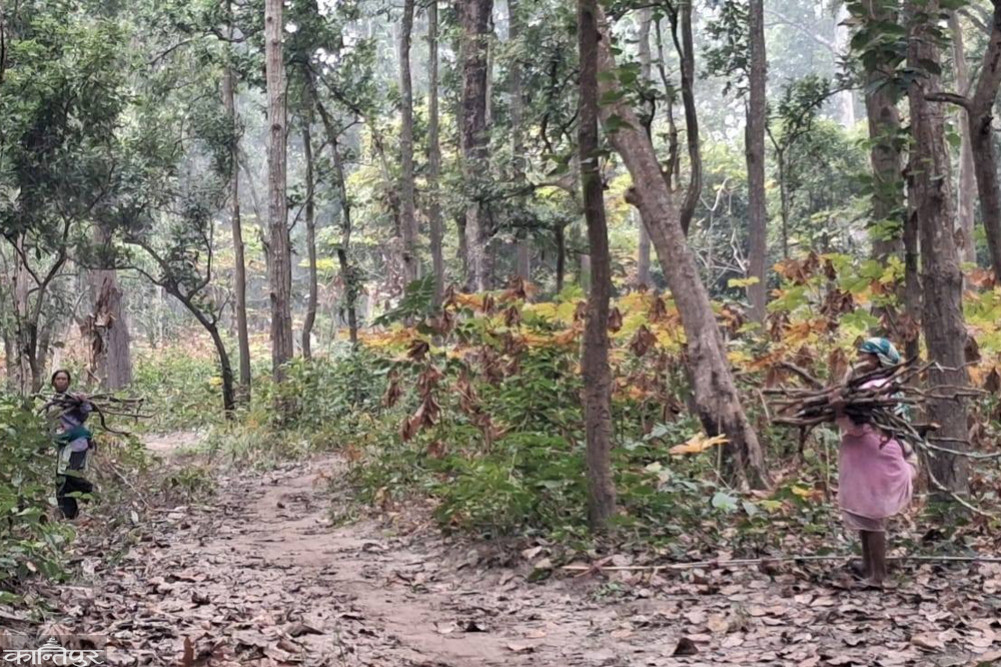
Community forestry is not limited to the conservation of trees and plants, it has also become a powerful institutional medium of democratic practice through thousands of user groups developed at the village level.
We use Google Cloud Translation Services. Google requires we provide the following disclaimer relating to use of this service:
This service may contain translations powered by Google. Google disclaims all warranties related to the translations, expressed or implied, including any warranties of accuracy, reliability, and any implied warranties of merchantability, fitness for a particular purpose, and noninfringement.
The Himalayan Degradation Theory, based on studies on the environment and deforestation of the Himalayan region in the 1970s and 1980s, caused a stir worldwide when it was published. These studies blamed population growth, poverty, and traditional livelihood systems as the main causes of environmental degradation in the Himalayan region. According to this theory, the dependence of local communities on firewood, grass, pasture, and agriculture was concluded to be the main factor in the deterioration of the Himalayan environment.
On the other hand, forest-dependent communities seem to have started discussing how to protect the surrounding forests and how to sustainably utilize them. In the early 1980s, the Chipko movement began in Uttarakhand, India. Leaders like Sundar Lal Bahuguna, Gaura Devi, and Chandi Prasad Bhatt launched a strong citizen movement against forest exploitation by contractors and companies through the Tree Hugging Campaign. This brought the role of local communities in forest conservation to the forefront. As a result, a serious debate began in Nepal about community involvement, ownership, and rights over forests. As a result, they began to engage in forest conservation campaigns in an organized manner. In particular, campaigns to protect forests were started on local initiatives in various villages of the country, including Sindhupalchowk, Bhojpur, and Dhankuta.
With the political changes of 2046, a new community concept of forest conservation, management, and utilization came to Nepal. The interim government formed under the leadership of Krishna Prasad Bhattarai decided to convert the Panchayat forests into community forests and give responsibility and authority to the communities in the protection of forests across the country. On this basis, the Forest Act was issued in 2049 BS and the Forest Regulations in 2051 BS, and a campaign was taken forward to legally expand community forests. A revolutionary step was taken to manage forests through citizen groups.
According to the Forest Research and Training Center's report-2024, 43.38 percent of the land area in Nepal is covered by forests and 2.70 percent by shrubs. Thus, a total of 46.08 percent of the land area falls under the forest area. According to various reports, before 2046 BS, the forest area in Nepal was only about 29 percent of the total land area, while the area of shrubs was about 10 percent.
Successes and challenges of community forests
Community forests are not limited to the conservation of trees and plants, they have also become a powerful institutional medium of democratic practice through thousands of user groups developed at the village level. About 32,000 rural community organizations have been formed. About 40 percent of the country's forest area has been protected, managed and sustainably utilized.
The most important reason why community forests have been able to achieve this success is the progressive policy steps taken by the then government to communalize the national forest by issuing the Forest Act and Regulations. This was possible only because the practical practice of democratic socialism began by handing over forest resources to the community in accordance with the belief that 'the roots of democracy should be strong from the village'. The manifesto of the Nepali Congress prepared in 2015 under the leadership of Bishweshwor Prasad Koirala clearly stated that the management of forests should be entrusted to the local villagers. Subsequent governments have implemented this and promoted community forest management.
The commitment shown enthusiastically by the employees of the departments and forest offices under the Ministry of Forests in forming community forest groups, preparing forest management action plans and implementing them is also one of the main reasons for the success of community forestry. Nobel Prize winner Elinor Ostrom has considered the role of the community as the main basis for the sustainability of common resources. According to her study, common resources remain sustainable when local communities themselves make rules, set resource usage limits, monitor and resolve disputes.
In Nepal's community forests, local communities have adopted the practice of making rules, setting usage limits, monitor and resolve disputes. This has ensured forest conservation, sustainability of production and social justice. Nepal's community forests are also moving towards obtaining co-benefits through the trade of carbon stored in forests. Nepal's community forestry program is known as a successful model in the world. It has institutionalized the practices of livelihood, participation and ownership of local communities along with forest conservation.
The population of the village has decreased . People who can produce have migrated . There has been a massive change in the lifestyle dependent on the forest . The number of livestock keepers has decreased . The practice of cooking with gas instead of firewood has increased . On the other hand, regular meetings of many forest groups have not been held . General meetings and regular audits have been stopped . Due to extreme partisanship in local community organizations, community forests have not been able to remain effective . Members of the poor and marginalized communities, including women, indigenous peoples, Dalits, and others depend on the forest, but their access to dividends is weak . Political party activists and others have benefited more from community forests .
Pressure has started to be created on the forest itself for roads, electricity, irrigation, airports, or whatever work needs to be done . On the other hand, due to the accumulation of biomass in the forest area, the number of forest fires is increasing every year and the risk to human life is increasing . Roads, electricity, irrigation, airports or whatever work needs to be done, pressure has started to be created in the forest. On the other hand, the number of forest fires is increasing every year due to the accumulating biomass in the forest area, and the risk to human life is increasing. Amidst these challenges, Nepal's community forestry needs to reform itself and redefine opportunities according to time and situation.
The atmosphere of trust between the government, non-government and private sectors working in the forest sector has not been strengthened. The policy-making process also seems disorganized. The lack of coordination between the forest acts/regulations made according to the province and the federal act and the differences in the distribution of benefits have caused problems in forest management. Some local governments are confused, saying that they do not have a role in community forests.
According to various reports, about 10 million cubic feet of wood is imported every year. Billions of rupees have gone out of the country. Although it is necessary to manage forests to prevent wood imports, extract wood/firewood and ensure its consumption in the domestic market, such work has not been fully implemented due to various political and administrative influences.
The concept of scientific forestry was launched in 2071 to sustainably manage forests and provide easy supply of wood/firewood. But it was politicized more than effectively implemented and was discarded. This not only wasted forest production but also led to a huge drain on the country's wealth. In discussions on the forest sector, everyone seems to agree on emphasizing production, but it seems that invisible forces dominate when it comes to work.
The future of community forestry
Reform and transformation of community forestry is necessary to end policy-based corruption in the forest sector, improve governance, strengthen democracy, promote social justice, ensure equality, sustainability of production and respect for community freedom.
The forest groups we have should be classified based on the nature of the forest, the current state of consumers and their potential. New forest management plans and programs should be determined based on the classification. Such plans will serve as a guide for forest production, conservation of biodiversity, protection of water resources, tourism development and the development of other forest-based enterprises. This work can be done by making some improvements in the traditional forest management action plan preparation process. All community-based forest groups should work to increase access to poor and marginalized communities. Providing land for income-generating activities to households in dire need of forest degradation and destruction will increase their ownership and protect the forest. All ethnic groups also have a cultural relationship with forests. In an environment where this relationship is gradually being forgotten, forest groups can collaborate with schools to educate students about the relationship between forests and humans.
It is necessary to prioritize the work of extracting, processing and supplying wood and firewood to the market by sustainably managing forests in the productive areas of the Terai, inner Madhesh and hills. For this, it is imperative to develop a transparent and accountable system. Collaboration with the private sector is also necessary. Local employment can be created by cultivating, managing, collecting and processing valuable herbs in the Himalayan and high-mountain forests. Since the forest sector is an important means of production, extensive investment is required in this sector. For that, it is essential for the government to remove the obstacles to investment and create an investment-friendly environment. It is necessary to pay attention to this as there are multiple benefits in converting the biomass wasted in the forest sector, forest fires into organic fertilizer, and supplying fuel for the industry by producing coal.
The lack of coordination between the forest acts/regulations made according to the province and the federal act and the differences in the distribution of benefits have caused problems in forest management. Some local governments are confused, saying that they do not have a role in community forests. To reduce conflict between humans and wildlife, agroforestry programs can be implemented in vacant spaces within the forest and even on private land. According to the forest action plan, tourism can be developed by linking the biodiversity of the forest with the cultural values of the community there. It is necessary to develop a package that makes tourism attractive by including the issues of local food, the relationship between forests and humans.
It is necessary to free community forests from party influence. In addition, only if legal arrangements are made to represent those who are more dependent on forests, proper participation can be ensured. Laws, programs and responsibilities should be provided to involve, create opportunities and involve local youth, women and indigenous communities in benefiting from forests.
The government formed after the elections needs to take active steps to resolve the problems and obstacles seen in terms of law and policy. Making local governments fully capable and responsible for the management and legal facilitation of community forests will not only increase the effectiveness of local governments, but will also strengthen the performance of the federal structure. This will institutionally strengthen the goals and essence of the organization.
Local governments will not only be able to create jobs through forests, but will also be able to strengthen local governance, raise policymaking and financial control issues from the local level to the federal level. For this, all programs and decisions need to be operated with social justice, proportional access and community interests as the main basis. By implementing this, community forests will become sustainable, transparent and inclusive, and both conservation of forest resources and local development will be ensured.