The Gen-G movement of 23-24 Bhadra was a direct expression of this consciousness. It was not a movement directed by any party. It was a spontaneous citizen outrage against corruption, impunity, extreme opportunism, and decades of incompetent leadership.
We use Google Cloud Translation Services. Google requires we provide the following disclaimer relating to use of this service:
This service may contain translations powered by Google. Google disclaims all warranties related to the translations, expressed or implied, including any warranties of accuracy, reliability, and any implied warranties of merchantability, fitness for a particular purpose, and noninfringement.
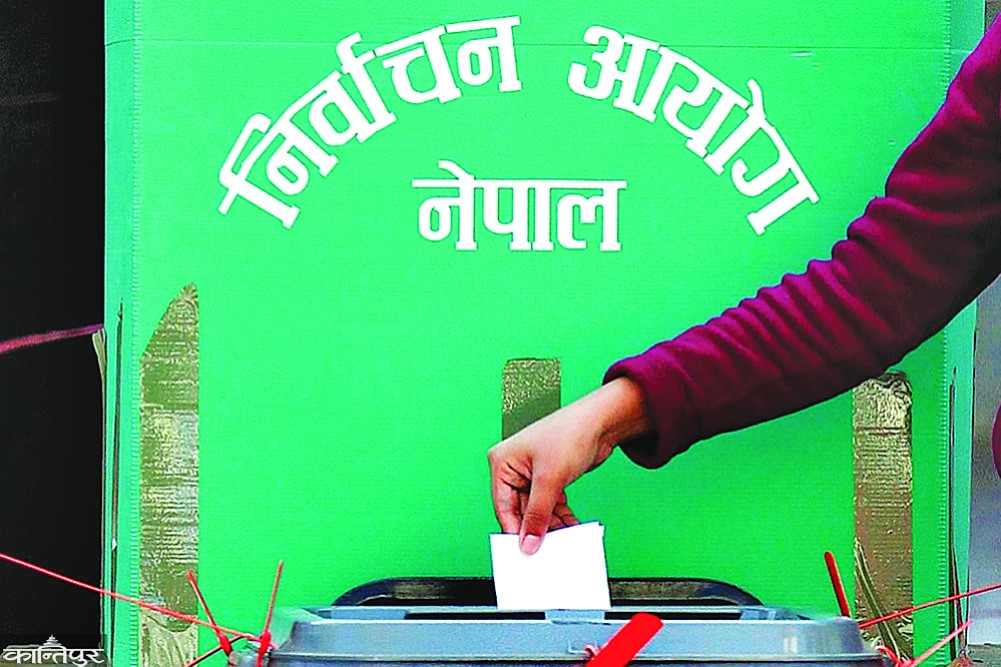
Nepal's political history is a complex series of continuous transitions, instability, and incomplete restructuring, where every change has opened the door to new possibilities. However, old governance traditions have not been uprooted. The people's movement of 2046 BS brought a multi-party system, but it could not deeply instill the methods, discipline, and institutional traditions of democratic governance. The historic movement of 2062/63 BS brought a republic, but the character of governance could not be transformed. The 2072 BS Constitution institutionalized a federal democratic republic, but even after a decade, the behavior of state governance - division, impunity, weak implementation, and unaccountability towards policy and service delivery - remains basically the same. This has had an impact on the younger generation. This has increased questions, pressure, and interference in politics. Therefore, the election of 21 Falgun is not just another periodic election, but a moment to reconsider the relationship between the state and citizens.
Not just voters now, but successors
In Nepal's political history, youth have been the fuel of the movement, but they have never been able to become the drivers of the regime. From the 2046 and 2062/63 movements, the Madhesh movement to the recent civil uprisings, youth have been at the forefront of all of them. They raised slogans, suffered arrests, and many even lost their lives. But at the decisive moment of the transfer of power, leadership has always gone to the hands of the older generation. This historical anomaly has forced today's generation to think not just as voters, but as successors to the state.
The Gen-G movement of 23-24 Bhadau was a direct expression of this consciousness. It was not a movement directed by any party. It was a spontaneous citizen outrage against corruption, impunity, extreme opportunism, and decades of incompetent leadership. The movement created nationwide pressure in a short time. Which raised serious questions about the moral legitimacy of the established parties. As a result of this pressure, an interim government was formed under neutral leadership, which in itself was an admission that the parties could not govern.
The movement itself is not the final solution. If the energy of the citizens is not transformed into organizations, policies, and institutional strategies, that energy quickly turns into fragmentation, despair, and mutual distrust. Movements open doors. However, the responsibility for institutionalizing change lies with elections, parliament, and policy-making.
A harsh lesson from history
The most profound example of a ‘new political emergence’ in Nepal is the Maoist movement. After entering the peace process after an armed rebellion, the Maoist movement presented itself as an alternative, people-oriented, and a force that would destroy the old structure. A large number of youth saw a future in it. But over time, leadership became limited to power-sharing, ministry sharing, and parliamentary arithmetic. Policy clarity was lost, and the movement merged with the same old power culture.
This history is a warning to today’s generation. Therefore, the consciousness seen now is not just a rebellion, it is a question of personality worship, emotional frenzy, and the illusion that ‘one hero changes everything.’
This election will be qualitatively different from the previous elections. This belief was also possible because the political energy of the new generation was unified. The enthusiasm seen among urban youth, the digital generation, the middle class, and Nepali youth in foreign employment is unprecedented.
In this context, the unification of Balen Shah and Ravi Lamichhane into the same political stream is not only a symbolic event, but also a clear strategic move. The party's promotion of Balen Shah as the potential face of the future Prime Minister should be understood as a challenge to the established political culture, leadership monopoly, and traditional power-centered practices. But at this point, the most sensitive and decisive question arises - is the current emotional popularity being promoted by realistically adjusting to Nepal's structural political reality, party organization, parliamentary practice, and electoral behavior, or does it carry the risk of repeating the risk of individual-centered politics?
Generational struggle within the old party
The internal changes seen within the Congress in recent years are at the center of this debate. Gagan Thapa's impressive rise through the special general convention is not just a personal achievement, but a result of the dissatisfaction of young cadres, organizational inertia, and pressure for reform that has accumulated within the party after Sher Bahadur Deuba's long leadership. This process was not easy and has not yet reached its full conclusion. But it has given an important historical message that change is possible even within old political structures if internal democracy is made active, competitive and accountable.
This fact redefines the path of political reform in a new way. Reform does not always mean only the formation of a new party, sometimes transformation is also possible within existing parties through rules, processes and organizational struggles. Therefore, limiting the upcoming elections to a simple conflict of ‘old party vs. new party’ would be an incomplete analysis.
In this context, the situation of UML is different but related. UML is still one of the strongest parties in the country organizationally, but its leadership is highly centralized. KP Sharma Oli’s influence is deeply rooted in the party and structural obstacles to the generational transfer process are clearly visible. Due to organizational reach, historical legacy and electoral capacity, there is still hope in society that ‘UML will improve’. But its appeal among young voters is gradually decreasing. This dissatisfaction is not only emotional, but also a structural problem linked to leadership style, internal democracy and decision-making process.
Nepal’s traditional parties are at a critical juncture. Either they redefine themselves through internal democracy, generational change and policy clarity, or they gradually lose young voters and social trust. The upcoming elections will be a test of these options, where the question of whether the old structures can change themselves will be tested in the harshest of public opinion.
It is not a question of winning, but of how to win.
The real question of the 21 Falgun elections is not ‘who will win?’. The question is, can this generation combine emotional popularity with strategic discernment? Can personality-centric appeal be transformed into institutional, policy and parliamentary practice?
This election is not just an opportunity for the youth, but also a historic responsibility. It is a time to vote not with emotion but with memory. It is a time to look at structures, not individuals. This election is not just about voting, but rather a time to get an answer to a tough question – has Nepal really learned this time, or will it just repeat what it has learned?