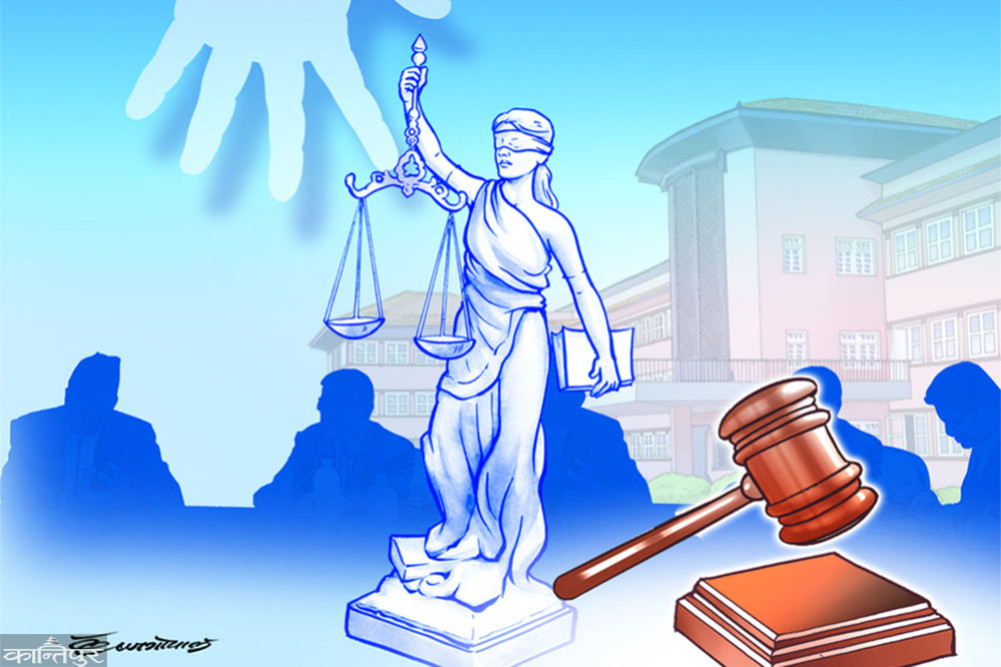
When courts do not view state power and civil rights in the same light, judicial impartiality is lost.
We use Google Cloud Translation Services. Google requires we provide the following disclaimer relating to use of this service:
This service may contain translations powered by Google. Google disclaims all warranties related to the translations, expressed or implied, including any warranties of accuracy, reliability, and any implied warranties of merchantability, fitness for a particular purpose, and noninfringement.
The foundation of a democratic state rests on three pillars - the legislature, the executive, and the judiciary. Of these, the judiciary is the pillar whose weakness makes the power of the other two pillars uncontrollable.
The Constitution envisions the court not only as a dispute resolution body, but also as the ultimate guardian of the citizen. Therefore, a court decision is not just the end of a case, but also an explanation of the relationship between justice, rights, and state power in society. But looking at some of the court decisions recently, serious questions have begun to arise – is our judiciary strengthening the rule of law, or is it becoming a mechanism to provide legal legitimacy to administrative facilities?
The duty of the court is not only to settle the case but also to judge by deeply examining the facts and evidence. The court is neither anyone's advocate, nor a facilitator of the state. Its only religion is to uphold the rule of law and justice. Justice is not a superficial decision, but to impartially hear and address all the questions and arguments of the citizen. However, in recent times, ignoring complex and serious constitutional questions and remaining silent or choosing only easy arguments in a manner favorable to the state is against judicial impartiality. Not answering questions ultimately weakens the citizen's faith in the justice system.
The case related to 'wheel lock' filed by me is an example. The petition did not only question the validity of an administrative action, but also raised the fundamental constitutional question of the legal basis on which the state machinery can interfere with the property of a citizen. The writ petition raised serious legal questions such as the limits of authority, clear provision of law, availability of alternative remedies, the principle of proportionality and the need for judicial review. However, when studying the judgment, it is seen that some questions have been answered in the center, while some basic constitutional questions have been left silent. There is a suspicion that the court has not considered all the questions raised in the petition. One feels the tendency to reach a decision by making administrative convenience and the need for implementation the main thing, without fully understanding the purpose for which and with what constitutional concerns the petitioner filed the case.
When the court does not hear all the questions and does not discuss all the possible options, then the feeling of justice is limited to paper only. This is why this ‘wheel lock’ case has gone beyond personal defeat and victory, and has become a reference to the practice of picking and choosing questions in our justice system.
Which questions are important and which are not should be based on the constitution and the spirit of the law, not on the convenience of the court. Leaving a question unanswered means not only rejecting that question, but also denying the rights of the citizen associated with it. When the court starts answering only the questions that suit it and ignores the rest, justice ceases to be universal. Justice becomes selective. Selective justice is ultimately another form of injustice. From the day the court starts giving selective justice, equality of justice ends, the rule of law weakens, and the citizen's trust in the court gradually erodes. The court must always remember that judicial power comes from the trust of the people. To maintain that trust, the court must show the courage to hear all questions, treat all parties equally, and answer all legal questions. Otherwise, even if the decision given by the court appears to be legally valid, it will become morally and democratically weak.
The problem is not with the character of a judge, but rather with the mindset that the decisions of the state are 'automatically right'. Instead of checking the power of the state, it is not appropriate for the court to initially consider administrative decisions as legitimate. This upsets the balance of power between citizens and the state. In this context, the concept of ‘public interest’ is used very easily, but is rarely defined in depth. The term public interest itself is attractive, but vague. When this concept is used without clear criteria, a situation is created where any violation of rights can be justified under the guise of this term. If the interpretation of public interest starts changing according to the convenience of the court, that concept becomes a shield for state power, not the protection of citizens. The fundamental rights of citizens cannot be curtailed on the basis of the argument that ‘implementation of the law should not be hindered’. The constitution is the highest form of public interest. Therefore, the interpretation of public interest should be within the limits of the constitution.
The court is not a supporter of administrative convenience, but should become the protector of the constitution. When the court does not view state power and citizen rights in the same light, then judicial impartiality ends. The ultimate loyalty of the court should not be to any mechanism, but only to the constitution.
Law is not an administrative convenience. Law is not a tool to make the state easier. Law is a combination of written law, constitutional values, judicial principles, and the protection of citizen rights. It is a weak jurisprudential practice to legitimize a matter that is not clearly regulated in law on the basis of ‘custom’, ‘practice’, ‘necessity’ or ‘public convenience’. Such a trend institutionalizes zero-level jurisprudential development. If the court legitimizes an action by saying that ‘even though it is not written in the law, it has been done in practice’, then tomorrow any violation of rights will be legitimized on this logic.
Citizens go to court to seek justice. The court is not an administrative counter, where ‘easy solutions’ are given. The court is a place to exercise judicial discretion – where deep analysis, search for alternative solutions, balance of rights and duties, and the principle of least interference are used. It is not justice to decide on the basis of what is found in the name of ‘dissolving the case’. A quick decision is not an achievement in itself. A correct decision is the standard of the court.
The rule of law means that both the citizen and the state are subject to the law. The spirit of the law should not be weakened in the name of administrative convenience or convenience. The rule of law should not be a convenience, but should be based on principles. When the court reminds the citizen of its duties, the state should also be reminded of its constitutional limits. When the state exceeds its limits, the duty of the citizen is automatically limited. It is not a judicial religion to remain silent about the state's mistakes and only give a sermon to the citizen. Although it is a duty to follow the court's decision, criticizing it is a democratic religion. The respect of the court increases not by blind devotion, but by transparency. Justice should not only be done, but also be seen. If the decision does not listen to the voice of the citizen and only favors the state, it is morally weak even if it is legally correct.
Today, it is necessary for the court to self-evaluate. The court is not a legalizer of administrative convenience, but a guardian of the constitution. If the court does not redefine its role, trust in the court will erode. A court that has lost trust is the most dangerous situation for democracy. The court should remember that history remembers not the number of decisions, but the courage of the decision.