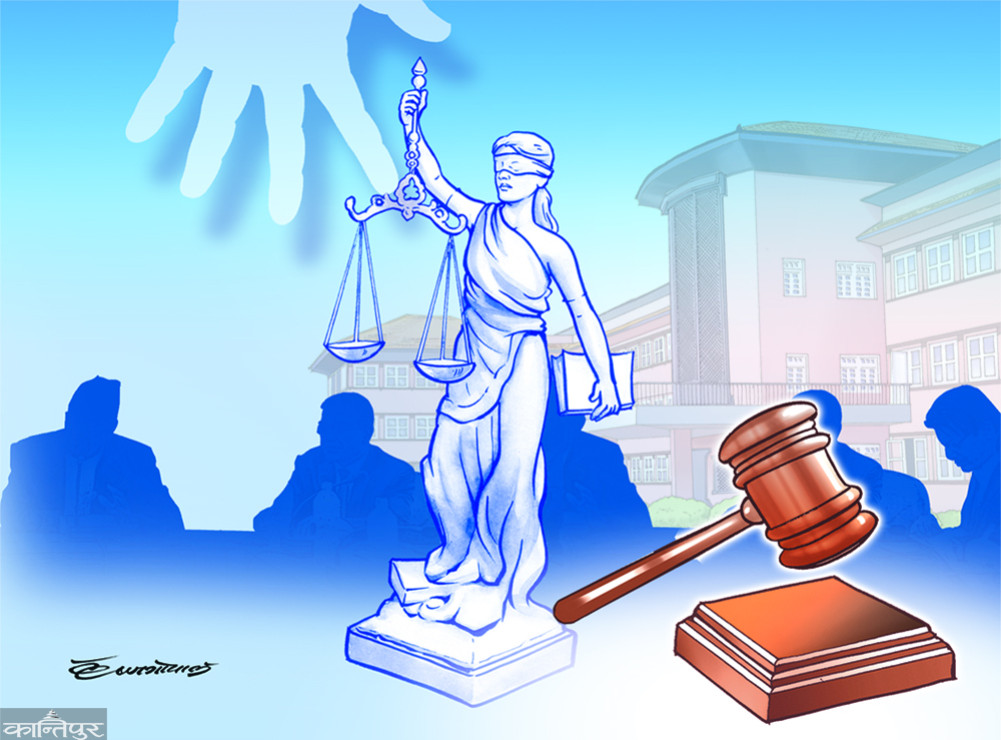
Emergency sessions are not a judicial luxury, but a means to keep the spirit of the Constitution alive and strengthen citizens' trust in the judiciary.
We use Google Cloud Translation Services. Google requires we provide the following disclaimer relating to use of this service:
This service may contain translations powered by Google. Google disclaims all warranties related to the translations, expressed or implied, including any warranties of accuracy, reliability, and any implied warranties of merchantability, fitness for a particular purpose, and noninfringement.
The judiciary is the backbone of democracy. The entire power structure of the state is focused on protecting the rights of citizens and ensuring justice. But when justice is delayed, it is not just a procedural weakness, but a direct violation of the fundamental rights guaranteed by the Constitution.
In this context, the principle that ‘justice delayed is justice denied’ has taken on even deeper meaning today. In Nepal, the performance of the courts, especially in emergency and sensitive cases, still does not seem to be up to the expectations of the citizens. The reality that this is weakening public trust in the courts cannot be ignored any longer.
The Constitution has ensured access to justice as a fundamental right. The essence of the Constitution is clear that it is not enough for justice to be available, it must be available in a timely and effective manner. However, in practice, the delay in cases related to the rights of detainees, human rights violations, elections, disputes between constitutional bodies, freedom of expression, life and personal freedom is a matter of concern.
More than 26,000 cases are pending in Nepal. Some of them even predate the current constitution. Such delays seem to be shaking the trust in the courts. Procedural delay in an emergency or an emergency dispute is a denial of justice. Patient
In an emergency, patients are taken directly to the emergency ward and doctors are also deployed 24 hours a day. Similarly, litigants who come to court to seek justice are also like patients, so their problems should also be resolved quickly. The state and the courts should not shy away from this in the name of procedural delays.
Therefore, getting justice is the fundamental right of every person, delaying it means violating fundamental rights and depriving citizens of their fundamental rights. Therefore, an emergency court that operates 24 hours a day in Nepal seems essential.
I was hit by a bike from behind on 7th December when a scooter I was riding was hit by a bike from behind, and both of us were injured. The bike rider was more speeding and he was more seriously injured. My scooter and bike were seized by the police and kept for 6 days. I claim that I was innocent, but my scooter was seized. In the process, my scooter broke down. It was not even decided who would bear the treatment expenses.
We had to wait a long time to get justice. If an emergency bench had been set up at that time, we would both have received justice on time, and my scooter would not have broken down, and the injured would have been treated on time. For the same reason, people's faith in justice is declining in Nepal.
In order to minimize the delay in getting justice in Nepal and maintain the faith of citizens in the judiciary, important lessons can be learned from the practices adopted by developed judicial systems in the world. The emergency bench system has been practiced in many courts around the world. Examples can be seen in neighboring countries like India and Pakistan.
The system of such a bench seems to be the most stable and developed in India, where the Supreme Court has constituted urgent benches, vacation benches, and special benches to hear cases such as fundamental rights of citizens, rights of persons in custody, election disputes, and stay of executions. In particular, the midnight bench sitting in the case of Yakub Memon v. State of Maharashtra (2015) in India is a very famous reference. It seems that the principle that 'delay defeats justice' is given top priority.
In Pakistan too, the Supreme Court has been hearing urgent cases related to citizens’ rights through Human Rights Cell Bench, Urgent Bench and ‘Suo Moto Bench’. In Bangladesh too, the Supreme Court operates an Urgent Motion Bench, where there is a practice of hearing cases of violation of fundamental rights, illegal detention and public interest cases urgently. The practice of listing urgent cases (writs) for the enforcement of fundamental rights under Article 102 of the Constitution of Bangladesh is a strong reference that can be used in Nepal as well.
Looking at the systems of Western countries, in the UK, higher courts register urgent petitions. This system has been implemented to ensure urgent hearing especially in cases that require urgent disposal under the Human Rights Act, 1998, security, immigration detention and urgent cases.
Also, in the United States, the US Supreme Court has a tradition of hearing urgent petitions and cases of stay of execution, urgent orders, temporary restraining orders and public interest cases under the power of circuit judges. Such practices prevent delays in justice and increase confidence in the judiciary. Therefore, the practice of such a bench also ensures the right to a fair hearing by imbibing the principle of speedy justice.
Today's reality is that even emergency cases in district and high courts are stuck for months waiting for regular hearings. Delayed hearing of writs for custodial interrogation of detained persons, delay in timely resolution of issues such as domestic violence, child rights, rape, disappearance, torture or interim orders requiring immediate implementation are weakening the very purpose of justice. This hurts not only the victims but also the citizens' trust in the entire justice system.
Access to justice is not just about having the doors of the court open, but also getting a hearing and decision on time. There is a need for an emergency bench to institutionalize this concept. An emergency bench is a special judicial mechanism that hears cases immediately, not only in extraordinary circumstances, but also in cases directly related to life, freedom, human dignity and the constitutional structure. Such a bench should not be limited to the Supreme Court but should be expanded to the High Court and, if necessary, the District Court with a clear legal basis.
The importance of 'speedy justice' has been repeatedly acknowledged in the precedents of the Supreme Court of Nepal. The court has made it clear in various judgments that delayed justice violates fundamental rights. However, the gap between precedent and practice has not yet been bridged. To bridge this gap, the emergency bench needs to be developed as a regular and predetermined mechanism, not a discretionary one.
Some concrete reforms are needed for this. First, clear provisions regarding emergency benches should be made in the Supreme Court Rules and other court rules. It should be clear what kind of cases are considered emergency, within what time frame they should be heard, and how the bench (bench) will be constituted.
Second, special training and guidelines should be given to judges and court administration on the sensitivity of emergency cases. Third, the electronic filing, online hearing, and immediate order system should be made effective by using technology.
The most important thing is that emergency sessions are not a judicial luxury, but a means to keep the spirit of the Constitution alive and strengthen the trust of citizens in the judiciary. Only when citizens get justice from the courts on time, then trust in the courts is strengthened. Otherwise, delayed justice can lead to frustration, distrust and sometimes a tendency to seek alternative and dangerous justice.
Ultimately, the strength of democracy is measured not only by elections, but also by an effective justice system. Understanding the relationship between access to justice and emergency sessions is the need of the day. If we truly want to establish the ‘rule of law’ in accordance with the spirit of the Constitution, then we must end the culture of considering delayed justice as normal and make emergency sessions an integral part of every court. Only this path can strengthen the weakening public trust in the courts.