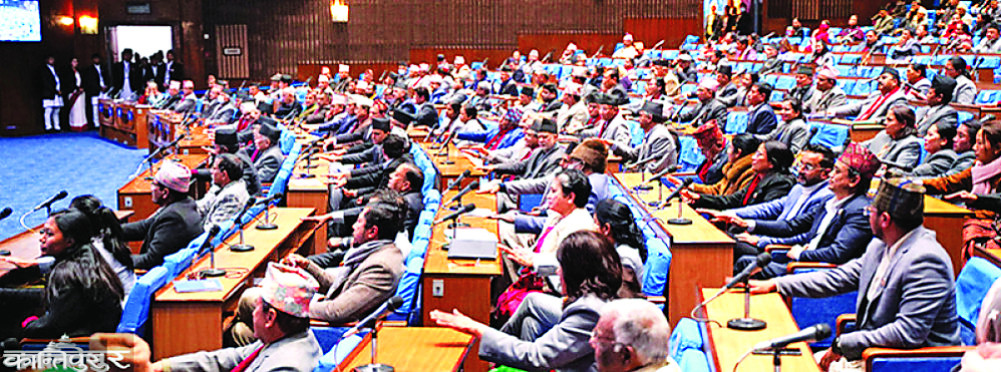
Looking at the proportional list registered with the Election Commission, it seems as if the parties are trying to eliminate the essence of the Gen-G movement.
We use Google Cloud Translation Services. Google requires we provide the following disclaimer relating to use of this service:
This service may contain translations powered by Google. Google disclaims all warranties related to the translations, expressed or implied, including any warranties of accuracy, reliability, and any implied warranties of merchantability, fitness for a particular purpose, and noninfringement.
Elections are the most beautiful aspect of democratic governance, by the people, for the people. Through elections, the people transfer the sovereign and state power vested in them to representatives to exercise for a limited period of time.
An efficient electoral system is needed to ensure the presence of representatives of the people, i.e., people's representatives, in the exercise of the country's sovereignty, law and policy formulation, state operation, and the use and management of state resources and power. In a country like Nepal, which is small in geography but has multi-ethnic, multilingual, multi-religious, and multicultural characteristics, the constitution itself has made clear provisions for elections to be held in a way that represents as many communities as possible. The constitution and laws of Nepal have made provisions to provide equal access to government positions for various communities in local, provincial, and federal elections. However, political parties have been repeatedly abusing such inclusive systems to fulfill their personal interests.
The system of inclusive principles in Nepal's electoral practice is not a new issue. An inclusive electoral system is indispensable, especially in the organs of the state like the House of Representatives that are responsible for lawmaking and government formation, so that people of all communities are represented. The proportional electoral system implemented in the House of Representatives elections is a system under which voters vote for a political party rather than for a single person. To make this system inclusive and representative, political parties are required to submit a closed list of their potential candidates to the Election Commission before the election.
While preparing this closed list, parties must mandatorily include at least 50 percent women candidates. In addition, there is a legal provision to ensure representation of Dalit, Adivasi Janajati, Khas Arya, Madhesi, Tharu and Muslim communities based on their population ratio in accordance with the social structure of Nepal. In addition, representation of people with disabilities and citizens from backward areas has also been ensured through this system. The main objective of this system is to ensure that no community or class is excluded from the parliament, the highest policy-making body of the state. In general, the proportional system is a system with the aim of bringing up people from classes and communities who cannot contest elections, are deprived, or cannot win even after contesting elections directly.
The Constitution of Nepal has provided that 165 of the total number of seats in the House of Representatives will be elected through direct voting and the remaining 110 through proportional representation. When political parties nominate candidates for the elections to the House of Representatives to be held under the proportional representation system, there is a constitutional provision that they must nominate candidates from women, Dalits, indigenous peoples, Khas Aryas, Madhesis, Tharus, Muslims, and backward areas on the basis of a closed list. Despite the constitutional obligation that the selection of proportional representation candidates for the House of Representatives elections should be based on the principle of inclusion, political parties have not put forward candidates in line with the constitutional spirit.
In fact, the Constitution is a guideline and the law should provide clarity on such matters. Since everything cannot be literally covered in the Constitution and the law, it is necessary for political parties and leadership to work with high ethics and understanding the constitutional spirit. However, amidst the tendency to interfere and find loopholes in the clear provisions of the Constitution, when there is no literal definition, it is not new to use and interpret the law in a way that suits them. For the same reason, the issue of proportional inclusion has also fallen under the purview of parties.
The parties have already registered the numbered closed list of candidates for the proportional representation for the upcoming elections scheduled for 21 Falgun with the Election Commission. After the lists of proportional representation candidates of all the new and old parties for the upcoming elections were made public, the parties are being criticized all over for putting forward names in a way that defies the proportional representation system. In particular, the new parties that consider themselves to be transformative and have entered the elections saying that all the old ones are bad are being criticized for promoting nepotism like the old ones in the proportional list and trying to gain popularity by putting forward popular faces on social media.
The closed list put forward by the parties for the upcoming elections to the House of Representatives is not inclusive. The names put forward through the closed list are not baseless. The names put forward include candidates representing communities including women, Dalits, Janajati, Madhesis, etc. But many believe that the constitution and the Act have been confused by including the names of relatives, friends, and those with access in the proposed candidate list to show inclusiveness.
The people are dissatisfied that the voices of the common man cannot be represented in the House by putting forward famous artists and industrialists on the basis of backward communities in the name of inclusiveness. But the presence of businessmen and filmmakers in the proportional electoral system is not all negative. The Parliament also needs their sectoral expertise and contribution. Contrary to the essence of inclusiveness, the people are angry that those with access have occupied a place within the shell of the real neglected class just to show their support in the Election Commission. Industrialists, artists, and journalists, regardless of their caste, religion, gender, or community, should get a place in the Parliament on the basis of their expertise and contribution, but it is not appropriate to give proportional MP seats to those who are already powerful on the basis of inclusiveness.
This proportional system strengthens inclusive democracy by providing representation in parliament to people from minorities, economically weak or deprived communities who face difficulties in getting elected through the direct system. It plays an important role in ensuring the belonging and participation of all castes, classes and communities in the democratic process. Therefore, the parties should have prepared a closed list by understanding the essence of proportional inclusion. All political parties, old and new, have failed in this regard.
One of the main reasons for the Gen-G rebellion was unequal access to development and the 'Nepobaby culture'. But looking at the proportional list registered with the Election Commission, it seems as if the parties are trying to destroy the essence of the Gen-G movement. As in the past, the benefits of the movement should not be enjoyed by the limited access class, all the people should benefit equally from the waves created by the Gen-G movement and the results of the movement. In this election, the parties should show inclusion from words to practice. Otherwise, it seems that the society may become more divided. To prevent conflict from escalating in society and to steer the country towards stability by making the elections successful, political parties should be reformed in a timely manner. Political parties and leadership should be more honest in adhering to the constitution and take the initiative to ensure that all classes and communities equally enjoy the benefits of democracy.