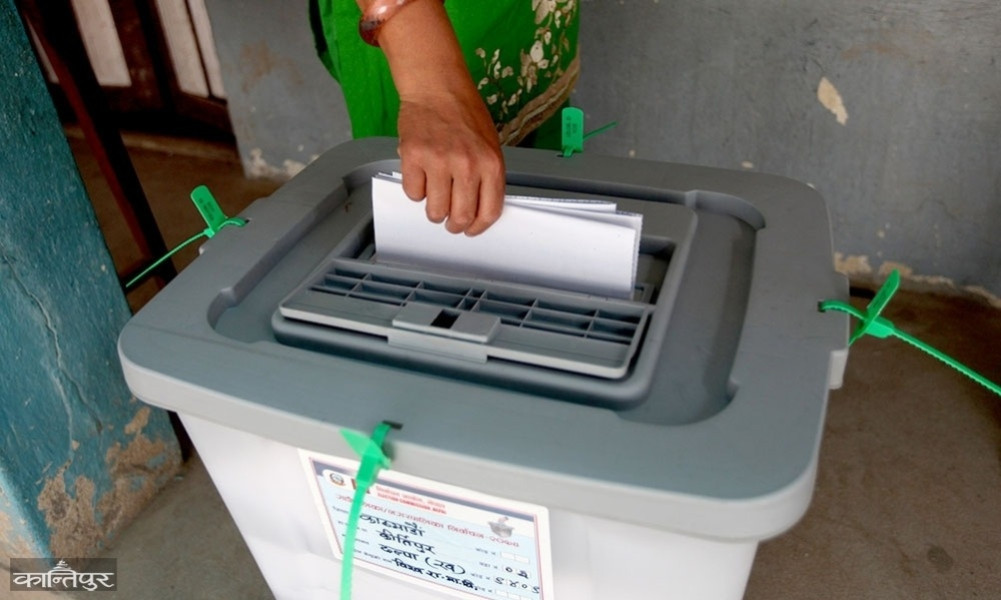
Although remittances contribute about 26 percent to GDP, Nepalis living abroad have not played any role in the political decision-making process. Despite being forced to leave, Nepalis living abroad have shown love for the country and helped bring in investment and tourism. It is appropriate for them to be given the right to vote.
We use Google Cloud Translation Services. Google requires we provide the following disclaimer relating to use of this service:
This service may contain translations powered by Google. Google disclaims all warranties related to the translations, expressed or implied, including any warranties of accuracy, reliability, and any implied warranties of merchantability, fitness for a particular purpose, and noninfringement.
It is said that elections are the backbone of democracy. They are the grand event that drives democracy in the country. They are an opportunity to choose representatives to lead the country. After the Gen-G uprising, the interim government has the mandate and mandate to hold elections on 21 Falgun.
The Election Commission had also extended the deadline for registering names in the voter list at the request of the government in order to ensure that as many young people as possible participate in the election, according to which 837,094 people had applied for registration.
The atmosphere of the election has been created in the country. The UML, the party of former Prime Minister KP Sharma Oli, who has shown an autocratic character while in government, has registered a party. Let us welcome this. However, some UML members are still daydreaming about the restoration of the parliament building.
After the Gen-G uprising, whether Nepali citizens living abroad will have the right to vote in the upcoming elections has become a matter of widespread interest. According to a study, Nepal is the 20th country on the list of countries with the highest number of citizens unable to vote while living abroad.
So far, 141 countries have adopted various methods to protect the electoral rights of their citizens. The United States has already made arrangements for its astronauts who have reached beyond the Earth to vote in elections. It was arranged for citizens living outside the United States to vote 160 years ago.
Even if the interim government is to at least start this time, it seems that it is necessary to make this arrangement as a pilot project. Nepalis who have gone abroad are fond of banknotes, but they are not allowed to vote? It is said that the Nepali diaspora has expressed dissatisfaction. The government has put forward an initial plan, albeit through an ordinance. The government's 'think tank' Policy Research Institute has also suggested to the government through its report. This article focuses on this context.
Why give the right?
It is the constitutional right of every Nepali citizen to participate in the elections called the lifeblood of democracy. In a writ petition filed in 2073 BS against Prem Chandra Rai by the Office of the Prime Minister and Council of Ministers, the Supreme Court had issued a directive order on 7 Chaitra 2074 BS, taking the side of the constitutional and human rights of citizens to vote in the elections.
Even if the mandate is not issued immediately due to the lack of infrastructure and necessary laws, the Supreme Court had issued a directive order in the name of the government and the Election Commission, stating that the state would benefit from remittances from abroad, but depriving them of the right to vote is not judicial, saying that Nepalis living abroad can be included in the elections through various methods and that it can be implemented practically.
At present, the Prime Minister, Home Minister and Law Minister in the government themselves have a legal background, so at least we human rights students have hope in this matter. It is estimated that more than 5 million Nepalis are currently outside the country for study, labor and employment.
Although remittances contribute about 26 percent to the GDP, Nepalis living abroad have not played any role in the political decision-making process. Despite having to leave, overseas Nepalis have shown love for the country by staying abroad and have helped bring in investment and tourism. It is appropriate for them to get the right to vote.
However, it seems that official data should be compiled on who will be given the right to vote, which we do not have. According to the National Census, 2078, there are 2.19 million Nepalis in countries other than India, but exact figures are not available. In any case, it is believed that more than 30 percent of the total population is abroad.
Priority can be given to students, workers with work permits, and diplomatic staff of Nepali embassies serving Nepalis abroad in granting voting rights. In the past, despite repeated studies, this issue could not be implemented due to the reluctance of political parties, but this time, despite the short time, it should be implemented as an example in a country with a small number of Nepalis.
Internal preparation to increase voting percentage
It is necessary to provide voting rights to those within the country who could not go to their constituencies due to study, employment, and various other reasons, even if they are not able to go to their constituencies from their own places, even if they are on the proportional representation route.
According to the Election Commission, in the elections to the House of Representatives and Provincial Assemblies held three years ago in 2079, 61 percent of the voter turnout was recorded. In that election, 17.988 million 570 voters were choosing the leadership at the federal and provincial levels, while 2.294 million 19 voters (12 percent) were participating for the first time.
In the local level elections held in 2079, 52 percent of the votes were cast in the capital Kathmandu, while 79.4 percent of the votes were cast in Humla. The election expenditure is estimated to be 7 billion rupees. In the elections held on Mangsir 4, 2070, 78.74 percent of the people voted enthusiastically, and as a result, the constitution was formed on Asoj 3, 2072, but in the subsequent elections, instead of increasing significantly, the percentage has been decreasing.
In the elections held on Mangsir 10 and 21 of 2074, 68.67 percent voted, while in the local level elections held in Baisakh 2079, 65.07 percent voted. According to the Election Commission, 2560 thousand 839 voters had been added since the general elections held in 2074. This was the second periodic election after the constitution was promulgated in 2072.
Even though there is a legal provision to vote from the place of work, the Election Commission has not implemented it this time, so there is a challenge to increase the election percentage within the country by doing this as well.
The way forward
The call to give voting rights to Nepalis living abroad was raised in 2074 and 2079 as well. The state should not deprive Nepalis living abroad of the minimum facilities to vote in elections. Similarly, this right should not be given to those who have renounced Nepali citizenship while living abroad.
The Constitution of Nepal has made provisions to give only social and cultural rights to non-resident Nepalis who have obtained foreign citizenship or permanent residence permits. Therefore, it seems possible to do this only after we extract the data of expatriate Nepalis.
Although it was not implemented in the past due to the inaction of the ruling political party, this time the government formed after the Gen-G movement has procedurally and practically hassled and difficult to give voting rights to expatriate Nepalis. In the past, this could not happen due to lack of political will. This time, it seems that a message needs to be delivered somewhere, at least to the diplomatic staff of the Nepali embassy or even as a pilot project in a country with a shortage of Nepalis.