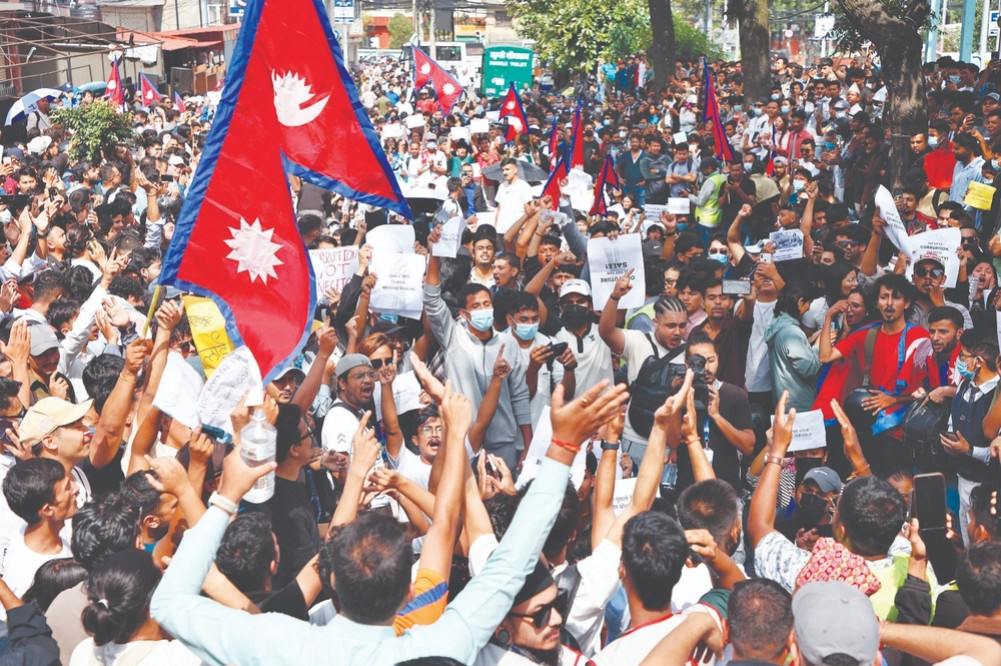
This generation is no longer afraid to speak up, no longer hesitant to ask questions. They write on Facebook, speak on the streets, file lawsuits in court. They are considered enemies by the state, but they are the most loyal citizens of the country - because they still believe that this country can improve.
We use Google Cloud Translation Services. Google requires we provide the following disclaimer relating to use of this service:
This service may contain translations powered by Google. Google disclaims all warranties related to the translations, expressed or implied, including any warranties of accuracy, reliability, and any implied warranties of merchantability, fitness for a particular purpose, and noninfringement.
We are now at a point where the map of the country is the same, but the meaning has changed. The youth who have taken to the streets are no longer carrying flags, but questions. The days of 23 and 24 Bhadra have been moments when the doors of consciousness have opened. The youth who took to the streets demanded – ‘A country that listens to our voice.’
That demand has exposed the entire illusion of power. Every time the people raise their voice, they try to link it to a political party or foreign inspiration. But this time the people's voice was free, unattached. That is why it was also dangerous. Because it was an expression of public sentiment.
The ministers of the then government say on TV that 'youth were carried away by emotions'. But the tradition of being carried away by emotions is theirs - in declarations, alliances and speeches. The youth are only seeking ownership of their own country. They find love for their country not in any poetry, but in the reality of life.
To understand the country that the youth are looking for, we must first understand - what kind of country is the country created by the leaders? In the country of leaders, rights are paragraphs in a book, in the country of the people, rights are the practice of life. In the country of leaders, citizens are silent after voting, in the country of the people, they ask questions after voting. In the country of leaders, police shooting is 'following the rules', in the country of the people, it is a failure of governance. The incidents of 23 and 24 Bhadra showed - the state has stopped communicating with its citizens.
In Nepal, the political class is still bound by the old belief that 'the people are with us'. But the new generation has reached a point where it says, ‘We are on our own path.’ The old tendency of running the government—command, discipline, control—does not work in today’s society. Today’s citizens are informed, think independently, and demand direct dialogue with the government. When the government uses force instead of dialogue, that moment democracy makes a fatal mistake. The day the government uses bullets instead of dialogue with its young citizens, the state begins to lose its legitimacy.
This is not a sudden dissatisfaction, it is a true transition. Nepal is currently in a tense conflict between the interests of the older generation and the consciousness of the new generation. The older generation still believes—those who run the government are the ones who run the country. For them, the concept of the country is rooted in the chair, not in the people. But Gen-G has learned—the country is built by the citizens, and the leaders are just temporary managers.
This generation does not believe in the ideology of any party, but in justice, opportunity, and honesty. They do not ask for the party’s manifesto, but for proof of their future. They ask the government—why am I unemployed? Why am I unsafe when I walk on the streets? Why is my voice heard only on the microphones of the movement, and not in parliament? When the youth say, ‘If you don’t represent me, you can’t stop me,’ that is the true voice of democracy.
The supremacy of the people is written in the preamble of our constitution. But in practice, that supremacy is closed with the ballot box every five years. The people are placed inside the ballot box, and the door is closed after the election. The time has come to open that box. A country is democratic only when the people participate every day—not just in elections, but also in decision-making.
The state has got used to considering every rebellion as anarchy. This trend is not new. In 2046 BS, students threw the first stone, and in 2062/63 BS, there were youth on the streets too. The only difference is this—the youth of today are not moving with the speeches of the leaders, but with their own consciousness. They need not the party flag, but personal integrity.
Political parties still try to capture the movement under the pretext of organizing it, but this movement cannot be captured. Because this is not a slogan of any party, but the voice of a generation. Leaders are still busy forming ‘committees’ and ‘investigation’ commissions, but the real court of the country has now shifted to the eyes of the people. In that court, all your lies, speeches and manifestos have been filed as evidence. What the leaders fail to understand is that now advocacy in the court of the people should be done with character, not political speeches. The youth no longer look for evidence, they do not look for arguments. They are only looking for honesty.
Today's Nepali youth are not afraid of the state. But they are definitely disappointed. They have realized that the problem is not in the system, but in the mentality. Leaders still think that the responsibility of running the country is their right, but now the people are taking that right back. Parliament has become a place for gossip, not for decision-making.
When the government uses the law to silence the voice of the people, and invokes the name of the constitution to cover up its mistakes, then the value of the law decreases. The law is meant to protect the citizens, not to control them. The constitution is owned by the people, not a tool of the government. Now it has been reversed. So justice has automatically shifted to the hands of the people.
This generation is no longer afraid to speak, does not hesitate to ask questions. They write on Facebook, speak on the streets, file cases in court. The state considers them enemies, but they are the most loyal citizens of the country— because they still believe that this country can be improved.
Ultimately, the country that Gen-G is looking for is not a miracle. They only asked for equality, honesty and participation.
There is only one thing that leaders need to understand— this country will no longer survive through speeches, but through responsibility. The younger generation has given this message— We did not come to live in your country, we came to build our country.’ So the question still remains— which country is Gen-G looking for? Perhaps that country has not been built yet. But bricks have been laid on the streets on 23 and 24 Bhadra.
Now no one has the power to stop the construction of that country. This generation will not lose anymore. They have started a movement not to change the government, but to change their thinking. And, when thinking changes, history changes direction. A new chapter for Nepal is now being written—with a redefinition of generation, power, and symbol. And perhaps, this redefinition is what Gen-G is looking for.