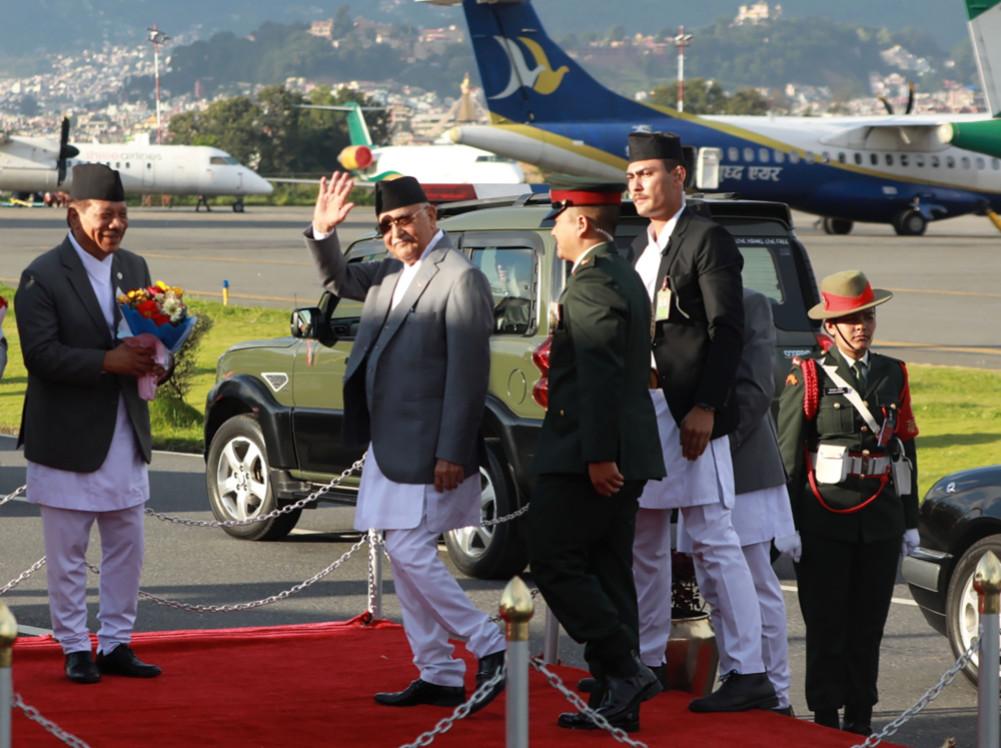
The question is for Prime Minister Oli himself. His speech at the United Nations General Assembly was on Thursday. However, even after the heavy rains on Friday and Saturday caused damage, he did not feel the need to return immediately.
We use Google Cloud Translation Services. Google requires we provide the following disclaimer relating to use of this service:
This service may contain translations powered by Google. Google disclaims all warranties related to the translations, expressed or implied, including any warranties of accuracy, reliability, and any implied warranties of merchantability, fitness for a particular purpose, and noninfringement.
The government is the first to be remembered when a citizen is in trouble. The citizens who were rendered helpless by the heavy rains of last Friday and Saturday and the resulting floods, landslides and inundation also remembered the government. However, not only the slums, but also the residents of the federal capital, Kathmandu, could not feel that there was a complete government. The government's pace was so slow that it could not reach the citizens who were begging for help.
It is not that no one who was affected by the emergency received the help of the government, but many such incidents were made public, where if the speed of the government had been a little more, if the sensitivity had been a little deeper, many people would not have lost their lives. For example, five people who were waiting for rescue were swept away by the flood in Lalitpur's Nakkhu on Saturday. Two of them are still missing. However, Home Minister Ramesh Ulak said that helicopters could not be used for rescue as there was no 'visibility'. Explanations and analyzes on technical issues have their place, but it is the helplessness of the government to flood those who are sitting on tin roofs and waiting for rescue for hours.
It seems that the government could not even anticipate the situation. Because, this time, predicting heavy rain a week ago, according to the decision of the 'Monsoon Preparedness and Response Command Post', the 'National Disaster Risk Reduction and Management Authority' had sent information for high alert. However, the level of rainfall that was estimated, it was seen that the government was hesitating about the chaos and damage that could be caused by it. He doesn't think about preparation. Therefore, resources such as life jackets, raft boats, ropes, etc. needed by the rescuers were not available enough. It is confirmed by the relaxation of the government throughout the day on Friday and Saturday.
Even on Monday, the missing persons buried in some places have not been found. All these reasons make the government realize that it is the government that needs to be rescued from the disaster. The Prime Minister and Ministers can claim that they had prepared, otherwise the damage could have been greater than it is now. However, what was the state of preparation can be tested by the feeling of the citizens who were affected by the disaster. Therefore, the government is not only the cabinet, but also includes the citizens from other parts of the state through various political parties. During the last great earthquake, such organs were seen to circulate themselves widely. This time it could not happen. Because the Council of Ministers is not able to take the leadership and initiative that it should take, other organs may also be relaxed. On the other hand, it does not seem to play a role in facilitating the lives of citizens after the disaster. As now the price increase of vegetables and fruits in the capital is unnatural. There is no government activity.
In the meantime, Prime Minister KP Sharma Oli was visiting the US in connection with a predetermined program. Therefore, the activism of Acting Prime Minister Prakashman Singh was expected. His leadership skills were also tested. However, he was not a caretaker, he looked like a handyman. To some extent, he did not consider it necessary to hold a cabinet meeting in the meantime. Whereas, in such a disaster, it is relevant to hold a cabinet meeting and announce integrated relief and compensation, appeal for assistance. When the Prime Minister is out of the country, it is the practice for the Acting Prime Minister to hold cabinet meetings and take necessary decisions. When the then Prime Minister Sushil Koirala went to participate in a program held in Indonesia, Vamdev Gautam took over the role of Acting Prime Minister. While Koirala was leaving Indonesia for medical treatment in Thailand, the Great Earthquake of Baisakh 12, 2072 struck Nepal. He canceled the health treatment program and returned home the next morning. However, in the evening on the 12th, Acting Prime Minister Gautam held a cabinet meeting and took decisions such as declaring a crisis in the earthquake-affected areas, mobilizing mechanisms for relief, and calling on the international community for assistance.
Similarly, in August 2065, when the then Prime Minister Pushpa Kamal Dahal was on a visit to China, the Koshi River destroyed eastern Nepal. At that time, the acting Prime Minister Baburam Bhattarai recalled that he held a cabinet meeting and proceeded with the rescue and relief work effectively. On the other hand, KP Oli also has the experience of holding cabinet meetings under his own leadership when the prime minister is abroad. On August 9, 2076, when he went to Singapore for treatment, Oli held a meeting through 'video conference' while the Acting Prime Minister Ishwar Pokharel was in Nepal. However, there was no crisis at that time. However, the need to hold a meeting of the Council of Ministers was not felt even when more than 150 people died and personal and public property was damaged beyond the estimate due to two days of heavy rain.
The next question is for Prime Minister Oli himself. His speech at the United Nations General Assembly was on Thursday. However, even after the heavy rains on Friday and Saturday caused damage, he did not feel the need to return immediately. If he had returned immediately when the country was plunged into disaster, his sensitivity would have been reflected. However, he returned home on Monday as per the predetermined schedule. During that time, he argued that floods cannot be prevented, landslides cannot be prevented by giving advance notice and asked them not to protest for the sake of protest. He has also claimed that he has come to Nepal and will now proceed with the work in a more effective manner. The government is being held accountable for the delays so far, now the progress made for relief, compensation and rehabilitation will also be reviewed by the government.