The small children of Saharbazar used to ask Sarmis that 'Why are the bananas hanging on the tree?' All these have lost even the general awareness that agricultural work is in harmony with nature. Farming without artificial chemicals and pesticides seems like a myth to them.
We use Google Cloud Translation Services. Google requires we provide the following disclaimer relating to use of this service:
This service may contain translations powered by Google. Google disclaims all warranties related to the translations, expressed or implied, including any warranties of accuracy, reliability, and any implied warranties of merchantability, fitness for a particular purpose, and noninfringement.
Food is the source of energy for all life. It is not possible to imagine life without food. From birth to death, all living beings are engaged in its maintenance. Man is no exception. With the development of the human race, he made a great leap in the provision of food on the strength of his own consciousness. Man, who, like other creatures, was dependent on nature for food, gradually got out of it and became able and accustomed to farming for his energy.
Farmers who have cultivated the tradition of farming in the rhythm of nature for 10/12 thousand years laid the foundation of modern agricultural consciousness through the process of watching, doing and learning. The community that organizes the social system of energy provision by doing agricultural work in the fields is called Kisan and this work is called Kisani. Until a few decades ago, farming was the epitome of the best karma. Along with the domination of the aristocracy over the land, many classes of peasants were formed.
From landlords to zamindars, big, small and laborers, now we have landed in the era of 'Jole Kisan'. Along with this landing, agricultural work is mentioned. On top of that, the initiation called education imposed by making the external glimmer of industrial development as the standard of development taught the peasants to do nothing. At present, the most neglected people in the society are the farmers, who work day and night in the fields to provide our food. Industrial agricultural development, which was started by destroying the foundation of farmers' natural conscience and consciousness, has become the main factor in all the crises seen now.
Without assessing the reality of its environment, a foreign approach to dealing with food and farming has been imposed on our society for the past seven decades by blind imitation. Its blind devotion has become the ideal of the society's leadership. Their imported ideals have destroyed our traditional agricultural consciousness. Based on this broken foundation, the illusion of modernization, commercialization and mechanization of agriculture is now being sold. Decades and decades of soil subsidies in the name of chemical fertilizers are examples of industrialized agricultural modernization as announced now. Subsidies and concessional loans given in the name of commercial agriculture promotion are the main source of income for agricultural brokers and small farmers. This has been confirmed by Brahmaloot of grant-based projects that have been conducted in the past.
Food has not only become market-oriented and popular, but farming for food has been scorned everywhere. Not only the farmers who have been engaged in agricultural work for centuries, but also thousands of agricultural professionals who have taken agricultural education at the huge investment of the government, households and society to help promote agriculture, are eager to shed this burden of contempt. Just as those who can't do anything else take up farming, even the youth who studied agriculture have come to the conclusion that they can't do anything in this country. Most of them, without exception, seem to be engrossed in finding ways to excel themselves in their frenetic development journey. What about others, more than 60 percent who graduated in agriculture education from Nepal have gone abroad without returning.
Farmer family members who grew up making a living by farming are now our leaders. Except for the exception, none of them had any other livelihood option other than agriculture. Unfortunately, they have now forgotten the essence of farmers and farmers. What could be a bigger pretence? Even the farmers who have been affected by their pretense have no awakening, enthusiasm and courage to make farming not only for themselves but also for future generations.
Now the government is doomed to run the government by selling and importing grain from the desert of the Gulf and other countries while showing the dream of modernity to the young generation who should enjoy farming. Whether old or new parties and governments, the leaders and workers who lead them, agriculture is not a priority for anyone. Looking at their attitude towards agriculture, it is not difficult to say that if they did not have to go to the door of the farmer's house to ask for votes, they would not even mention agriculture.
Apart from a small group of people who are interested in agriculture because of their own consciousness, all the heroes of the society can be seen everywhere turning their noses up at the word agriculture. Let's say they don't have to eat morning and evening. The children and grandchildren who are growing up have forgotten even the basic principles of food and farming. The small children of Saharbazar used to ask Sarmis that 'Why are the bananas hanging on the tree?' All these have lost even the general awareness that agricultural work is in harmony with nature. Farming without artificial chemicals and pesticides seems like a myth to them.
The future of our agriculture
With changing nature, trends and technology, rebuilding the overall agricultural knowledge will not secure our food. If you can't secure your own food, the nationalism shown by sticking the Chuche map on the wall will surely prove to be a pretense sooner or later. You don't have to go too far, it is easy to see the reason for the current embargo on food imports.
Our farming culture will not be awakened by any other means without increasing agricultural awareness at the community level. In other words, there will be no renaissance of the worn-out agricultural consciousness of the present generation without community practice of agricultural education and awareness. If so, what is the foundation of such awareness in the reality of the current social system? Can such a foundation be made? What to do to increase collective awareness of agricultural work? Let's discuss these burning questions.
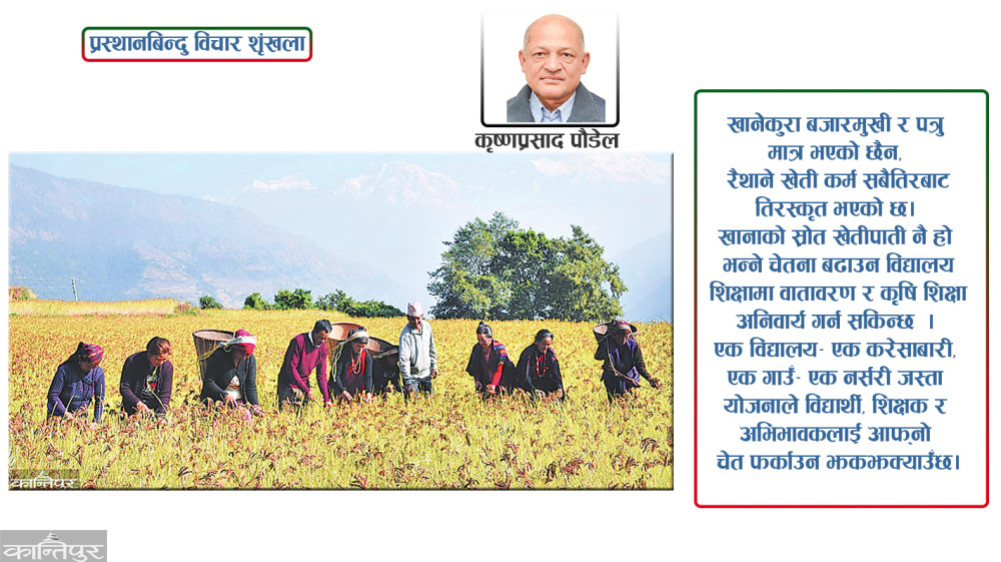
Currently, the agricultural sector, which has become both the cause and the result of climate change, will not be able to meet the basic needs of the general public for food and daily life without addressing the problem in the aggregate. The dying soil and the tearing clouds point to this. Realizing this, the society needs maintenance from the ground up. A few days ago, the education minister decided to use Raithane agricultural produce in the mid-day meals of all schools on her first day in office. It is definitely a useful, simple and feasible way to raise awareness about healthy food and the source of food from agriculture. But this is not enough to return the conscience of agricultural work. For this, environment and agriculture education can be made compulsory in school education. A school a karesabari, a village (toll) a nursery are examples of other simple measures that can be added to it. It makes students, teachers and parents all come to their senses at once. It does not require a separate large resource and investment.
It is important to understand that because the Raithane agricultural system based on local characteristics could not be advanced, it had to depend on the provision of food. It is necessary to explain to the leadership that the development of agricultural enterprises and the industrialization of agriculture is just a fantasy without a strong foundation of agriculture based on the local characteristics of a country rich in natural biological resources like ours. First of all, increasing agricultural production is the most important step.
is the only way to advance our traditional integrated farming system based on locally available resources. For this, it is necessary to make maximum use of local means, resources and technology based on the adoption of the basic guiding principles of nature-based agricultural systems (environmental balance, respect for coexistence, use of natural nutrient cycles, awareness of public health, cooperation, equitable and sustainable prosperity).
In this way, there should be pressure to make necessary political and institutional arrangements and action plans to transform Nepal's agricultural sector into an organic structure. Only this can make the agricultural sector productive and competitive according to the principles of sustainable environment based on economic strength, social justice and equality. Through this, the direction can be understood by increasing the respect of the farmer's culture.
For their own interests, social control and imposing backward social psychology on us, the world view based on the industrial economy and the hypocrisy of the political, administrative and intellectual leadership that has made this ideal, is necessary from all levels. Otherwise the consciousness and collective awakening to change our situation cannot be awakened. To do this, we all must dare to ask reasonable questions based on facts from our own place. Only such questions awaken the social consciousness of the leader who is sleeping in Besur like Kumbhakarna.
How long can we live without air, water and food? What is the source of our food? Where does our food come from if farmers don't grow it? Can farming be done without soil, climate, fertilizers and seeds? Is there no cultivation without chemicals and poisons? It is a common responsibility of all of us to raise contemporary issues of food and agriculture.