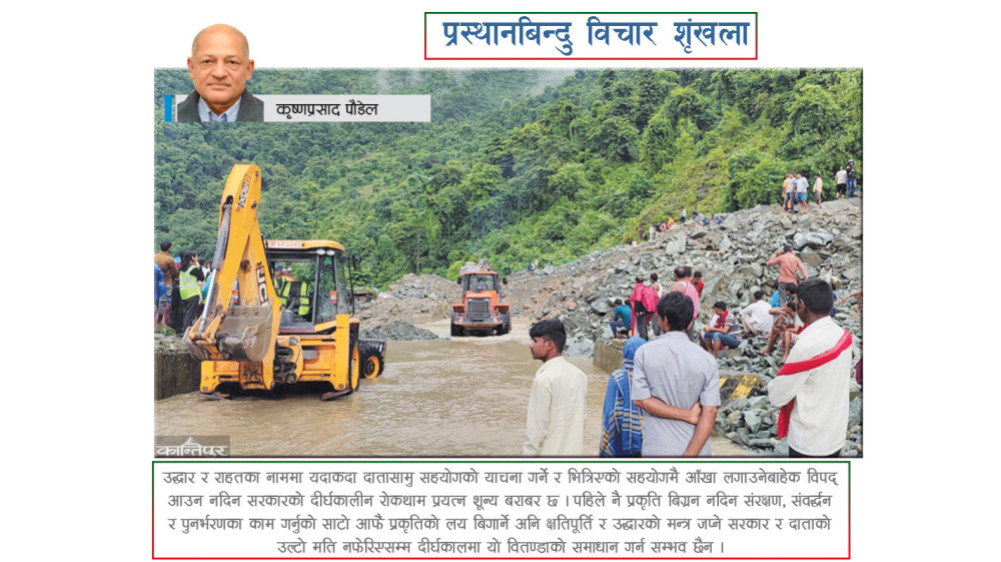
It is not possible to solve this problem in the long run unless the government and the donors change their minds and chant the mantra of compensation and rescue, instead of doing conservation, enhancement and replenishment work to prevent the deterioration of nature.
We use Google Cloud Translation Services. Google requires we provide the following disclaimer relating to use of this service:
This service may contain translations powered by Google. Google disclaims all warranties related to the translations, expressed or implied, including any warranties of accuracy, reliability, and any implied warranties of merchantability, fitness for a particular purpose, and noninfringement.
Rainwater from the Bay of Bengal is the main source of our food supply. Rains are basically the lifeblood of our farming system which relies on sky water. It is important to arrange water supply for farming throughout the year.
This is what fills our springs, rivers, lakes, ponds and wetlands. These are the main sources of water needed for drinking water and agriculture. Of these spring water is the most important. Because this is the only source of water in the settlements in most parts of Nepal, except in some parts of South Terai.
Along with this, water storage in the subsurface soil naturally regulates the water cycle throughout the year. But due to sudden changes in climate for the past few years, the water storage process has fluctuated. The area, timing, intensity, and amount of rainfall have all become uncertain. The environmental and food crisis is intensifying due to increasing temperature, unexpected and unpredictable changes in the water cycle, deforestation and overexploitation of biological diversity. Due to this change, the shortage of water needed for food and agriculture has increased day by day. During the rainy season, instead of being stored under the soil, this water spreads on the surface and the problems of floods, landslides, erosion and inundation are becoming serious. The main reason behind this is disruption of the natural water cycle.
Most of the water that is naturally available on the surface is absorbed into the subsurface soil and it gradually seeps out as springs. Also, various biological and chemical processes in the soil come to the surface through the pores formed in it. In this way, small plants, organisms, bacteria and their remains play an important role in maintaining the water that comes to the surface soil. The organic matter formed from these keeps the water thus available on the surface for a long time, which is available to the plants.
About 90 percent of rain falls in our geography during the rainy season. Evaporated ocean water turns into dense clouds during summer days, causing snow and rain in other regions of low pressure. This water is recharged and accumulates below the surface. The process of such precipitation is mainly determined by the direction of the wind and the location of the forest on the ground surface. Due to their balancing effect, the natural water cycle is regulated. When it is disturbed, the water cycle itself is disrupted.
With the industrialization, the excessive exploitation of mineral energy and the cutting down of forests, along with the emission of green gases, the temperature has increased rapidly. This has caused sudden changes in climate. In particular, it has an adverse effect on the water cycle. The increase in temperature has increased the uncertainty of rainfall over the land during winter and rainy season as the land is excessively warmed.
In particular, the surface soil has started to dry out for a long time after the winter rains stopped. This has also slowed down the biological process of our geography that starts with the end of winter, while on the other hand, the biological activity in the surface soil is continuously decreasing due to deforestation and monoculture based on chemicals. All these have accelerated soil erosion and desertification. This order has increased steadily. The impact of intensive farming can be directly seen in urban areas, villages and coastal areas.
Due to the interruption of winter and annual water in the natural rhythm, the availability of underground water, which is most used for food and agriculture, has automatically decreased. It has been many years since the Chure and Mahabharata ranges have been fully recharged. This has reduced the water level in mountain rivers, Khare and Mool Sukne valleys, Taltalaiya of Terai-Madhesh, wells and wells. Now, the water springs have started to dry up as winter sets in. Many streams and creeks have had no winter water for years. As a result of this, some settlements in the mountains have been emptied, and some agricultural lands have been left barren. Due to the lack of water in Chure Bhawar and the Terai area connected to it, the risk of land desertification and desertification is constantly increasing, while the soil and fine sand flowing from above cannot absorb the water, and the lower coastal area of the Terai is flooded every year as the water remains at the surface. This sequence is also continuously increasing.
As the rains that have been happening regularly for the past few years have stopped, its destruction is also getting worse. This kind of conflict is caused by the dozer terror, which is done in the name of development, unorganized cities, deforestation, gravel and sand sold to make way for development. This kind of damage is being increased by the rampant activity of tying nature like a cat to cut the natural course of rivers and streams to settle disorderly cities and settlements.
The slopes of the hills have been eroded by landslides. The coastal areas of the rivers have turned into bogs. It has flooded the plains and valleys. Millions of tonnes of fertile topsoil are forever flowing into the Bay of Bengal. Since the onset of the monsoon this year, more than two hundred people have lost their lives, hundreds have been injured, and millions have been damaged. It is estimated that there will be 45 to 65 percent more rain this year. If there is heavy rain like now, the situation will be more dire.
Even though there is a decade-old law not to disturb the nature of the river, the land along the river has been occupied and settled. There is no visible attempt to take any meaningful steps to stop this undertaking. Except for the exception, the river has not entered the slums, but because of the settlement in the river, thousands of people have been displaced. The ruler, who has turned a blind eye to all these realities, has called this disaster a sudden rain and a natural disaster, and has brushed aside some rescue and relief programs.
There is no effective long-term approach to addressing human-caused changes in nature and their underlying causes. Sometimes the government asks donors for help in the name of rescue and relief and keeps an eye on the help that comes in, but the long-term prevention efforts to prevent such disasters are zero. In addition, they are entering projects worth billions of dollars in donations and loans to reduce the risk of floods and address climate change. Most of the work of these projects is limited to the construction of dams to block the river, advance warning mechanism to avoid such risks, technology, its promotion and weeding in the post-disaster rescue and relief. It is not possible to solve this problem in the long run unless the government and donors change their mind, which instead of doing conservation, enhancement and replenishment work to prevent the deterioration of nature, and chanting the mantra of compensation and rescue, instead of doing conservation, enhancement and replenishment work.
When considering this, first of all, it is necessary to be clear how biodiversity, forest and environment are being destroyed by our rapid development and what long-term direction to go to correct it. First of all, it should not be forgotten that the overall nature, especially the destruction of forests and the environment, has further increased this suffering. Deforestation disrupts the biological process of the soil of the desolated land, the water absorption capacity of the soil decreases, and the water begins to flow from the surface when the forest and grassland are desolated, which stops the rapid flow of water. This has led to erosion of the surface soil and increased floods and landslides. The distribution of rains in the past and this year across the country are the products of these.
Next, this opinion of the planners, who made the only formula to stop this conflict, is to build dams with wire mesh in the river, is motivated by the private interests of today. In collaboration with middlemen brokers, they are pouring billions of money on the banks of the river to build such embankments, trading in gravel and sand by raising the river, and enclosing the public land on the banks of the river and making the river a prisoner. This trend is one of the main reasons for the current crisis.
For all these reasons, the risk posed by water is becoming more dire. To reduce these risks, a long-term vision of water as well as forest conservation, enhancement and management based on the characteristics of the local geography and its framework needs to be reconstructed.
This requires high moral strength and nature-based conscience at all levels to enhance effective policy interventions by advancing understanding of development approaches and frameworks, local environmental characteristics, water cycles, agricultural biodiversity. But the game of power struggle going on in the midst of this conflict, let alone hoping for such an intervention, we cannot expect to get help even to save lives. Therefore, there is no alternative to protect people's wealth today and to protect nature for tomorrow from all levels.