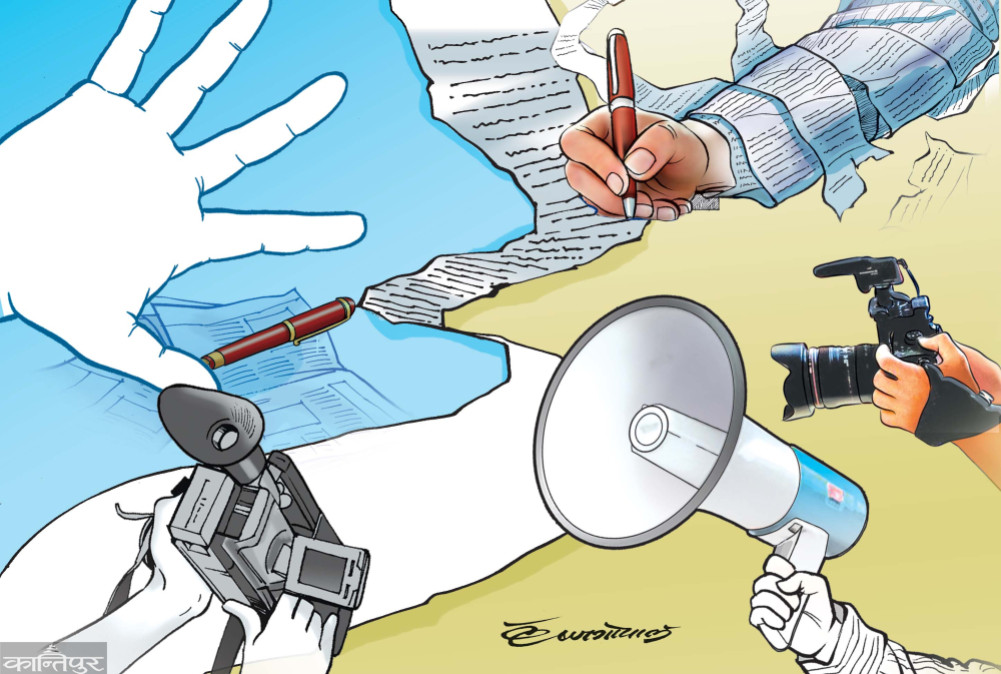
By taking action against a media house, the government basically tries to spread fear among the masses. However, the reality is that the government is a 'slave' to its weaknesses and such a slave government becomes 'miserable' due to the siege of questions and takes revenge on the media houses in a well-planned manner.
We use Google Cloud Translation Services. Google requires we provide the following disclaimer relating to use of this service:
This service may contain translations powered by Google. Google disclaims all warranties related to the translations, expressed or implied, including any warranties of accuracy, reliability, and any implied warranties of merchantability, fitness for a particular purpose, and noninfringement.
It is about to be 50 years since the emergency was imposed by the elected government in India. During that declared emergency, the strict monitoring, control and efforts to eliminate some of the media by the government apparatus still pinch and shock any citizen who believes in a free press. The government under a democratic guise not only reminds us of the efforts made to make journalists and journalism puppets on the occasion of the National Discipline Festival citing the constitutional provisions, but also reminds us of the tireless fighters who refused to bow down to the government.
After this, what wave of changes started in Indian journalism, which is known as the world's largest democratic country? How did the journalists themselves to be freed from the power? How did the journalists themselves create a 'space' for themselves in the perspective of the government's 'gesture' in that period of extreme abuse of power and power? No attempt has been made here to trace the root causes of the failure of the original players and their political ambitions, institutions associated with the Indian Emergency. It was a declared emergency, but the government is creating an atmosphere of an undeclared emergency and trying to find ways to make journalists and journalism harmless. An attempt has been made here to point out how the effort of unannounced control rather than the declared one makes the independent press suffocating.
There were some good people even in those bad times. Those who preferred speed to stability stood firm. On that Kalaratri, those who believed in the light presented themselves as Junkiris. It was this group that spoke truth to power and put themselves and their businesses at risk. Even today, there are good people even in bad times where there is an atmosphere of unannounced emergency. Kalamjivi, an intellectual who clearly defined the era of India, had a good eye on where the supreme power was moving to achieve his personal interests and devoted himself to scripting the new era of 'Bhakti Kaal'. Such zeal for the assurance of an immediate future joined the opposition to fundamental freedoms there too. Those who conflated their conformity with the status quo interpreted the government blunder as an embellishment. For such people, journalism is only a means of self-fulfillment and is not an institution of faith.
At a time when the values and dignity of democracy were being eroded, some press owners tried their best to tell their readers that the Emperor was naked, referring to the government's attempts to drag him from democracy to un-democracy. Indian Express publisher Ramnath Goenka and The Statesman editor-in-chief CR Irani paid the price. There is a long list of such struggles across India. Excluded from government advertising. Some newspapers (then still newspapers) tried to stand up to the regime, and in doing so played a role in their publishers' unconditional commitment to civil liberties and dignity. The editorial group of the publishers who were loyal to the civil rights and constitutional dignity made a pro-people history, some editors for whom the publisher happened to be a candidate for the then government, they were dismissed. The then editor of Hindustan Times, BG Burgess, was sacked and created a record in the history of journalism. Things like cutting off the lights of Nirbhika media house, causing many sufferings, putting them in jail, blocking movement, censorship etc.
press is such an organization, where without the generosity and commitment of the publisher, the editorial team involved in it could not use their freedom without interruption. Therefore, the freedom of the press takes its meaning and shape from the editorial group as well as from who the publisher is and to what extent he can show controversy. Therefore, the argument that the freedom of the press has started to be suppressed when the government uses many traps, conspiracies or inducements to suppress, tire and bend the publisher. We don't have to wait long to see the effect of the government laying many omen traps to seek revenge on the publisher, we need to show unswerving loyalty to the freedom of the press immediately. Loyalty to press freedom is inherently fluid. History is made by journalists who have the courage to leave a publisher who has taken a stand and who does not bow to Navdarbar to bargain for profit.
Freedom in practice is the 'space' achieved between the friction of ruling and civil practice. The power naturally oppresses, it is trying to appease its intolerance by using the legal process, but the citizen tries hard to stretch such contraction with his practice, and the available space in this intermediate state comes to be used for the society at that time. The government tries to establish the process of narrowing the space by example, but the civil power does not want to believe the anecdotes coming from the mechanism of permanent power. As disagreement and criticism increases, the ruler considers it a challenge. Power always comes with questions. During the Emergency, the government there classified the media into three groups: friendly, neutral and hostile. And made a coping strategy accordingly.
Among the 'hostile' groups in the eyes of the government were those who brought the power vacuum to the public. The government had turned into a gang and was sacrificing the basic dreams and interests of the people for its own stability. The government first wants to bring the hostile group to 'size'. In his estimation, as this group matures, the 'neutral' group may slowly shift their natural sympathies towards the incumbents. Therefore, the ruler abuses state power to the extreme to destroy what he deems to be a hostile group. In such a situation, not the rule of law, but the rule of speech. After the Emergency, the rulers seem to prefer unannounced rather than declared attempts at control. Looking back at the Indian Emergency, it is clear that the lines drawn by one elected government became the mantra for governments elsewhere.
The government basically tries to spread fear among the masses by taking action against a media house. However, the reality is that the government is a 'slave' to its weaknesses and such a slave government becomes 'miserable' due to the siege of questions and takes revenge on the media houses in a well-planned manner. When a servile government becomes the primary character of its stability, then an elected government is transformed into a despotic government. Analyzing any major political events of the past in the present time, many aspects become clear.
History must be evaluated time and time again in the context of the present, because it is only through that that the footsteps of the immediate future can be understood. There is an example of what would be the basis of evaluation, that which was not accepted yesterday, is gradually getting used. Therefore, rather than keeping track of which media house the government is hitting on the head of, where will the hammer turn tomorrow, whose head will it crack, that sensitivity is the urge of every era. Such governments tend to target large institutions first, which makes it easier to find other critical but smaller institutions. Therefore, the assessment of the media house is done holistically, but the answer to this difficult question created by the government is not worth it.
Emergency was declared in India for a period of 21 months from 25 June 1975 to 21 March 1977. It was the most controversial and undemocratic period in the history of independent India. The then Prime Minister Indira Gandhi jailed political opponents in large numbers and imposed several directives on the press. To ensure that no one questions the power, all that is done which is a crime in a democracy. Today, there are governments in the world, who say to bow to power without an emergency, but a section of the media dares to bow before the government. Power's success lies in how divided and contradictory journalists can be on the issue of press freedom. By resorting to the word 'but', not only journalists themselves, but also political parties, professionals, civil society and ordinary citizens to start seeing the light in the government's mischief is now to collectively prepare for a possible scandal. The Indian Emergency can be a mirror to see the face of freedom of speech in newly republican Nepal after 50 years. The dark chapter of autocracy does not come with a bang.
was a strand of freedom fighters there who supported the Indian Emergency. Many characters of public life joined in cheering in the government maze without understanding his mischief. Realizing the sweet poison of power and power, political activists, civil society and finally common people took the path of collective resistance and the People's Power was victorious. Even though this story is Indian, it is a universal epic that understands the suffering of democracy.