To avoid extreme heat and heatstroke, doctors have advised people not to go out except for essential work between 11 am and 4 pm.
We use Google Cloud Translation Services. Google requires we provide the following disclaimer relating to use of this service:
This service may contain translations powered by Google. Google disclaims all warranties related to the translations, expressed or implied, including any warranties of accuracy, reliability, and any implied warranties of merchantability, fitness for a particular purpose, and noninfringement.
The temperature in Madhesh and Western Tarai has suddenly risen. The movement of the general public has become thin as the hot wind has started blowing. As the sun starts to shine after 10 am, the markets as well as the rural areas have become deserted. Due to the sudden increase in heat since Tuesday, normal life has been affected from Rajbiraj, Birgunj to the west in Madhesh and from Bhairahawa to Nepalgunj, Dhangadhi in the Far Western Tarai.
According to the Department of Hydrology and Meteorology, the temperature in Rajbiraj, Saptari, reached 36.1 degrees Celsius on Wednesday. The maximum temperature here on Tuesday was 38.2 degrees Celsius. According to the measurements of the Agricultural Equipment Research Center in Birgunj-Ranighat, the minimum temperature on Tuesday was 27 and the maximum was 39.9 degrees Celsius. Although the minimum temperature on Wednesday was 22.5, the maximum temperature reached 41 degrees Celsius.
The hot wind blowing along with the high temperature has also affected normal life in western Nawalparasi. Rajendra Chaudhary of Ramgram said that he has been suffering from the heat of the sun and the heat of the ground for the past few days. He said, "Until a few days ago, we could do outdoor work. Now, it seems like the sun is burning. We have been doing outdoor work in the morning and evening." The temperature in Parasi, the district headquarters, was measured at 37 degrees Celsius at 1 pm on Wednesday. The poor families who earn their living by working as daily wage laborers have found it difficult to work due to the hot wind.
Sant Malaha, an auto-rickshaw driver in the bordering Bhairahawa market of Rupandehi, is currently suffering from the heat. He does not even have the energy to take his rickshaw out on the road due to the heat. Even if he does take it out, he does not find any passengers in the heat. Even the auto-rickshaws that are crowded at other times at the market squares have thinned out. Public transport has also started running less. "People have stopped coming out of their homes due to the heat," Malaha said.
Bhim Bhandari, teacher at Bhairahawa Multiple Campus The maximum temperature was more than 40 degrees Celsius. Since Monday, hot winds have been blowing in Bhairahawa and its surrounding areas after noon. According to Gautam Buddha International Airport Information Officer Binod Singh Rawat, it is not possible to travel during the day on Wednesday. The heat makes you lazy, your lips dry, and you only want to sleep.- On Wednesday, there were few people moving around in the border area of Bhairahawa's Marchwar. Auto rickshaws and motorcycles were plying sporadically. Some local Gamchhas were traveling on bicycles with their heads and faces covered. Most of the common people were sitting under the shade of trees on the roads and around their homes. The market was deserted. There was no one to graze livestock in the barren fields of Marchwari in Rupandehi and Kotahimai. Bachchan Yadav of Kotahimai said that due to the heat, livestock was taken to the fields only in the morning and evening. 'Not only people, but also livestock feel the heat,' he said.
Bhim Bhandari, a teacher at Bhairahawa Multiple Campus, said that the hot air makes the body dry and thirsty. ‘It is not possible to travel during the day,’ he said, ‘The heat makes the body lazy, the lips dry and only makes you sleepy.’
Most municipalities in Rupandehi are starting the academic session from 10 Baisakh. Parents are worried as schools will be opened in the summer. ‘The heat starts in the morning,’ said Jayakesh Harijan of Siddharthanagar-12, ‘It is difficult to go out and work in the afternoon. How can students study in such a hot weather?’
The heat has also affected life in Nepalgunj, Banke. According to the Meteorological Forecasting Division under the department on Wednesday, daily wage earners, rickshaw pullers and women businessmen have faced problems after the maximum temperature here reached above 39.2 degrees Celsius. There is less movement on the roads during the day due to the scorching sun. The general public has been forced to stay indoors. ‘Because people do not come out of their homes during the summer, there is no income even if they drive rickshaws all day,’ said Ram Vilas Kumal of Nepalgunj, ‘It is as hot as Jestha-Asar even in Baishakh.’
Daily wage earners have been affected by the decrease in the presence of people in the market area. Kranti Burma, who runs a clothing shop in Gharbari Tole, Nepalgunj-2, said that business has decreased due to the heat. ‘Even though the shop is open all day, customers do not come,’ she said, ‘Customers are seen in the market only after 6 pm.’
The heat has also increased sharply in Dhangadhi in the Far West. According to the data released by the Meteorological Forecasting Division on Wednesday morning, the temperature in Dhangadhi was between 38 and 40 degrees Celsius. The department stated that it reached above 38 degrees Celsius in Dhangadhi between 12 and 2 pm. The biggest hit of the heat has been daily wage earners and farmers. Sohan Chaudhary, who is working at LN Chowk in Dhangadhi, said that the working hours have been changed due to the heat.
Earlier, he used to work from 7 am to 5 pm, but now he is forced to take a 2-hour break in the afternoon. He said that working in the open air in the hot air is very painful. The heat has also affected the students. Chetna Kunwar, a student of class 11 in Trinagar, Dhangadhi, was seen going to school under an umbrella in the scorching sun at 2 pm. She said that even though she did not feel like going to school due to the heat, she was forced to go to school as the exams were approaching.
Kalpana Ode, who is roasting corn with a three-year-old child in her arms at LN Chowk, said that her business has decreased in the past few days. Before the heat, she used to do business of up to 1,000 rupees a day, but now she says that she earns only 3-400. ‘They do not like to eat hot corn in the summer. They eat it only sporadically in the evening,’ she said.
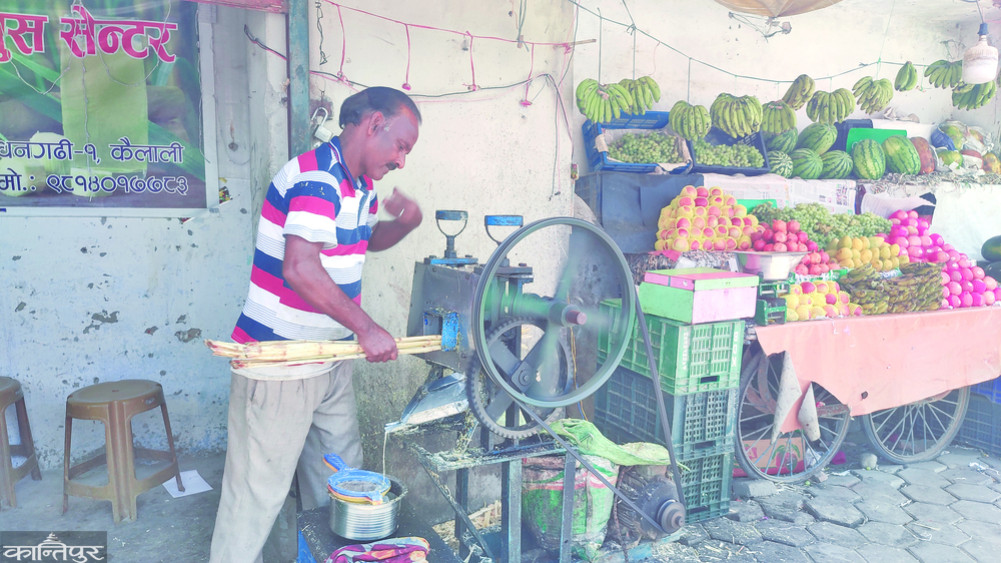
For Sameer Khan, who sells sugarcane juice at LN Chowk in Dhangadhi, business has also increased with the increase in heat. For the past week, he has been selling more than 100 glasses of juice a day. He said that he has started earning more than Rs 3,000 a day by selling a glass of juice for Rs 40. “Until a week ago, there was not much business. Since 3-4 days, there has been good earnings,” said Sameer. Not only in the market, but also in government offices in Dhangadhi, the presence of service recipients has started to decrease in the afternoon.
To avoid extreme heat and ‘lu’, doctors have suggested not to go out from 11 am to 4 pm except for essential work. Dr. Akash Rawat, consultant physician at Kailali Hospital in Dhangadhi, suggested that if you have to go out, cover your body completely, wear loose cotton clothes, use a hat or umbrella on your head, and stay in a cool place as much as possible.