While AI is changing work styles, skills, and employment structures, there is still confusion about curriculum and policy in the educational sector.
We use Google Cloud Translation Services. Google requires we provide the following disclaimer relating to use of this service:
This service may contain translations powered by Google. Google disclaims all warranties related to the translations, expressed or implied, including any warranties of accuracy, reliability, and any implied warranties of merchantability, fitness for a particular purpose, and noninfringement.
Mamta Chaudhary, a software developer at Cedar Gate Technologies in Lalitpur, is currently coding with a new friend. Her new friend is Amazon Q. Amazon Web Services has developed this AI-assistant tool to make software development and data analysis easier.
Mamta feels that the work is becoming easier because Cedar Gate has purchased a license and provided such an AI-assistant tool to its developers. ‘Earlier, whenever I faced any problem, I would try it myself and think logically from different angles. Now, whenever I face a new challenge, I have become accustomed to asking AI for help before trying it myself,’ says Mamta. ‘This has saved me from having to depend on others, as I don’t have to ask for help from other colleagues or supervisors, but I feel like my thinking power has diminished to some extent.’
Nepal’s IT companies have started taking the help of AI to increase internal efficiency, formulate business strategies, and even in cyber security and employee management. To prevent her creativity from dying, Mamta shared her experience of trying things herself first or not taking help from AI when she was not in a hurry. However, she says that she does not believe that AI will replace humans. ‘In the future, jobs that many people do may be done by a few due to AI, but people are still needed,’ she said, ‘This means that the workforce of today must be skilled in AI.’
Many people in Nepal’s software companies have had experiences like Mamata’s. As artificial intelligence (AI) continues to create a stir in the global technology market, the use of AI is also increasing in Nepal’s technology companies. It has changed the way work is done. Nepal’s IT companies, which provide services in the domestic and international markets, have started taking the help of AI to increase internal efficiency, formulate business strategies, and even in cyber security and employee management.
Santosh Tamrakar, Managing Director of IMS Software, which has dozens of clients including Nepali Army, Bhatbhateni, Salesberries, Mini So, Nestle, Jimbu Thakali, and others, is observing the changing pace of work due to AI integration. ‘Previously, it took half a day to prepare a business proposal, but now it is ready in 10 minutes with the help of AI,’ he says, ‘We are in the initial stage now, it has given an attractive signal to increase productivity.’ He said that IMS uses tools like ‘Clud’ for coding and ‘Beautiful.AI’ for making presentations. 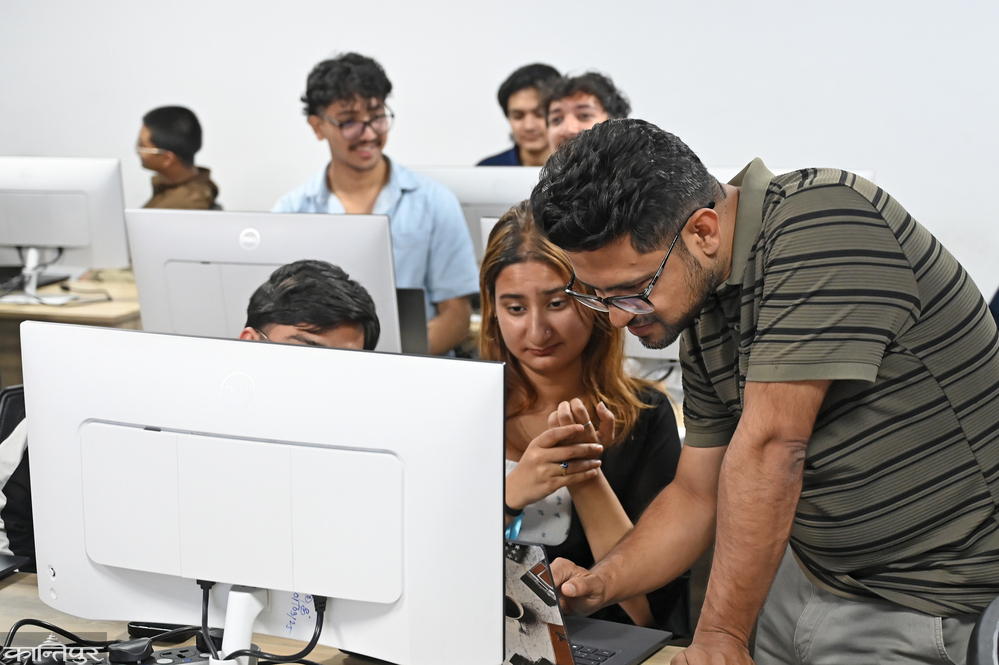
What used to take two-three days of hard work to create the ‘system architecture’ of the software, AI has now finished it in two minutes. ‘Now, the market is looking for people who can not only code, but also check whether the output given by AI is correct and input the necessary data,’ says Tamrakar. ‘The future is challenging for mid-level developers who can only do one-off coding.’ However, the demand for AI-savvy people is increasing.’
Abhay Poudel, co-founder of software development company Gokyo Labs and treasurer of Nepal Association for Software and IT Services Companies (NAS-IT), also finds that everyone is now choosing AI to increase ‘operational efficiency’. ‘We have also increased the use of AI tools in the software development process,’ he said. ‘AI tools provide services like agents in tasks such as planning software development, adding features, and preparing documentation.’
Now universities and industries should collaborate closely and familiarize students with modern tools from day one.- Ankur Sharma , Innovation Director at Leapfrog Technology Poudel believes that the rate of new employee recruitment in Nepal’s information technology sector has slowed down due to the impact of AI. However, he pointed out that there are ample opportunities for those with AI-related skills. He understands that the industry sector is in need of manpower such as AI application developers, data engineers, AI operations and cloud experts, prompt engineers, and AI consultants. However, tech CEOs have been complaining that the education sector has not been able to provide manpower according to the demand of the industry.
‘We have hired 10-12 college graduates in the last one year, and we have hired 50 percent of the 20-25 people we interviewed,’ said Poudel. ‘This is a good hiring, but the problem is that all those hired should be given 4 to 6 months of training from the basic level.’ He believes that if students coming from universities learn basic mathematics and AI skills in college, the training provided by the industry will be more effective and easier.
Kapilraj Pandey, head of Cedar Gate, a leader in the health technology sector, said that they have launched ‘traineeship’ and ‘internship’ programs for students to bridge the gap between the information technology industry and academic courses. ‘Through the traineeship program, students studying in the eighth semester get the opportunity to work on live projects with us,’ he said. ‘When the caliber of the students is not up to par, the company gives them the option to hire them after providing them with special training for six months.’
Ankur Sharma, Innovation Director at Leapfrog Technology in Kathmandu, points out that the main reason for the widening gap between Nepal’s academic sector and the information technology industry is the rapid development of technology and the sluggish educational system of universities.’ ‘Companies need employees who know how to use the tools used in the company, because in some places, there is no need to write code anymore,’ he said. ‘The industry is looking for AI-capable talent who can improve the quality of work using AI along with basic knowledge of software engineering.’ However, he mentioned that when young people who graduated from universities after studying old curricula created when the wave of AI had not yet arrived, there is a mismatch between demand and supply when they enter the market. 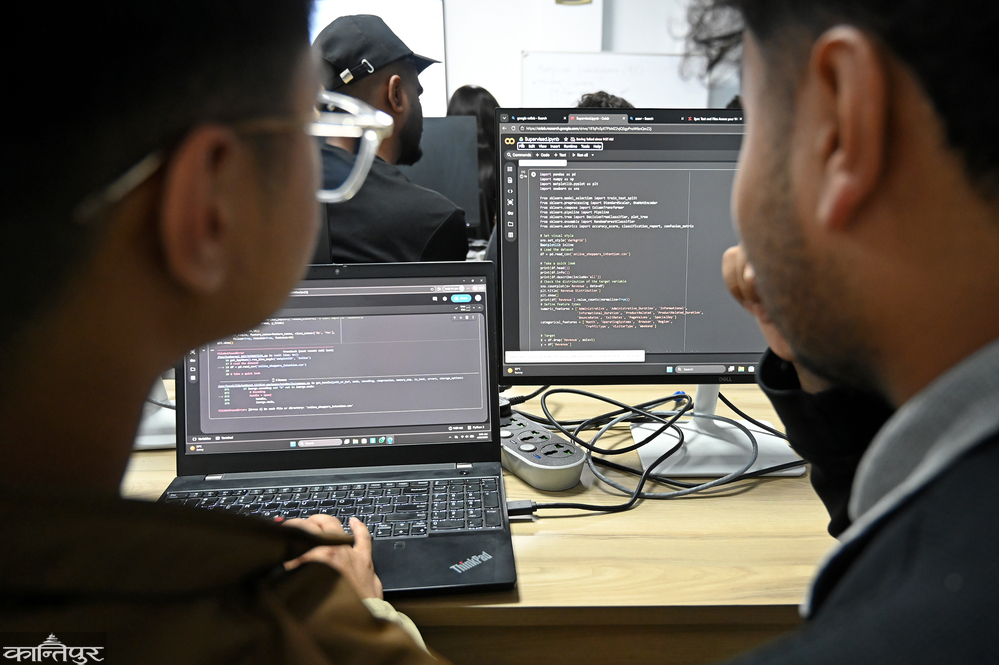
Not only in Nepal, but all over the world, there is a search for people who know and understand AI. While developing human resources, one must have both knowledge and skills of AI. - Arun Timilsina , Professor of Computer Engineering at Tribhuvan University The government's recently released 'National Commitment' to bridge this gap mentions making AI literacy compulsory up to grade 12 and Nepal developing its own 'Sovereign Large Language Model'. The 'National Commitment', a joint document of the Nepal government prepared by encompassing the manifestos, pledges and commitments of six major political parties, also sets a goal of becoming a country that exports computing power in the next five years and declaring information technology a strategic industry. However, looking at the ground realities of the industry and education sectors, the question arises as to how practical this ambition is.
While the market is looking for AI manpower, the discussion of AI in Nepal's educational institutions has just begun. Kathmandu and Purbanchal Universities have started teaching AI as a separate subject. KU has established an AI department under the Department of Computer Science and Engineering.
Tribhuvan University, the largest in the country, does not have a separate full degree program in AI, but it is included as a basic course in BSc CSIT, BIT, BCA, BIM and some engineering programs. Pulchowk Engineering Campus has been teaching AI-related subjects through the ‘Data Science and Analytics’ program since 2076 BS. Interestingly, amid confusion over how to manage this expansion of technology, Tribhuvan University has been banning the use of AI in exams since 2080 BS. There is a provision that if intellectual theft is found, the exam will be canceled. KU, on the other hand, has passed a policy to use AI completely. One country, one generation of students, two opposite policies seem to be in place. While the university prioritizes the use of AI in the classroom, it has adopted a policy of discouraging its maximum use in exams. Tribhuvan University has been using software to prevent intellectual theft in theses. Technology analysts point out that most educational institutions are spending more time and energy on how to prevent its use instead of adopting the technology as a supporting tool. “Our educational institutions themselves are not in a position to assimilate AI or design new assignments keeping its use in mind,” said Sharma of Leapfrog. “Now universities and industry must work closely together and familiarize students with modern tools from day one.”
Vedmani Dahal , Dean of Kathmandu University School of Science Arun Timilsina, Professor of Computer Engineering at TU, admits that the teaching activities that should have been done by prioritizing AI have not been as much as they should have been. ‘Not only in Nepal, but all over the world, there is a search for people who know and understand AI. When developing human resources, they must know and understand both the knowledge and skills of AI,’ he said. ‘Now such programs must come up in universities, the curriculum must be revised accordingly. The state must invest.’ Feeling that the foundation of the teaching profession has been shaken due to technologies like AI, he said that even teachers no longer see an option to keep themselves ‘updated’. ‘With AI, teachers no longer have to wait to study, there is no longer a situation where they have to teach only old topics in the classroom,’ he said. ‘Both teachers and students have to be updated.’ We have already passed a policy on including AI, whether when creating a new curriculum or revising an old one. -
The AI course was implemented under Timilsina’s leadership. He said that AI tools are being used to the maximum extent in the classroom. ‘Both teachers and students can learn and see how teaching and learning is done at MIT Harvard University,’ he said.
Vedmani Dahal, Dean of the School of Science at Kathmandu University, says the university has adopted a policy to fully utilize AI. ‘Whether it is creating a new curriculum or revising an old curriculum, we have already adopted a policy on including AI,’ he said. ‘All schools will have AI content and both teachers and students will have to learn and teach.’
King’s College in Kathmandu has run a BSCS Artificial Intelligence class. The college’s head Narottam Aryal said that AI subjects have also been implemented at the postgraduate level. Aryal admitted that although this college, affiliated with Westcliff University in California, USA, has been updating the curriculum, AI education has not flourished in Nepal. ‘It has brought upheavals from school to college, but AI has also been misused,’ he said, ‘How to use it, to what extent, should be clear in the curriculum. Students’ creative potential may be dying.’
Sarvin Sayami, head of the Central Department of Computer Science and Information Technology at Tribhuvan University, is concerned that the negative effects of AI outweigh the positive effects. ‘It seems that AI is being used more for entertainment than for teaching and learning, and there is more misuse,’ he said, ‘A curriculum that provides awareness about AI should be implemented right from school.’ He said that the issue of introducing an AI policy in Nepal’s educational institutions is in its early stages.
In the experience of Sunaina Pandey, president of the Computer Association Nepal (CAN Federation), AI has made tasks like graphic design, video editing, and preparing legal documents easier. In her own company, General Technology, developers are using AI to speed up coding. According to Pandey, even though AI is making work faster and more automated, Nepal is not facing a large-scale layoff. However, she believes that it is gradually changing the employment landscape.
‘Although the series of layoffs in the international market has begun, it does not seem like Nepal’s IT sector will face that dire situation right now,’ says Pandey. ‘However, it will touch Nepal in the near future.’ Currently, Nepalese companies are focusing more on making their daily work smarter and more effective by training their available workforce to use AI tools rather than laying off employees.’
In the international technology market, companies have been laying off employees for the past three years and investing that budget in AI infrastructure and development. As AI has started doing repetitive tasks like data entry and customer service, the need for human resources has decreased. However, despite the various reasons for laying off employees, companies are also accused of using AI as an excuse. This has been termed ‘AI-washing’ by the tech sector.
Digital infrastructure is a fundamental condition for creating about 1.5 million new jobs and building an economy worth Rs 100 billion. -
Sanjeev Subba , Financial-Technology Expert Speaking to CNBC-TV Eighteen at the AI Conference in India two months ago, Sam Altman, head of OpenAI, made this observation. ‘I can’t say exactly what percentage, but a lot of people are engaging in AI-washing to a significant extent, blaming AI for employee layoffs,’ he said. ‘Even if AI didn’t exist, they would have laid off employees.’ Some jobs have been displaced by AI.’ Nepali technology analysts, however, believe that AI will help increase productivity rather than displacing people. Santosh Tamrakar of IMS says that AI cannot replace people because it requires people who understand AI to check the results given by AI. ‘In the Nepali IT sector, more attention is being paid to teaching employees to use AI (re-skilling) rather than AI washing,’ he said.
A World Bank report
showed that monthly advertisements for ‘white collar’ jobs in South Asia have decreased by 20 percent due to generative AI. According to the ‘South Asia Development Update’ released last October, 7 percent of jobs in the South Asian region are at high risk due to AI and automation. The report states that employees without a college degree and those who have just started working will be the most affected by this revolution. Shailendraraj Giri, Managing Director of online job portal 'Merojob.com', says that the demand for software developers, transcribers, translators, and content writers is currently low in Nepal's IT companies. 'The main reason for this is the ease brought by AI, there is no longer a demand for manpower for the work that AI can do,' said Giri, who is also the president of AI Association Nepal. 'The demand has mainly decreased for mid-level and entry-level developers. The market for fresh graduates in IT has become dark, and companies have stopped hiring new people.'
Giri informed that the demand has not decreased in categories like product management, UI/UX design, and QA/QC. The demand for IT administrators, system administrators, cloud engineers and network administrators is also unchanged, he estimates that the demand may not have decreased because AI cannot do these tasks. According to Giri, when hiring an employee, whether he knows how to use 'AI tools' and whether he knows 'prompt engineering' has become a mandatory condition. He believes that Nepali manpower is lagging behind India or the Philippines because colleges teach coding but do not teach AI skills, team management and communication skills. He suggested revising the curriculum to suit 'corporate culture' and having experts working in the industry teach it.
Nas-IT President Gaurav Pandey says that Nepalese companies have started making radical changes in their working style. With the increasing use of AI in tasks such as code generation and testing, complex tasks that were previously impossible have become easier. However, he mentioned that the challenge is that the industry itself must prepare the manpower needed by the industry.
Financial technology expert Sanjeev Subba also considers the government's commitment to move towards a digital economy promising. But he says that digital infrastructure is a basic condition for creating about 1.5 million new jobs and building an economy worth one trillion rupees. 'Although there is a debate about AI in Nepal, the necessary data infrastructure is not being discussed for this. Investment should be made in AI infrastructure such as data lakes and 'data warehousing,'' he said. 'The government's vision of encouraging the IT sector and making a leap in AI is correct. However, we need to improve our digital capabilities a lot. First of all, we should have a fast AI research and development facility, only then can we make new innovations.' Subba's analysis is that Nepal needs to work in a future-oriented manner as the computational power of supercomputers and the growth of AI that will come by 2030-32 will make some of the current developments obsolete.
While the debate and policy confusion surrounding AI continues in educational institutions, developers like Mamta Chaudhary of Cedar Gate have made AI their colleague. For them, AI has opened new doors to self-reliance and efficiency by reducing the workload. They don't have time to wait. Because the market has moved on, curriculum after curriculum.

