UML says: We await the government's report, police unhappy with IGP's recommendation to prosecute
We use Google Cloud Translation Services. Google requires we provide the following disclaimer relating to use of this service:
This service may contain translations powered by Google. Google disclaims all warranties related to the translations, expressed or implied, including any warranties of accuracy, reliability, and any implied warranties of merchantability, fitness for a particular purpose, and noninfringement.
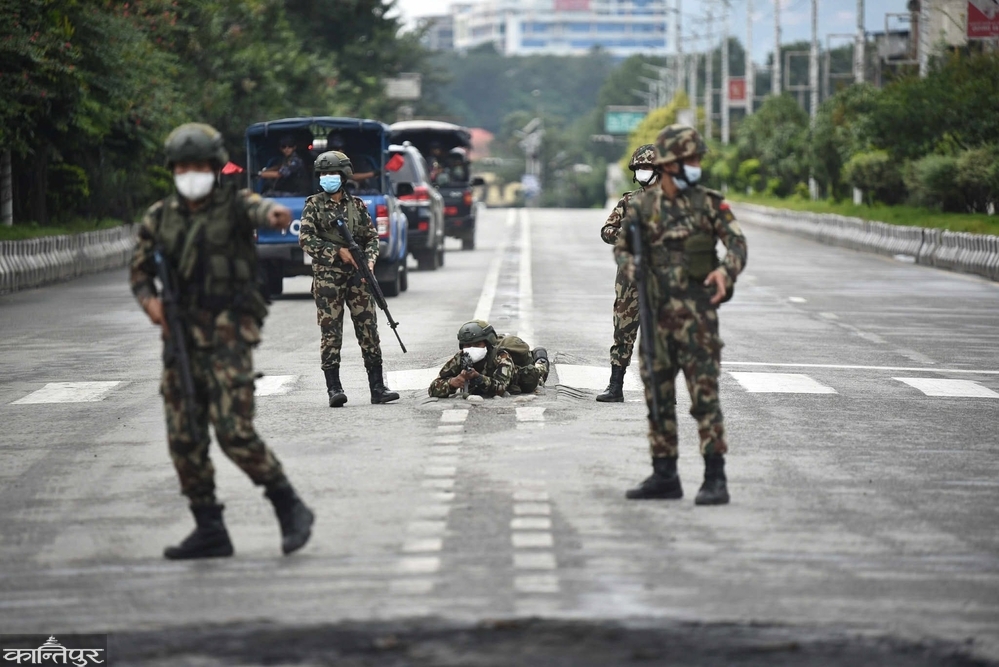
The inquiry commission has concluded that the then Prime Minister KP Sharma Oli, Home Minister Ramesh Lekhak and Nepal Police Chief Chandrakuber Khapung did not take any steps to stop the clashes between protesters and security forces even before the curfew was imposed on 23 Bhadra.
The commission formed to investigate the incident during the Gen-G movement had submitted a report on 24 Falgun recommending that Oli, Lekhak and Police Chief Khapung be investigated for criminal offences. The government had formed a committee to study the report, but it was not made public.
On Wednesday morning, the online version of Jana Aastha Weekly made public some important parts of the report's recommendation section, in which it was recommended that action be taken against Oli, Lekhak and Khapung for negligent homicide and negligent homicide. Section 181 of the Criminal Code states that ‘no one shall kill another by negligent act’. Except in cases under Sections 177, 178 and 179, a person who commits such an offence can be imprisoned for three to 10 years and fined from Rs 30,000 to Rs 100,000. Sections 177, 178 and 179 contain offences related to murder, which are charges that are imposed on those involved in murder. Section 182 states that ‘no one shall kill another by negligent act’. It states that imprisonment for three years and a fine of up to Rs 30,000 can be imposed.
BP Bhandari, a member of the Commission of Inquiry, said that they have submitted the report to the Prime Minister and urged the government to consider the matter to be made public as official. ‘We are legally obliged not to make the report public, so if the current government does not make it public, I think the next government will do it,’ he told Kantipur.
Retired Additional Inspector General (AIG) of Nepal Police Uttam Raj Subedi says that he finds it incongruous to take action against the then IGP. ‘Maybe this is a suggestion of the inquiry commission, but the implementation will be done by a different body.’ But I see some difficulties in going through the case process,’ he told Kantipur, ‘No law gives the IGP the authority to give the order to shoot, the District Security Committee works at the strategic level, the Central Security Committee at the operational level, and the National Security at the policy level.’ Other police officers are also expressing dissatisfaction with the recommendation to prosecute a large number of security officers.
Stating that there is a legal provision for the Chief District Officer to give the order in the matter of firing, Subedi added, ‘There are situations where officers deployed in the field can use the authority to shoot for the protection of themselves or important structures or for self-defense.’
The Commission of Inquiry submitted the investigation report of the incidents of Bhadra 23 and 24 to Prime Minister Karki
The report of the commission states that the Prime Minister will be the head of the system and that ‘the responsibility of taking credit for good deeds and taking credit for bad deeds within the country will also fall on the Prime Minister’. It is also mentioned that since he is the Prime Minister, he will be responsible for the work and actions of subordinate bodies.
During his tenure, Oli had taken the country’s intelligence agency, the National Investigation Department, under the Office of the Prime Minister and Council of Ministers, saying that it would strengthen it.
‘The security arrangements for Bhadra 23 were made based on information collected by the National Investigation Department from various sources, according to which it was estimated that 3 to 5 thousand people could be involved. Which proved to be wrong,' the report says, 'It seems that there has been no concrete initiative from the Office of the Prime Minister and the Council of Ministers to strengthen and enable an important body like the National Investigation Department.'
UML to wait for the report to be made public by the government
UML leader Pradeep Gyawali said that they are waiting for the report to be made public by the government formally. He said, 'Details have been coming in for some time, saying that parts of the report have been made public, we will make a formal opinion after the government makes it public.'
It is said that the National Security Council led by the Prime Minister failed to assess the possible security challenges that could arise the next day after the death of 19 protesters by the evening of 23 Bhadra.
‘Only a light and verbal decision was made to form a high-level investigation committee to investigate the reality of the incident, including a realistic assessment of the potential security risks, and a planned and effective mobilization of security forces, but no written decision was made, so the incident seems to have been taken in a casual manner,’ the report says. ‘The government had not conducted any study on the impact of banning social media. Even in the Security Council meeting held on the evening of 23 Bhadra, there was an option to declare a state of emergency and mobilize the army to maintain peace and security. However, no concrete decision was taken.’
It is said that the Council did not take any other concrete decisions regarding the outcome of 24 Bhadra. As a result, the report says that an incident the country has never experienced on 24 Bhadra. It is said that a person in a position of responsibility like the Prime Minister, taking into account the deteriorating situation, should coordinate effectively with the security forces to resolve it, minimize the risk, and take initiatives to stop the firing immediately. It is said that if the army could have been mobilized for directive effect in coordination with the military headquarters and with the help of the army, the number of casualties could have been reduced.
‘Even when the security situation was known, the Prime Minister did not seem to have taken the necessary initiative in time,’ the report said.
The report has asked Home Secretary Gokarna Mani Duwadi, Armed Police Force Inspector General (IGP) Raju Aryal, the then head of the National Investigation Department Hutraj Thapa, and the then Chief District Officer of Kathmandu Chhabilal Rijal to take action under Section 182 for negligent acts that could lead to the death of anyone.
Questions on the role of the army
The report also raises questions about the role of the Nepali Army. It is said that the local administration did not provide the requested assistance even though the army representatives were informed about the developing situation that day. ‘As a result, many people died and hundreds of others were injured due to the use of force instead of crowd control,’ the report says. ‘A representative of the army was also a member of the District Security Committee, and the meeting of the District Security Committee, Kathmandu, on Bhadra 23 was held in the office of the Chief District Officer since the morning.’
The inquiry commission has said that flammable materials were used to burn down important structures such as Singha Durbar, Parliament Building, Supreme Court, and President’s Office Sheetal Niwas. There was a report that petroleum product residues were found in the samples collected during the tests carried out in India.
‘When attacking an office or house, the first thing that was seen was destroying the CCTV, emptying and destroying the water tank, destroying the data center in government offices and attacking the computer room, then burning documents, and looting,’ the report says. ‘Finally, it is found that gas cylinders in those buildings are set on fire and thrown inside the building. If that is not available, petrol is poured into bottles and thrown inside the house and set on fire.’
Member of the Commission of Inquiry says: Further investigation is needed on Bhadra 24
In the case of Bhadra 24, it is said that the Commission was unable to prove the guilt of anyone who was investigating the incidents across the country in detail due to lack of time and manpower, saying that ‘the mandate received by the Commission was definite but for a short period’.
However, it is said that the telephone numbers of the people physically present at the time of the incident were taken and mentioned based on the data available on the telephone tower.
‘Now the government needs to form an investigation team with experts and conduct a detailed investigation to immediately reach the accused by comparing it with other available evidence, video clips obtained from victims and other sources,’ the report says.
Bhandari, a member of the Commission of Inquiry, also said that the incident of Bhadra 24 was detailed and that he would demand a broader investigation. ‘We have said that incidents have occurred across the country at the same time, and a short-term investigation is not enough for that,’ he said.
However, police officials say that the deadline for filing cases for crimes such as arson, weapons and ammunition have already expired in the case of Bhadra 24. ‘In some cases, there is a deadline of 6 months, in some cases, there is a shorter deadline, so I do not see any legal action being taken in some of the incidents of Bhadra 24 unless the police first file a case,’ said former AIG Subedi.

