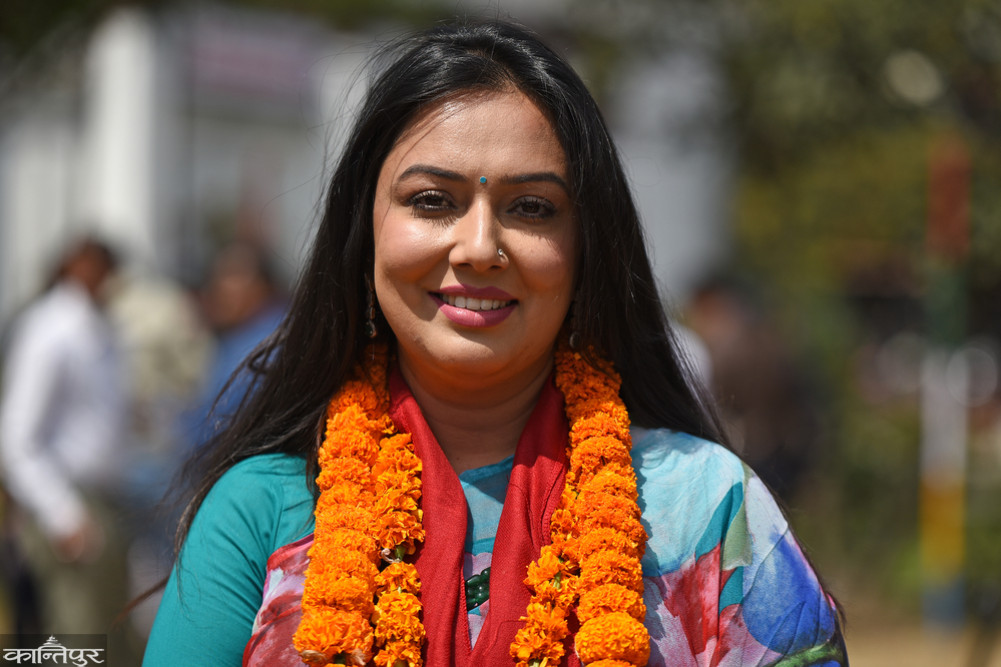
Many keep asking him, ”Why, as a new generation politician, do you have a retrograde agenda?”
We use Google Cloud Translation Services. Google requires we provide the following disclaimer relating to use of this service:
This service may contain translations powered by Google. Google disclaims all warranties related to the translations, expressed or implied, including any warranties of accuracy, reliability, and any implied warranties of merchantability, fitness for a particular purpose, and noninfringement.
Seven years ago, Khushbu Oli from Jhapa had many opportunities when she returned home after completing her studies at Kingston University in the UK. With a degree from a prestigious university and experience working in a social organization, she could have worked for any international organization.
However, Khushbu thought of returning to her village and trying her hand at agriculture. In the old district headquarters of Jhapa, which is about 30 kilometers from her home in Surunga, most people were involved in agriculture. Sometimes they were not getting fertilizer on time, sometimes there was a lack of irrigation, and sometimes floods ruined the crops.
‘After I decided to do something in agriculture, I started working with an organization called Crop in India.’ For that, I chose a village near my home,' she recalls, 'I felt that without working with the farmers, their problems would not be understood, so I started working in the village.'
At that time, she also saw a serious problem among the farmers. With the increasing use of chemical fertilizers, farmers in the village were getting cancer. 'After learning that many of the farmers I met had cancer, I launched a campaign to use organic fertilizers,' she said. 'Since it is a border area, many Indians also come to Nepal to farm. Those who come like that would use fertilizers indiscriminately, which was affecting the fertility of the soil and even their lives.'
The local level and the government did not pay any attention to the suffering of the farmers. To the extent that sometimes hailstorms or insect infestations damaged the crops, the government agencies would not even collect data.
'Farmers were suffering everywhere. Even when the production was good, the produce was not getting any value,' Khushbu added, 'Then I thought, I should go to parliament to speak the voice of the farmers, I should reach a place where their voice would be heard.'
She had previously worked on the rehabilitation of people in the streets and prisons in Nepal. She also gained attention by organizing football tournaments for prisoners in prisons. She had received the 'AFC Dream Asia Award' twice for organizing 'Prison Football' tournaments in collaboration with the Nepal Football Association and the Asian Football Association.
'All that background made it easy for me to enter politics. I was told that I would intervene politically in things I understood,' she said.
Initially, she thought of pursuing politics independently. That is why she filed an independent candidacy in the 2079 BS elections in Jhapa Constituency No. 4, which is also her home. In that election, Oli got 5,010 votes, while UML's LP Sanwa Limbu won with 29,315 votes. Deuman Thebe of the Congress came second and Shambhu Dhakal of the Rashtriya Prajatantra Party (RPP) came third.
In the aftermath of the Gen-G movement, by the time the elections were held on 21 Falgun, she had already joined the Rashtriya Prajatantra Party (RPP). At that time, the leadership of Rajendra Lingden came to the RPP, so the message of generational transfer was also sent.
After joining the RPP, she actively participated in the monarchist movement on 15 Chaitra and other movements demanding the restoration of the monarchy. She also spoke to the international media to explain the party's agenda.
At a meeting held by the RPP in Balkhu in the last week of Chaitra 2081, she had shown constructive protest by listing the corruption committed by the Congress-UML-Maoist and other parties on her T-shirt. A photo of her participating in the protest wearing a T-shirt with the words 'Kand' written in the middle and 'Lalita Niwas', 'Wide Body', 'Sudan', 'Bhutan Refugee', 'Omni', 'Giribandhu', 'Sunkand' and others had gone viral on social media.
Khushbu, who had earlier filed her candidacy as an independent candidate from Jhapa-4, was placed by the RPP this time on the proportional representation side. Amidst the wave of the RPP, only Gyanendra Shahi of the RPP was elected directly, so the party got 4 seats through the proportional representation. After the party selected her as a special woman, Oli's parliamentary journey has been ensured.
However, many keep asking him, 'Why did you join a party that carries a backward agenda as a new generation politician?' Even UML Chairman KP Oli once criticized him on the same issue.
Oli, on the other hand, says that due to the problem of religious conversions seen when she visited a marginal village, she supported a party that carried the same agenda, thinking that the country should be a Hindu nation.
‘That village is a place with a large number of backward classes and the Santhal community, religious conversions are taking place there in many greedy ways,’ she said, ‘In such a situation, I felt that we should not go to a party that does not save religion, culture and history in the name of modernity.’
She says that she is of the opinion that a constitutional monarchy is necessary because she understands how foreign powers manipulate when there is a vacuum in the country. ‘The RPP is not an active, but a guardian monarchy,’ she said, ‘The RPP does not compromise with democracy, but we need a king as the guardian of the country.’
Khushbu is of the opinion that a ‘Hindu emperor’ is necessary to unify society, giving examples of kings in many countries of the world. ‘After the monarchy was abolished, society has never been unified, there is a lot of hatred and chaos,’ she told Kantipur. ‘I believe that to unite Nepal under a single identity, there must be a Hindu kingdom and a Hindu emperor is needed for that.’
Expressing her belief that the behavior of the world community will also be different when there is a king, she adds, ‘The monarchy is independent, not of any particular person.’ This is something related to the dignity of the country. We must also understand that being a king means that the world community will treat us differently.’