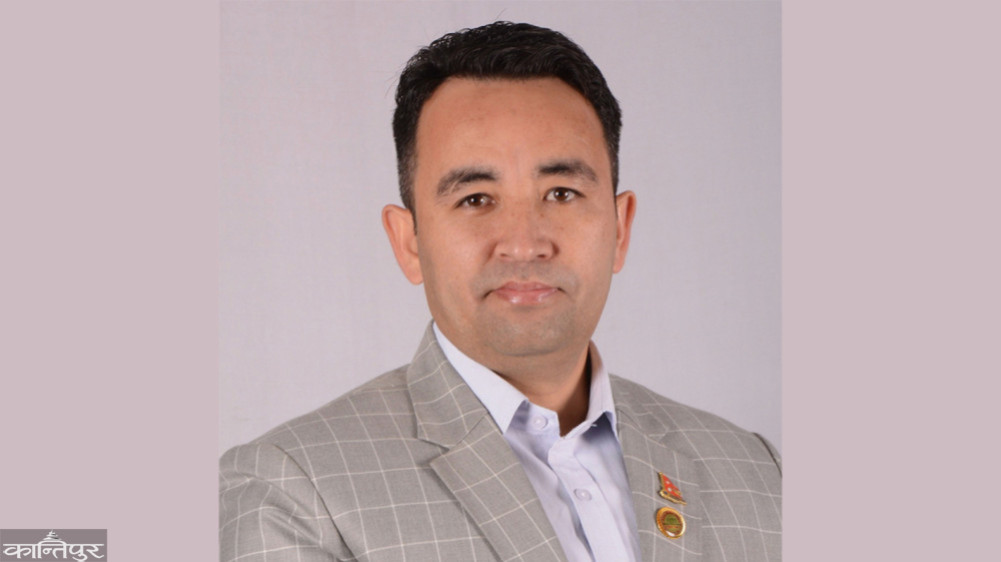
Ganesh Parajuli left active business and turned to politics after Ravi Lamichhane founded the party in 2022. According to him, he once had to pay a bribe while going to get a company's PAN number, and only then did he think he should work for good governance.
We use Google Cloud Translation Services. Google requires we provide the following disclaimer relating to use of this service:
This service may contain translations powered by Google. Google disclaims all warranties related to the translations, expressed or implied, including any warranties of accuracy, reliability, and any implied warranties of merchantability, fitness for a particular purpose, and noninfringement.
Before the silent period of the election on 21 Falgun, Kathmandu-7 candidate Ganesh Parajuli asked an elderly voter, ‘Do you know who the Ghanti MP is in this constituency?’
She said she did not know the candidate but said that she would vote for Ghanti (National Independent Party). Hearing that, she smiled and indicated that she was a representative of Ghanti.
Parajuli herself posted this video on social media on Facebook. When she introduced herself, the woman said that she had 30 votes and that all of them would go to ‘Ghanti’. Parajuli thanked her happily.
However, he was not so sure about his victory before the election. Despite having won the 2079 BS election by getting 8,743 votes, he understood that other parties had put all their efforts to defeat them from their previous victories.
He understood that it was easy for him to win because the parties did not take him seriously in the past. He understood that this time he would not be exempted.
UML was also preparing for that election, reviewing the difficulty of having a rebel candidate from its party, while Congress was also meeting with workers and running a separate campaign.
This is the same area where UML leader Madan Bhandari was once elected twice. Looking at the background of Kathmandu-7, after it was divided into 7 constituencies, different parties had won in the elections since 2051, so Parajuli was working hard.
However, the results of the vote on Friday evening came in Parajuli's favor. He won from Kathmandu-7 with 27,805 votes, while his closest rival Pramodahari Guragain of Congress got 3,982 votes.
He had already understood that a wave had come in his favor throughout Kathmandu on Friday morning. That is why, at the victory rally of the winning Rashtriya Swatantra Party candidate Ranju Darshan from Kathmandu-1, he said that everyone should present themselves responsibly to fulfill their responsibilities, saying that there was an ‘atmosphere from all over the country’. ‘Now there is no need to do anything for victory, the people have given responsibility to the shoulders of the new generation,’ he said, ‘The time has come to work intensively on how to fulfill the responsibility.’
Entering politics through entrepreneurship
Parajuli, whose permanent home is Khotang, entered politics through entrepreneurship. When Ravi Lamichhane opened the National Independent Party, he was running Himalayan Handicrafts Pvt. Ltd.
This company, which he started in 2002, exports fabrics and other materials produced from fiber raw materials such as jute, cotton, etc. in Nepal to foreign countries. He had also been exporting other handicrafts abroad.
However, after Ravi Lamichhane founded the party in 2022, he left active entrepreneurship and turned to politics. According to Parajuli, once he had to pay a bribe himself when he went to get a company's PAN number, and it was then that he thought he should work for good governance.
In the past, he had even raised his voice in major corruption cases including visit visas as an MP. 'I was born in Khotang in Koshi Province, it was very remote at first,' he says, 'I came to Kathmandu to become a teacher after completing my SLC there.'
He could not further his studies for various reasons, and becoming a teacher was out of the question. Instead, he later became an entrepreneur who provided employment to many. ‘Even now, the money I need to manage my family and myself comes from there, employment is just social service for me,’ says Parajuli.
This time, Parajuli had made his 15-point vision public, in which priority has been given to ensuring quality and modern education, sustainable and integrated water management, ecotourism, spiritual destinations and greenery park development, and green tourism development in the Shivpuri Nagarjuna area.
He had also announced the formation of an election regional volunteer think tank and the advancement of digital ward and citizen transparency systems. Labor rights, minimum wage assurance, and meaningful employment were also on his agenda.