Why has the movement of teachers and private school administrators started again? What is the meaning of this movement? Are their demands contrary to the principles of public education reform?
We use Google Cloud Translation Services. Google requires we provide the following disclaimer relating to use of this service:
This service may contain translations powered by Google. Google disclaims all warranties related to the translations, expressed or implied, including any warranties of accuracy, reliability, and any implied warranties of merchantability, fitness for a particular purpose, and noninfringement.
At the moment, teachers and private school administrators are protesting on the streets. Although the movement is different, at the center of both these movements is the school education bill passed by the Education and Health Committee of the House of Representatives.
Last March/May for 29 days When the Kathmandu-centered educational movement , the entire city was in chaos . The government concluded by saying that their demands will be addressed when drafting the bill. But now the situation is different . Why has the movement of teachers and private school administrators started again? What is the meaning of this movement? We have tried to explain these and similar questions through 5 questions and answers.
Why are teachers and administrators of private schools protesting?
The Nepal Teachers' Federation and private school owners have started a protest against the school education bill passed by the education and health committee of the House of Representatives. The teachers' federation has expressed its displeasure that prior consent was not included in the bill. To transfer teacher posts to the local level They have been disagreeing on various provisions of the bill including. They have also advanced the demand that 75 percent of the temporary teachers should be made permanent from within, permanent teachers should be promoted periodically. The owners of the private schools have started the movement by demanding that the private schools in the bill be gradually made non-profit and that 10 to 15 percent of the students be given full scholarships.
What is the government's response to their movement?
The government's response to both these protests has not been made public. The government may not have responded because the subject of both the protests is related to the bill and the matter falls under the jurisdiction of the parliament. The bill is yet to be discussed and passed in the House of Representatives and the National Assembly.
Is it possible to meet the demands of protesting teachers and private school administrators?
This bill was passed by the Parliament's Education, Health Committee with the consent of all parties. Teachers' federations and private school administrators have been trying to influence the law making through agitation. Which has also been criticized. The right to secondary education is provided by the constitution itself at the local level. But the teachers seem to be against this system too.
The constitution and the constitutional bench of the Supreme Court have already defined that education and health are not profit-making items. The bill does not mean that private schools will be made non-profit immediately. In the bill, the term "making it non-profitable" is mentioned . Stakeholders other than teachers have been demanding 100 percent open competition for the appointment of teachers in schools. This is also a complicated topic in itself . In the proposed bill, there is a provision to appoint 60 percent of teachers through internal competition and 40 percent through open competition. But the teachers said 75 percent internal and 25 open They have been demanding to be appointed through competition. Their demands are contrary to the principles of public education reform. 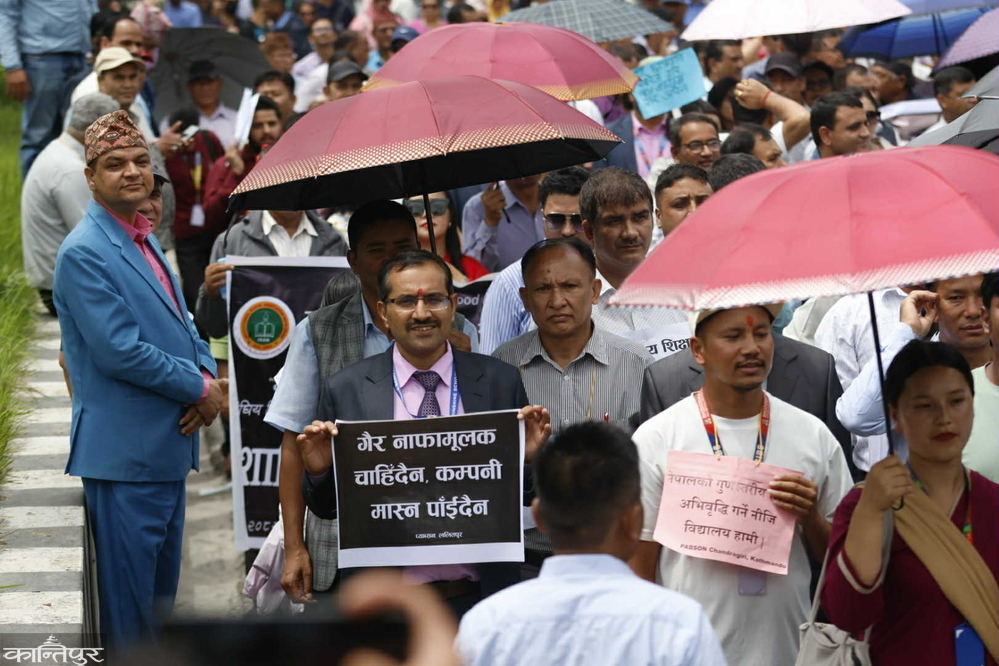
Both of these movements have affected teaching ?
So far, both the protests have been limited to the streets, so the teaching has not been affected . But teachers' federations and private school owners have been threatening to start a protest by stopping teaching. Earlier, the children were deprived of education when the teachers' federation went on an educational strike centered on Kathmandu for 29 days in March/May.
What can be done now ?
Parliament and parliamentarians should be given an environment to make laws freely and prudently . But by saying this, it does not mean that you cannot have a different opinion . It is also possible to make your demands through peaceful protest. But fulfilling your demands should not affect the rights of others. The warning of both protestors to close the school is against the constitutional right of children to get education . On the other hand, the government and parliamentarians should hear the disagreement. Rather than the choice of interest groups Stakeholders should pay attention to pass the bill by paying attention to the 7 million students and how to make the future education system of Nepal. Other news related to

