1.99 billion allocation for the implementation of the National Employment Promotion Program
We use Google Cloud Translation Services. Google requires we provide the following disclaimer relating to use of this service:
This service may contain translations powered by Google. Google disclaims all warranties related to the translations, expressed or implied, including any warranties of accuracy, reliability, and any implied warranties of merchantability, fitness for a particular purpose, and noninfringement.
The government has given priority to the youth, start-up, digital infrastructure and information technology sectors in the budget for the next financial year 2082/83. Finance Minister Bishnu Prasad Paudel presented the budget in the joint house of the Parliament on Thursday and announced the program with the declaration of producing 'job-giving youth, not job-seeking'. Arrangements from 'Incubation Center' to 'Digital Nomad Visa' targeted at Gen-G are included in the budget.
Saying 'no tax on startup business', Prime Minister KP Sharma Oli also promoted youth and information technology friendly programs through his social media page while the budget was being presented.
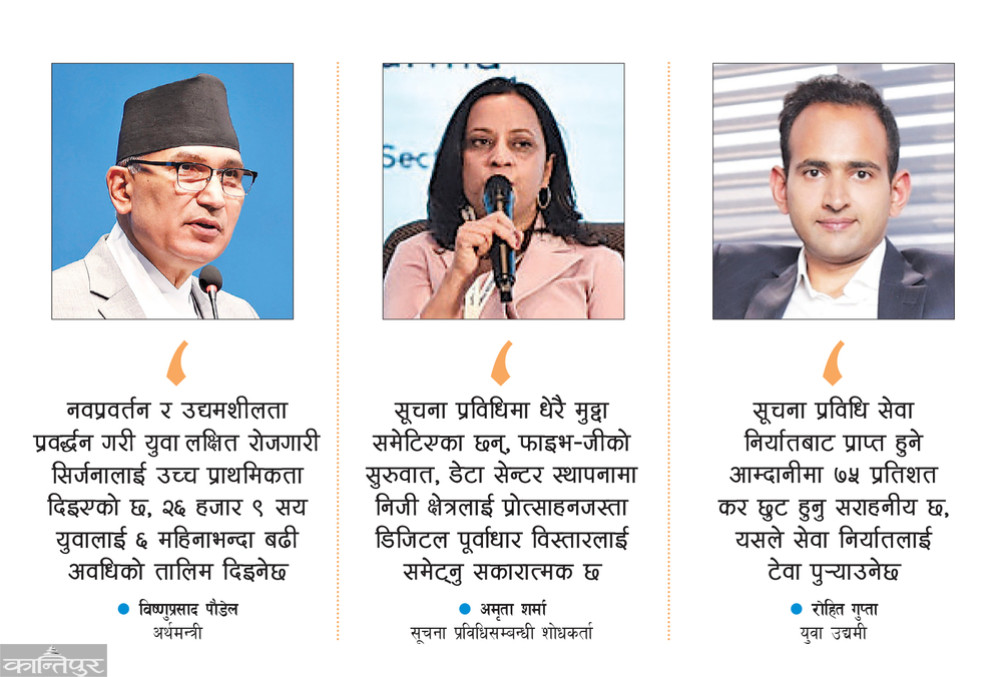
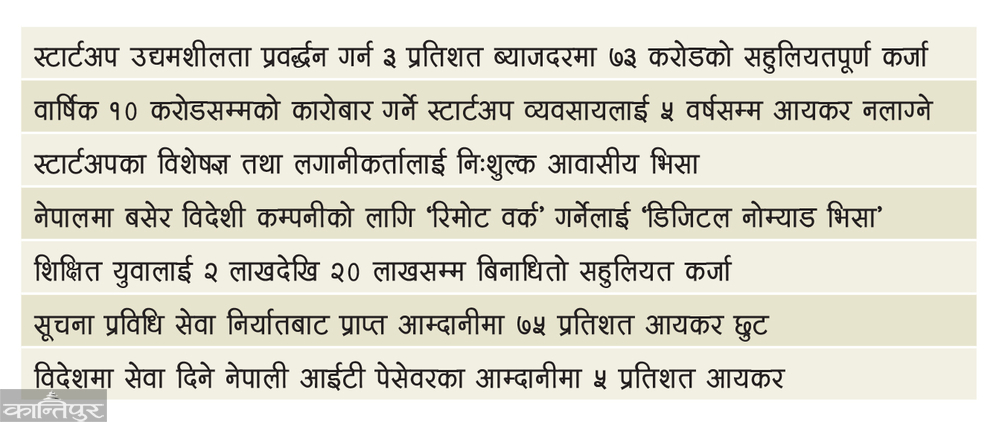
Finance Minister Paudel said that job creation aimed at youth has been given high priority by promoting innovation and entrepreneurship. To promote startup entrepreneurship, a concessional loan program of Rs 73 crore has been introduced at an interest rate of three percent. Incubation center targeting Gen-G generation, skill development, marketing, involvement in value chain and provision of unsecured subsidized loans from 2 lakh to 20 lakh rupees to educated youth are included in the budget.
"Next year, 26,900 youths will be provided with training for a period of more than 6 months from the Technical Education and Vocational Training Council," Minister Paudel said, "Young people who could not study higher education will be made entrepreneurs through skill-based training." I have allocated 1 billion 99 crores for the operation of the National Employment Promotion Program. Startup entrepreneurs have welcomed the system of not charging income tax for 5 years for startup businesses with an annual turnover of up to 100 crores.
The government claims that experts and investors working in start-up businesses will be provided free residential visas and 'Digital Nomad Visas' will be provided to people who live in Nepal and do 'remote work' for foreign companies. The High Level Economic Reforms Suggestion Commission, chaired by former Finance Secretary Rameshwar Khanal, also suggested the government to provide multiple entry visas with a validity of 5 years at a time to attract digital nomads. Currently, about two dozen countries in the world have started the Digital Nomad visa program.
Similarly, stakeholders and experts have also appreciated the arrangements included in the information technology sector in the next year's budget. Finance Minister Paudel said that 75 percent income tax exemption has been arranged for the income received from the export of information technology services.
It has been proposed that a total of 5 percent income tax will be levied on the income of IT professionals working abroad in Nepal and this tax will be final. Exemption has been provided to the IT industry as a special industry. Minister Paudel said, ``I have arranged for income tax and electricity tariff exemptions for information technology-based industries, hotels and resorts as special industries.
Nepali companies are now allowed to invest abroad and Nepali citizens can get 'sweat share' for providing technology or specific knowledge or services to foreign companies in the budget. A 'sweat share' is a share in a company or startup that is acquired on the basis of providing labour, skill, time or knowledge (sweat) without investing cash. When Nepali companies invest abroad, 50 percent of the profits generated there will have to be brought back to Nepal.
Similarly, data center establishment, preference for indigenous products in IT software and expansion of digital infrastructure are also included in the budget. The government has made a proposal through the budget to develop an 'ecosystem' for the information technology industry and make policy arrangements to promote the export of information technology services.
Information technology researcher Amrita Sharma says the budget, while balanced, needs more clarity and depth. "Many issues raised by the private sector regarding information technology have been covered," she said, "but it would have been better if it had been presented more clearly and strategically." However, she said, there is a need to pay attention to the implementation of such programs.
Sharma drew attention to the fact that the announcement of 'IT Hub' and 'IT Decade' was not included in this time's budget. "AI center has been talked about, but it is also incomplete, it is not enough by announcing," she says, "whatever programs there are, in the present complicated economic situation, if it is implemented, it will bring a lot of relief." She doubts that the IT sector will not get the desired direction if there is no clear strategy for skill development. "Though it is said to make the Gen-G generation entrepreneurial and professional, there is no program to connect with the global market," she pointed out.
Young entrepreneur Rohit Gupta also expresses doubts about the implementation of this budget, even though it is positive and gives hope to IT and youth. "The budget has a positive cover for the youth and the information technology sector," he responded. This will help export of services.' Pointing to some weaknesses in the budget, he complained that the reduction of personal income tax was not covered. "Industrial development strategy is also not seen, it shows the lack of long-term vision," he said.
Gupta welcomed proposals to develop AI and data centers in collaboration with the private sector. In the budget, it is said that the feasibility of setting up a data center in the Madhyapahari area will be studied to attract foreign investment in the information technology sector.
Finance Minister Paudel has allocated 74 crore rupees to build digital infrastructure and develop the ecosystem. Initial comments from experts are that it will make a negligible contribution to the expansion of digital infrastructure.