The fifth edition of Nari Masik, a co-publication of Kantipur Media Group, 'Nirbhik Nari', was completed in Kathmandu on Wednesday.
We use Google Cloud Translation Services. Google requires we provide the following disclaimer relating to use of this service:
This service may contain translations powered by Google. Google disclaims all warranties related to the translations, expressed or implied, including any warranties of accuracy, reliability, and any implied warranties of merchantability, fitness for a particular purpose, and noninfringement.
Stakeholders have said that although women are witnessing the transformation of all times, there are still invisible obstacles in society for them to move forward. A speaker participating in the fifth edition of the 'Nirbhik Nari: Nari Shakti in Leadership' interactive program organized by Nari Masik, a co-publication of Kantipur Media Group, said that the transformations and contributions made by women have not been included in history.
The main speaker of the program is Commissioner of National Human Rights Commission. Lily Thapa said that as history goes on, from the Lichchawi period to the time of the Republic, women have been witnesses of social transformation every time.
Yogamaya, who contributed strongly to the transformation of society, gave the example of Bhrikuti and said, "From the Lichchavi period to the time of the republic, women are the conductors of transformation, their history should not be left behind to be included and exposed in the history of the university." In the first session of the
program, the former urban development minister and leader of the Integrated Socialists, Ramkumari Jhankri said that she came into politics since she was a student to voice the discrimination against women in the society. He also says that during his time, violence and discrimination against women was taken for granted, oppression of women was established as a man's right.
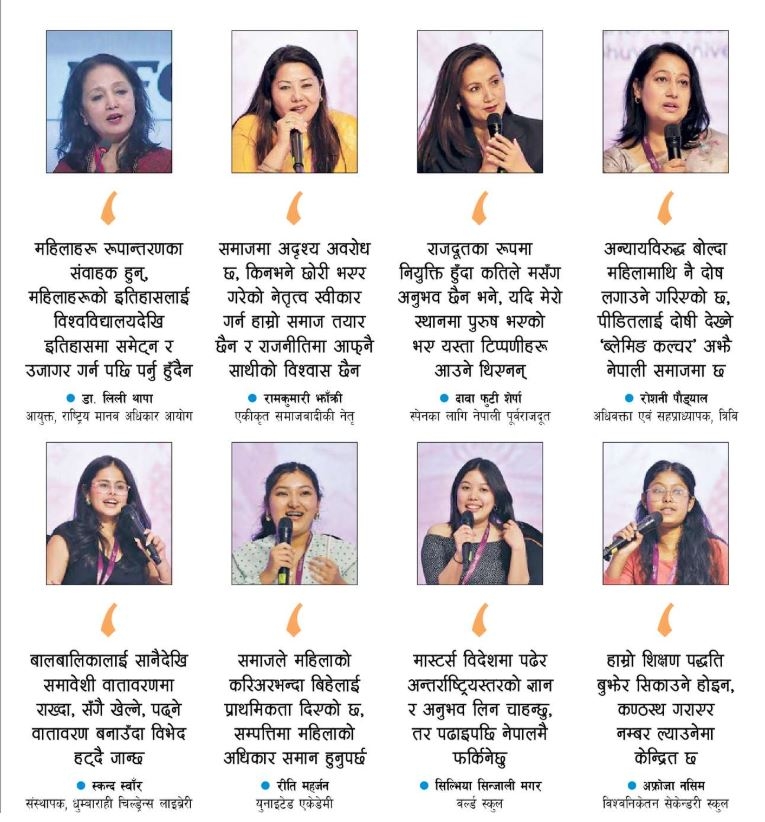
'There is an invisible barrier in society. Because our society is not ready to accept the leadership given by being a daughter and our friends do not have faith in politics,' she said, 'Now we have to wonder where the invisible barrier was. It was everywhere yesterday. It was in the family, society, party and the state.'' She said that even if a person with progressive ideas behaves consciously in this regard, there are invisible obstacles in every field. She said that such obstacles are produced by the society and the standards created by the society itself.
Jhankri said that even in the society of yesteryear, which accepted discrimination against women just because they were born as girls, there was discrimination and its form is changing nowadays. I'm calling disruption a social product. Because women are considered weak, have attitude, and are unable to work in the standard society," she says, "this involves changing our working style and structure. This should be accepted by the family and the society. If we can't change, there will be different forms of obstacles.' During the
program, Dawa Footi Sherpa, Nepal's former ambassador to Spain, said that when she was appointed as ambassador, she had to listen to various comments due to her lack of experience. "When I was appointed as ambassador, some people said that I had no experience," she said. If there was a man in my place, such comments would not have come.' She said that she was young when her mother Pasang Lhamu Sherpa climbed Mt.
'Mother never got to read. But his dream was big and he had to face many challenges for that," she says. "At that time, many people said that my mother was not a professional climber. But my mother challenged herself and succeeded in climbing Mt.
Advocate and associate professor of Tribhuvan University Roshni Paudyal said that the society is not ready to accept the opinion of women. She said that when women speak against the injustice done to them, the blame is placed on them. They do not accept that I have been wronged, or that I have this opinion on a matter. Not only in society, but in social media, women are shown to be guilty first before they find themselves in trouble,' said Paudyal. Even now the society is not ready to listen to my voice. The ``blaming culture'' of seeing the victim as guilty is still present in Nepali society.'
In terms of the constitution and laws, even though women's empowerment and gender equality have come a long way, ordinary women have to face invisible obstacles in the fight for their rights. Rozina Raut, head of training and development of Devyani International, said that the presence of women in leadership is not yet accepted and is difficult to digest. She also commented that there is still no trust in women. "The women who work with him, they will not believe that he is a manager. In my own experience, there were those who distrusted my work,' she says, 'I am working with 80 percent women. I have seen that the invisible barrier for women is the lack of belief and acceptance that they too can come to leadership.'
'Ghokante is not, practical education is needed'
In the second session of the fifth edition of 'Nirbhik Nari', the speaker emphasized on the reform of the current education system. Afroja Naseem, who recently gave her SEE from Viswaniketan Secondary School, questioned the current education system.
"Our teaching method is not about teaching by understanding, but focusing on memorizing and getting numbers," she said. Citing an example from a news story in India, she mentioned that a student with more than 50 certificates and dozens of medals did not get an internship opportunity. "Skills are more important than numbers," she said. He emphasized on giving priority to creative thinking and practical education in schools.
Riti Maharjan, a class 11 science student at United Academy, opined on gender discrimination and the impact of AI along with the quality of education. "Although AI has helped, it has reduced my thinking and creative abilities," she said. He said that society still prioritizes marriage over women's career. Narrating her experience, Reeti said, "Mother says, this is the life of us girls." But I'm saying it doesn't have to be.' She emphasized that women should have equal rights in property.
Sylvia Sinjali Magar, studying in class 11 at World School, expressed her desire to stay and work in Nepal. She is planning to study in Nepal for her graduation and go abroad for her master's degree, she said, "I want to get international level knowledge and experience by studying masters abroad, but I will return to Nepal after my studies." She was of the opinion that teenagers can compete internationally, are bolder than before and can express their opinions easily.
Dhumbarahi Children's Library founder Skanda Swar said that if children are kept in an inclusive environment from an early age, there will be no discrimination. Skanda, an A-level student at St Xavier's, has been running an open library for children every Saturday in Dhumbarahi for the past two years. “Children from different backgrounds come to my library. They read and play together. "When you include everyone from a young age, you neither discriminate against others, nor are you a victim of discrimination," she said.
'Difficult for women to come forward due to lack of opportunities'
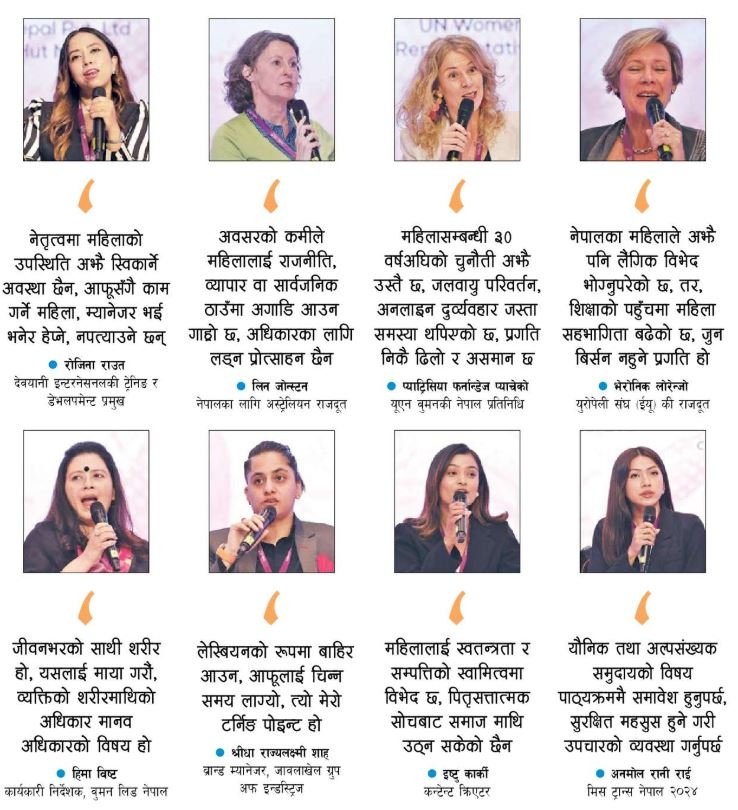
Female diplomats have said that it is difficult for women to come forward in politics, business and public sector due to lack of opportunities. In the third session of the program, 'Nepal through the eyes of diplomats', the Australian ambassador to Nepal, Lynne Johnston, said that lack of equal access to education in Nepal is a big challenge.
It is difficult for women to come forward in politics, business or public space due to the lack of opportunities. Women are not encouraged to fight for their rights due to low political participation," she said.
In the session conducted by former Miss Nepal series Khatiwada, United Nations Women (UN Women) Nepal representative Patricia Fernandez Pacheco said that child marriage, housework and low access to education did not allow women to come forward.
Village women spend 30 percent of the day fetching water. 90 percent of women are in informal jobs. Housekeeping has added to the burden on women. The challenges of 30 years ago are still the same," she said, adding problems like climate change and online abuse have been added. It cannot be said that there is no progress, but it is very slow and uneven.'
European Union (EU) Ambassador to Nepal Veronique Lorenzo says that women in Nepal still face gender discrimination. The women of Nepal come from the very bottom. They have experienced discrimination. Education is the foundation for women's progress. Women's participation in access to education has increased. Now the female students are studying very well, which is a progress that should not be forgotten,” she said. In the second phase of the
session, Ambassador Lin gave the example of Australia. In 1994, an Australian party fielded a woman candidate in a 35 percent win-win position, which has now increased women's participation in the Australian parliament to 50 percent, she said. He said that the 33 percent quota should be made more effective in Nepal as well.
She suggested that men and women should share the work equally at home. Véronique said the EU's global gender equality plan emphasizes violence reduction, economic freedom and political participation. In Nepal too, programs like 'Shakta Mahila, Prosperous Nepal' should work in these areas. He said that more needs to be done in Nepal to teach men about equality. Increasing participation in politics is like an engine. This is the engine that powers other women's issues forward. "Feminist men should be raised for women's empowerment," Veronique said.
In the third phase, Lynn praised all the programs from Australia to Nepal on gender equality. She appreciated the 50 percent women in scholarships and the strong performance of the local government under the leadership of a female mayor in Karnali, the policy of benefiting women in water resources and budget. Likewise, Veronique said that women's participation in the EU has benefited from pashmina, coffee, safe public spaces and green agriculture. Patricia informed that UN Women seeks to hold the media, private sector and political parties accountable for the inclusion of women during various crises.
'Let's love your body' In the fourth session of the
program 'My body, my choice', the executive director of Woman Lead Nepal Hima Bisht said that you should love your body. Your lifelong friend is this body. So let's love the body," she said. "The right to the body is a matter of human rights." Hima says that there is no culture that accepts her body.
'We have a moral belief that has made a standard that a woman's body should be like this. The same body is in one size standard in youth and in another standard in 30-40 years. But they don't understand that the body changes," she said.
She said that the topic of women having children is within her wishes. It is the will of a person to have children and not to have children. We had to accept that wish of others,' Hima said, 'As soon as we meet someone, we start commenting on their body, and then we say, 'Is he fat?' May I be fat or not fat.'
'Miss Trans Nepal 2024' winner Anmol Rani Rai stressed on the need to work at the policy level to treat women as equals and protect sexual and minority communities. She opined that the subject of sexuality and minority communities should be included in the curriculum. He also says that this community should be taught to respect and be free. "There should be good healthcare for them, where women and sexual minorities feel safe," said Anmol.
She recounted her experience of finding no one to help her understand her sexual identity. She also said that when there are few people who understand the issues of sexuality and minorities, they are using the wrong medicine to get out of 'gender dysmormia'. Some people think that trans men don't menstruate. But how many trans men menstruate? Therefore, there should be a safe place for them to receive the same kind of healthcare,' she said.
She said that there should be positive representation of sexual and minority communities in the media. I will not exist only in Pride Month. I also belong to this community at other times. We are asked insensitive questions even in interviews,' said Anmol.
Sridha Rajyalakshmi Shah, brand manager of Jawalakhel Group of Industries, felt that she should accept herself first. She said, "As an educated and professional woman, what I feel is to learn to accept myself." It took a long time to identify myself, to come out as a lesbian. I got to know myself after marriage. That became my turning point. It was difficult to come to the society but it was necessary.'
Ishtu Karki, a content creator who is a victim of trolls on social media, believes that the view of women is narrow. "In the name of religion and culture, limits have been set for women, that they can do this, that they can wear this or not," she said.
On the other hand, he says that daughters are also discriminated against in property ownership. "Women are discriminated against in terms of freedom and ownership of property, the society has not been able to rise up due to patriarchal thinking, women's clothing and freedom are discriminated against," she said.

