Capital market, government income and expenditure and the external sector of the economy improved at the end of 2081 compared to the end of March 2080.
We use Google Cloud Translation Services. Google requires we provide the following disclaimer relating to use of this service:
This service may contain translations powered by Google. Google disclaims all warranties related to the translations, expressed or implied, including any warranties of accuracy, reliability, and any implied warranties of merchantability, fitness for a particular purpose, and noninfringement.
Less than three months after the start of the new year, the coalition government formed by two major parties, Congress and UML, has not yet shown hope in politics even after nine months have passed. Enthusiasm for development, governance and legal reform has not been done. The two parties that announced the amendment of the constitution to strengthen the political system and federalism have not started their homework.
Even though the common people do not feel much in their daily life, most of the indicators of the economy have improved in the meantime.
External indicators including foreign exchange reserves, remittances, remittances, current account continued to strengthen throughout the year. Remittances and foreign exchange reserves have hit multiple records. Capital market, government finance i.e. government income (revenue) and expenditure and the external sector of the economy have seen improvement compared to the end of 2080. It is estimated that the growth rate of the gross domestic product (GDP), which indicates the overall economic situation, will be around the same as last year.
Remittance inflows are encouraging. According to the data of Rashtra Bank, the remittance inflow was 9 trillion 61 billion 22 crore rupees till the end of March 2080 and reached 10 trillion 51 billion 77 crore rupees by the end of March 2081. This resulted in record foreign exchange reserves. At the end of March 2080, foreign exchange reserves were 18 trillion 72 billion 82 million rupees, and by March 2081, they reached 24 trillion 8 billion 25 million rupees.
According to the National Bank, inflation has also remained within the limits. Inflation, which was 4.82 percent a year ago, was only 3.75 percent this year. The NEPSE index closed at 2025.70 in March 080 and closed at 2662.08 in mid-March 081.
The report submitted by the High Level Recommendation Commission chaired by former Finance Secretary Rameshwar Khanal to the Deputy Prime Minister and Finance Minister Bishnu Paudel on Friday has also mentioned that some indicators are positive. According to the report, the economic growth rate is slow but gradually increasing.
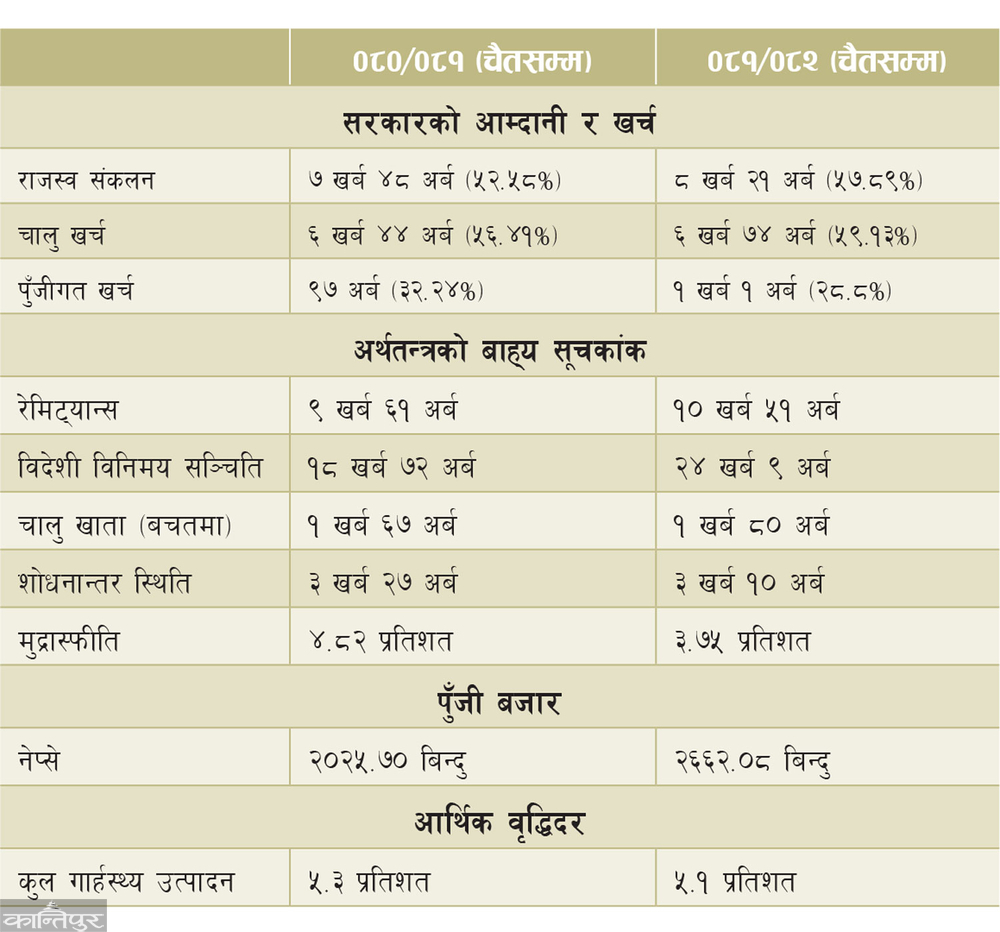
The Central Statistics Department has predicted that the country's gross domestic product (GDP) growth rate will be 5.1 percent until the second quarter of 2081. The previous year was 5.3 percent. However, on the other hand, industries operated at less than half capacity. The demand in the market could not increase. Despite the continuous reduction of interest rates, the demand for loans in banks and financial institutions did not increase. Throughout the year, the banks accumulated 5 to 6 billion loanable funds.
Former Vice Chairman of the National Planning Commission, Meen Bahadur Shrestha, says that in 2081, although the external indicators were positive among macroeconomic indicators, they could not benefit from them. Can we use positive indicators or not? Can we now or not? Liquidity has increased and interest rates have decreased due to savings.
If we can't use it, the economy should be considered shrinking,' he says, 'price growth is between 3 and 4 percent when it should be 5 percent. It is generally not bad. If our economy was running as it wanted, the current growth rate could be said to be very good.'
According to Shrestha, the demand has decreased due to the low purchasing power of consumers. Since they could not earn income, they had to live on savings. Citizens who have savings in cooperatives are not even able to get medical treatment. Consumption has decreased due to various reasons," he said. His conclusion is that the production capacity of industries is low, they are going abroad without getting jobs, and the investment of schools is shrinking is not showing a good sign.
Although the economic index shows an improvement compared to the previous year, the government's capital (development) expenditure, which is required to make the economy run, is higher in numbers this year, but lower in percentage. In the current fiscal year, the government has allocated 3 trillion 52 billion 354 million rupees for capital, so far the government has spent only 1 trillion 1 billion 495 million rupees, i.e. 28.8 percent. In the same period last year, 31.41 percent (Rs 94 billion 88 crore) was spent on capital expenditure.
Economists say that economic activity is expected to accelerate due to political stability when the major parties Congress and UML are in government, but that did not happen. According to them, when the government spends 1 rupee, the private sector spends at least 3 rupees. But since the government's expenditure is not significant, its effect has also been seen in the private sector. According to the National Bank's monthly report, domestic credit utilization has increased by 1.8 percent till February. Internal credit increased by 4 percent till February 2008.
Compared to the financial year 080/081 till the end of March, there has been an improvement in the revenue income till March of the current financial year. In the current fiscal year, the target of collecting 14 trillion 19 billion 33 million rupees in revenue has been raised only 8 trillion 21 billion 67 million 35 million (57.89) rupees till March. In the fiscal year 080/081, the target of revenue collection was 14 trillion 22 billion 54 billion 17 lakh rupees, but 7 trillion 48 billion 42 million rupees (52.58) was collected till March. Although revenue collection has increased this year, it is much less than the annual target.
For the current financial year, the government has allocated 11 trillion 40 billion 664 billion rupees, but 6 trillion 74 billion 49 billion rupees (59.13) have been spent till March. In 080/081, 11 trillion 41 billion 78 million 41 million rupees were allocated till mid March, 6 trillion 44 billion 2 million 54 million (56.41) rupees were spent.
Foreign grants and aid have also seen some improvement this year. As of March, the government has received 14 billion 260 million or 27.27 percent of the target of foreign subsidies. Until March of last year, the government had received foreign grants of 2.75 billion or only 5.52 percent of the target.
According to Rashtra Bank, the balance sheet is in surplus by 3 trillion 10 billion 27 million rupees till February. From July to February of the financial year 080/081, the balance was 3 trillion 27 billion 55 million rupees. From July to February of the current financial year, the current account is in surplus by 1 trillion 80 billion rupees. During the same period of the last financial year, the current account was in surplus by 1 trillion 67 billion 45 crore rupees. Every month since August 080 the current account has been in savings and the current account has been in savings since November 079.
In the report of the High Level Economic Reforms Suggestion Commission, it is mentioned that although the export of domestic tourism and tourism sector, energy production and export, export of services based on information technology is increasing, industrial production has continuously decreased for the past three years. The report also stated that the construction sector has shrunk and some businessmen who were running small and medium businesses have fled. According to the report, industrialists are facing a difficult situation.
Kalpana Khanal, a member of the high-level commission and a senior researcher at the Institute of Policy Research, said that there has been a good improvement in the indicators of the economy recently. According to him, there has been improvement in the economy due to various reasons such as the recommendations of the commission, the government's ordinance through various acts, amendments to laws, payment to construction professionals. "When the commission was formed, we suggested that it should be done immediately, its implementation also had a positive effect on the economy," she says, "The payment to the construction business is still pending, it should be given."
As liquidity is increasing in banks and financial institutions, Khanal said that if they can provide loans by encouraging production-oriented industries, there will be more positive effects on the economy. She emphasized that the government should implement it by mentioning that the report submitted by the commission recently suggested that it will be implemented in three phases, immediate, medium and long term.
Although the government has set a target of 6 percent economic growth in the current financial year, there is no possibility of achieving it. Experts estimate that economic growth will be around 4 and a half to 5 percent. The World Bank has projected economic growth of 5.1 percent and the Asian Development Bank of 4.4 percent. According to the National Statistics Office, the country's economic growth rate will be more than 5 percent in the second quarter of the financial year 2081/82.
In the previous three quarters, the economic growth rate was only 2.6, 3.1 and 4 percent respectively, the office has forecast that the gross domestic product (GDP) growth rate will be 5.1 percent in the second quarter (October-Pus) of this year. In the same period of the last financial year, the economic growth rate was 5.3 percent. According to the commission's report, the economic growth of more than 5 percent in the second quarter is due to improvements in the transportation and construction sectors, increase in agricultural production, electricity production and distribution, and improvements in the banking and insurance sectors.
Out of the 18 sectors of the economy, all have positive growth in this quarter. But compared to other sectors, the growth rate in education, housing and food and other service sectors is normal, which is why the growth rate of the economy is estimated to be 5.1 percent. The growth rate of the sector related to transportation and storage sector is the highest at 14.2 percent. The mining and quarrying sector emerged as the second fastest growing industrial sector with a growth rate of 9.5 percent. Following the industrial sector, the electricity and gas sector has a growth rate of 9.2 percent.