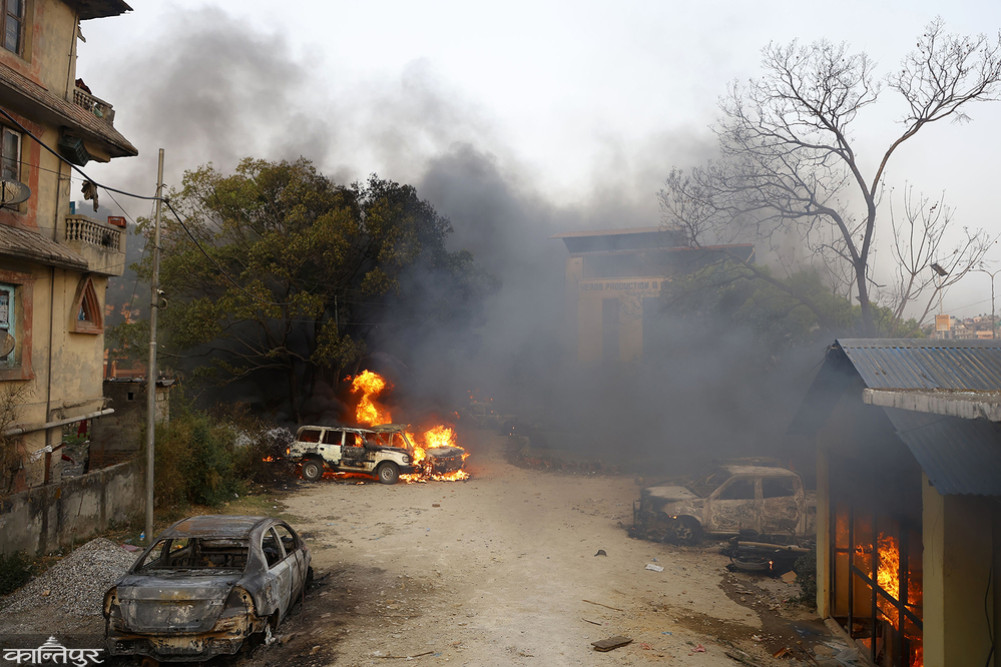
Demands of political parties, civil society leaders and jurists to form an inquiry commission to find out the truth of the incident and bring the investigation to the former king.
We use Google Cloud Translation Services. Google requires we provide the following disclaimer relating to use of this service:
This service may contain translations powered by Google. Google disclaims all warranties related to the translations, expressed or implied, including any warranties of accuracy, reliability, and any implied warranties of merchantability, fitness for a particular purpose, and noninfringement.
Prime Minister KP Sharma Oli on Monday confirmed in the Parliament that the main culprit of the violent incident in Tinkune was former King Gyanendra Shah. The meeting of the 12 pro-republican parties held at Singh Darbar on Sunday held the former King Shah as the main responsible for the incident.
Although Shah was found guilty by the government, even after four days of the incident, the government is not interested in forming a judicial commission or committee for investigation. Even in the cabinet meeting held on Monday evening, there was no discussion about the formation of the commission.
Leaders of political parties, leaders of civil society and experts in the law have insisted on the need to form a competent inquiry commission or committee to investigate Shah, saying that the decision and expression of political parties alone will not gain legitimacy. In Parliament on Monday, RSWP, RPP and JSP Nepal demanded that a judicial inquiry commission be formed for an independent investigation of the incident.
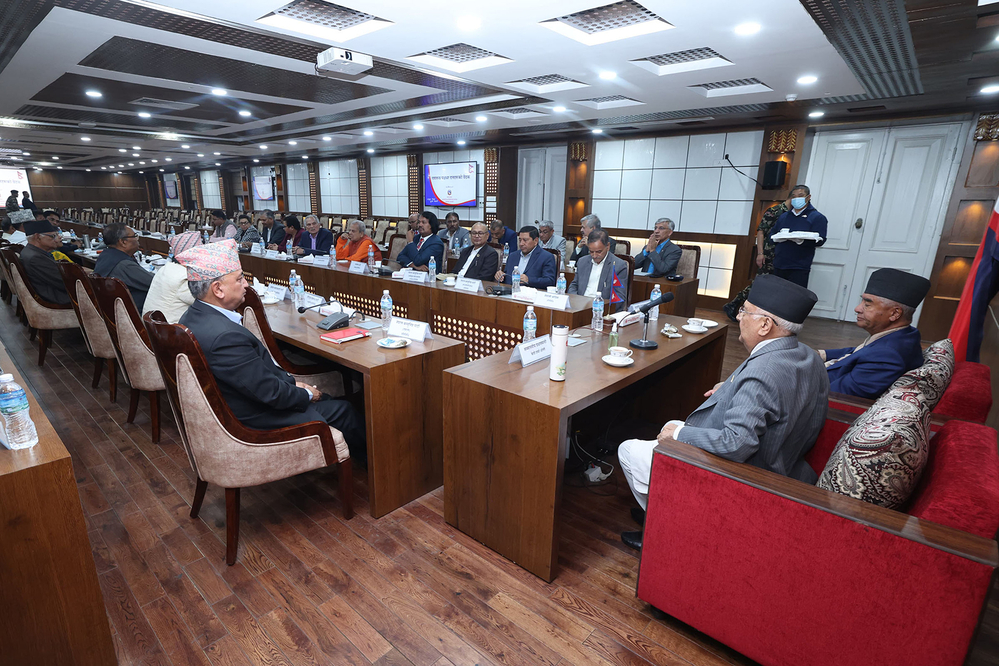 However, the government is not interested in forming a commission because it is a criminal incident and the state agency will investigate, arrest and prosecute the case according to the criminal administration.
A video of a young man being shot in the middle of the three-cornered road during the Rajawadi demonstration has been released on social media. Although it is claimed that the young policeman is Savin Maharjan, who was shot dead by the police, the police administration has not officially confirmed it. After the video came out, the demand for a judicial investigation of the incident has become stronger. A journalist Suresh Rajak who was inside the building was also killed when the Rajawadis set fire during the demonstration. In addition to dozens of injuries, public and private structures were vandalized, looted and set on fire.
Congress General Minister Gagan Thapa says that an inquiry commission or committee should be formed to increase credibility in the investigation and trial process conducted by the state and to prevent future misadventures by the former king against the republican system. On that day, there was chaos in the streets, and the perpetrators were identified as they came to the streets. They are being investigated. It will also be defined by the law," said Thapa, "We all know, the main instigator and planner of this is Poorvaraja. There is a similar conclusion within political parties such as Congress and UML. This conclusion may be political, but it needs to be fact-checked to legitimize it. That creates a legal basis to bring him under investigation.'
It is a practice of the government to form an inquiry committee in such cases even for legal grounds and documents. In accordance with the provisions of the Commission of Inquiry Act, 2026, the government formed a high-level commission of inquiry under the leadership of former High Court judge Shekhar Paudel in the incident in which two youths died in Balkumari, Lalitpur. In the same incident, the Ministry of Home Affairs also constituted a committee for internal investigation under the coordination of DIG Lalamani Acharya with the then Assistant Chief District Officer of Lalitpur Amardeep Sunuwar and SP Vasu Sigdel of the National Investigation Department as members.
Political analyst and professor Krishna Pokharel says that the government is not going to take action and make Shah responsible for the incident. It was not seen that they thought about forming a commission, taking statements and gathering facts and evidence to reach a conclusion. It was seen that they were trying to make Purvaraja defensive only," he said. "The circumstances show Gyanendra's involvement. However, it is not the government's intention to make Gyanendra make a statement. It was seen that he was just trying to build his political capital from this incident.' He says that investigating the former king through
judicial investigation will increase legitimacy and credibility. "Looking at the circumstantial evidence such as the expression of February 7, the movements of the royalists, it was Shah who started the matter. "It seems that the incident was inspired by his expression," he said, "It is more credible if it is verified not only by the generation of the political level, but by forming a commission." "This was not a political movement, it was a criminal incident, but no one is ready to bear the blame. We should investigate and bring out the truth," Pokharel said. He said that the government should not run away from the responsibility of establishing the commission and bringing the truth to the conclusion.
If a committee is formed under the Investigation Act, the committee has the right to investigate and arrest if necessary for statements. Home Minister Ramesh Akhtar says there is no need for a separate commission as investigation of criminal incidents is done by the criminal administration. Who was involved in the incident? Who had what role? He argues that there is no need for a separate commission as the police are investigating, arresting and prosecuting by bringing video and CCTV footage of which people were involved in which incident. "Rather than a separate commission or committee, the state agency works according to the criminal administration," he said.
Congress General Minister Thapa says that if there is a weakness in the state, the true picture of it should come out. There is a practice of forming an inquiry commission in the case of Bal Kumari. After such a big incident has happened and many questions have been raised, the need for it has been felt, Thapa said. It does well.'
Senior advocate Tikaram Bhattarai asserts that Purvaraja is a common citizen and on the basis of that, there is no obstacle on the basis of not forming a commission to bring him into regular legal proceedings. It is not that other citizens investigate when committing a crime, Gyanendra Shah does not investigate when committing a crime. "The government is not happy without bringing him under investigation," he said. Bhattarai says that since there is enough basis to confirm Shah's involvement, the police can bring it into the scope of investigation. Shah's physical presence is not seen in Three Kune, but his involvement in various stages of the crime is seen. Absence from the crime scene is not proof of innocence. Planned crime and abetted the commission of crime. Based on that, the government can bring him under investigation," he said.
Anubhav Bhattarai narrated the experience of forming an investigation committee in such incidents in Nepal without investigating the regular crimes, protecting those involved in the crime and preventing the incident. The judicial committee has a different subject. It should be investigated according to law. Whether there is fairness or not will be known after coming under investigation. Suspicion without being in the scope of investigation? "If citizens are investigated in other crimes, why don't the police investigate the case involving Gyanendra Shah?" he asked.