Only in Kalikot, Jumla, Humla, Mugu and Dolpa, 52 thousand 440 children have been found malnourished during the five years since 2076, while in Surkhet, Salyan, Rukum, Dailekh and Jajarkot, where the nutrition program has not been implemented, 26 thousand 442 children have been found malnourished.
We use Google Cloud Translation Services. Google requires we provide the following disclaimer relating to use of this service:
This service may contain translations powered by Google. Google disclaims all warranties related to the translations, expressed or implied, including any warranties of accuracy, reliability, and any implied warranties of merchantability, fitness for a particular purpose, and noninfringement.
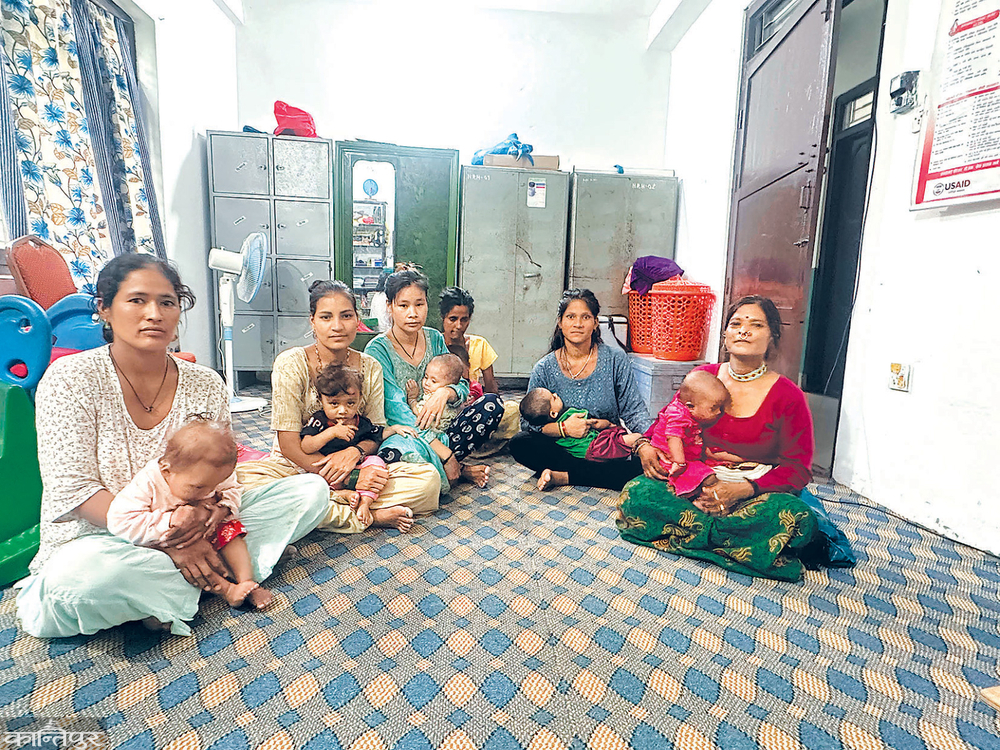
After her eight-month-old daughter's weight and height did not increase according to her age, Kalpana Sunar of Tajakot-3, Bachaud in Humla came to the Nutrition Rehabilitation Center in Surkhet. The doctor told her that because she did not eat junk food during her pregnancy, it affected her daughter.
Showing her eight-month-old daughter, Kalpana says, 'She weighs only 4 kg. So far, I have only received dirty flour twice from the health institution. There is nothing if you feed other dirty food at home.'
Sanni Triveni-3 of Calikot, Saraswati Devkota, also came to the nutrition improvement center this week for the treatment of her son. She has come to the center with her son before and alleges that the village health institution only gives enough powdered flour to acquaintances.
"Even if it is a day late to go to buy powdered flour, the staff reprimands for not having it, there is always a fight," she said. What is the cost of fearing that the person in whose name it came will not get it? We should have known that.
The government claims that it is sending dirty flour to villages to reduce malnutrition. But the poor people of the village have to rush to the hospital for treatment. Saraswati told that the community service health unit, which can only be reached after a 4-hour walk from home, has run out of free flour provided by the government before reaching Luyata.
Dolpobuddha Rural Municipality-1 Dhoki Nimalajum Bhote says that she got dirty flour only 6/7 times during the 17 months after delivery. He complains that he does not get enough flour every month. 'Sometimes they don't give because there are no employees, sometimes they say that the flour is not available because of the rain,' she laments, 'They don't give the flour that they didn't get during the holidays.' 1 billion 3 crore rupees have been spent in the period of 5 years till June. However, in the five districts of Karnali, Kalikot, Jumla, Humla, Mugu and Dolpa alone, 52,440 children have been found malnourished since 2076. In Surkhet, Salyan, Rukum, Dailekh and Jazarkot, where the
program is not implemented, 26,442 children are malnourished. In these districts, 'Balvita Program' is implemented. The program started from 2069/70 has been implemented in all local levels of Rukum West, Jajarkot, Dailekh, Salyan and Surkhet. Under this programme, children between the ages of 6 months and 23 months are fed nutritious Lito 'Balvita'.
In partnership with the Government of Nepal and the United Nations World Food Programme, the 'Mother and Child Health and Nutrition Program' has been implemented in 5 districts of Karnali Province. Apart from this, other programs are also implemented in the province.
However, the data of the Karnali Province Health Directorate says that in 5 years, malnutrition has been found in 23 thousand 869 children of the age group up to 11 months and 28 thousand 571 children of the age group of 12 to 23 months. The Ministry of Federal Affairs and General Administration of the Federal Government has spent 593.34 lakh 64 thousand rupees from 2077/78 to 080/81 only for the multi-sectoral nutrition program in Karnali.
Pediatrician Dr. working in Surkhet. Navraj KC comments that the state investment in reducing malnutrition rate in Karnali is not working. It seems that spending such a large amount of money has only benefited the companies that sell flour and the related agencies, but the children of poor families have not been able to benefit. It is evident in the data.'
He said that it is necessary to find out why the program costing 1 billion has not been able to reduce malnutrition. Dr. According to KC, the main problem in Karnali is lack of food and lack of awareness about malnutrition.
Here, child marriage and child labor due to childbearing are the main causes of malnutrition and extreme poverty of marginalized groups. Until this is addressed, nutrition will not be improved by distributing flour alone. Casey understands. He says, "In Karnali, the number of pregnant women at a young age is high, and children from another Dalit community are also malnourished."
Province Health Supply Management Center Surkhet spent 146 million 68 lakhs in the supply of powdered flour in 2079/80 and 80/81. Since then, no new tender has been conducted after receiving a complaint to the Abuse of Authority Investigation Commission that there were irregularities in the tender process. 40 million 36 lakh 76 thousand rupees have been spent on
distribution alone in 2076 to 5 years. But according to the data provided by the directorate, there is no reduction in the number of malnourished children. The number of malnourished children was 9,584 in 2076/77, and 9,469 in 2080/81.
The government has implemented this program in Karnali province since 2070 with the slogan 'healthy, happy and prosperous families, our concern is effective multi-sectoral nutrition services, people's rights'. As part of the program, under the mother and child health and nutrition program implemented in 148 health institutions in 5 districts of Karnali province, flour mixed with nutrition is distributed to pregnant women and infants from 6 to 23 months for nutritious food.
The program officer review of the Ministry of Social Development, Health Division, says that the nutritional status of children and women in Karnali is very poor. "There are a lot of problems such as obesity and stunting in children, malnutrition and anemia in adolescents and women," she said.
According to the data of the Health Office, about 1 thousand 39 metric tons of nutritious food has been distributed in Calikot in the last 5 years. This is more than other districts of Karnali. This flour is distributed from 73 health units here.
District Hospital Kalikot has claimed that 7,650 pregnant women and children have benefited from this program annually. However, information officer of Kalikot District Health Office Katak Mahat says that in Kalikot only 8 months of the year are available.
'Four not eaten for four months is not available again. Children do not get flour for four months. We don't know if the flour that is not sent to the district for four months is purchased/not. In Kalikot alone, 1,770 children were malnourished in 2077/78, while in 2080/81, 1,669 children were malnourished. In Jumla, Humla and Dolpa, the number of malnourished children has increased in a span of 5 years.
Parvati Singh, Vice President of Sanni Triveni Rural Municipality of Kalikot, says that pregnant women come to the municipality complaining of not getting enough flour. "When going to the health institution for follow-up, it seems that the pregnant women have prepared the documents that they have received the flour every month," she said. It looked like corruption by arranging documents.'
After receiving a complaint of corruption, the Abuse of Authority Investigation Commission, Surkhet Center is also investigating. "Since 2078, there have been complaints of irregularities in the purchase of flour, so we are investigating. Other things will be revealed," said an authority official.
Ramlal Devkota, head of Madana health center in Tajakot Rural Municipality of Humla, says that there will be no flour shipment from August to February. After the snowfall, the air services are closed, the roads are also blocked. Therefore, flour will not be distributed for 6 months. According to him, even though the government agencies and non-governmental organizations that are coordinating the distribution of flour show a large number of flour distributions in their areas, it is not actually found that the flour is distributed accordingly.
Karuna Bhattarai, Senior Public Health Officer of the Provincial Health Services Directorate, says that malnutrition has increased in Karnali due to poverty, child marriage, lack of food and sanitation. "Flour distribution should not only be done in the post-natal stage, we also need a program aimed at adolescents," she added, "After malnutrition appears in children, mothers do not agree to stay at the nutrition improvement center, they cannot come for follow-up." That is why the rate of malnutrition has not decreased.'
Mankumari Gurung, senior community nursing officer at the Directorate of Health, believes lack of awareness is the main cause of malnutrition. She says, "Despite not being able to fully breastfeed the baby, malnutrition is becoming terrible. 80 percent of the child's intellectual development should be completed by the age of 2 years, but in Karnali, if they are not fed supplementary food, children become victims of malnutrition and their physical and mental development is not sufficient. She said that due to lack of budget, the flour that should be provided every month had to be distributed 3/4 months apart.
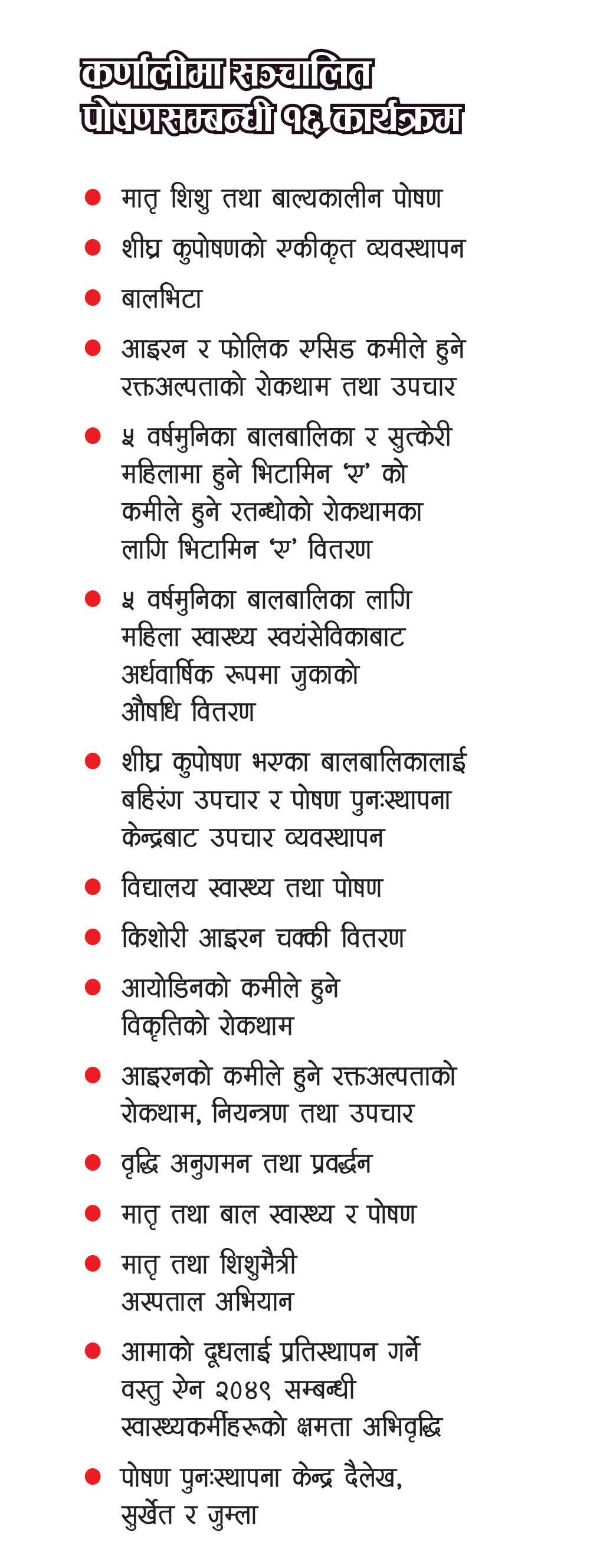
The government has conducted 16 programs in Karnali to prevent malnutrition. Nutritional rehabilitation centers are operating in Surkhet, Dailekh and Jumla. However, malnutrition is not being reduced. Public Health Dr. Aruna Upreti says that distributing flour in the urban slums of Karnali will not reduce malnutrition. "Nutrition is a development issue," she questioned, "Karnali government has not been able to make nutrition a big issue."
According to him, Balvita is useless. She says that it would be appropriate to give information on how to eat healthy food while emphasizing local products. "When Mugu was gone, I saw rotten flour being distributed," said Dr. Upreti says, "The situation is the same in all the remote districts of Karnali."
(For Investigative Journalism Center)

