According to the Nepal Demographic Health Survey 022 report, 25 percent of children under 5 years of age in Nepal have chronic malnutrition, while 28 percent of children in the far west are malnourished.
We use Google Cloud Translation Services. Google requires we provide the following disclaimer relating to use of this service:
This service may contain translations powered by Google. Google disclaims all warranties related to the translations, expressed or implied, including any warranties of accuracy, reliability, and any implied warranties of merchantability, fitness for a particular purpose, and noninfringement.
The Chief Minister of Far East Kamal Bahadur Shah issued a press release on August 3 and said that while preparing the budget for the current financial year, it was prepared on four bases according to "necessity and justification". 2
Keeping a budget plan with a ceiling of more than 5 lakhs, transferring funds to the local level in the form of a conditional plan if the budget is less than 2.5 lakhs, allocating the budget without targeting individual groups, firms, companies and not implementing any plan allocated from the state government through the consumer committee. were mentioned.
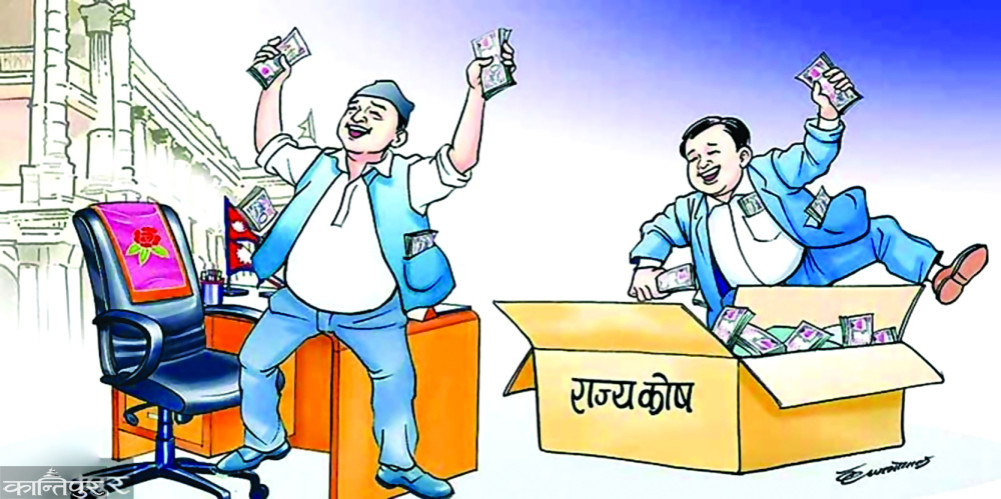
Two months late from the beginning of the financial year, on August 31, the government presented a budget of 31 billion 62 billion 98 lakh 28 thousand in the state assembly for 081/82, while in the annual development program, the government allocated the plan and budget by mixing the bases and commitments announced by itself. . Most of the schemes have a budget allocation of less than 25 lakhs. On the other hand, as the Chief Minister himself said, the MP is angry that the plan was not selected based on the needs and justifications of the state, but was chosen from the pockets of the beneficiaries. After the announcement of the budget, the reactions expressed by most of the people are similar. Their comments are, "Not on the basis of necessity and justification, the plans of the middlemen who have been manipulating the leaders, employees and the budget have been chosen." They complain that the ministers have allocated budget plans based on access to their respective areas.
ing is not the first time that the situation in the budget preparation of Far West has deteriorated. But the inconsistency that has been growing in the budget every year brought by the state government has continued this time as well. Targeting the people with access, the government has allocated more than 24 crores to Sasana Mandir. No tourism professional seems to agree about the contribution of allocating crores of money for the construction of such temples to the tourism development of the province. That budget is in addition to the budget allocated for the major tourist destinations of Badimalika, Khaptad, Ramaroshan, Vaidyanath and others.
In the 081/82 budget, the government has allocated 242,900,500 to 224 small temples with a budget ranging from 5 to 20 million across the state. In Kailali alone, 62 temples have been allocated more than 7 crores. 3 crores have been allocated for 28 small temples in Dhangadhi sub-metropolitan city alone. 3 crore 64 lakh in 34 temples in Bajang, 3 crore 35 lakh in 28 temples in Baitadi, 2 crore 81 lakh in 29 temples in Kanchanpur, 1 crore 96 lakh in 15 temples in Doti, 1 crore 86 lakh in 18 temples in Bajura, 1 crore 68 lakh in 16 temples in Darchula, 1 crore 12 lakhs have been allocated for 11 temples in Achham and 86 lakhs for 11 temples in Dadeldhura.
9.5 million budget has been allocated for 8 schemes of small temples in Dilasaini Rural Municipality of Baitadi. Among them, 45 lakhs has been allocated in four schemes in Ward 5. There has been strong opposition to the budget allocation for temples and other areas since the past because of investment in unproductive areas. Criticism has increased after repeating the same trend in the budget of the current year.
Everyone knows how the provincial budget is allocated. More than that, it would be more successful if funds were allocated for a larger scheme, which is essential in the same ward,' Santosh Prakash Joshi, a resident of Ward 5, said, 'This is a wrong practice.' Lobbying' has been found. During the preparation of the budget, the government asked directly elected MPs to recommend 40 million rupees and proportional MPs 20 million rupees. Most of the MPs had included the plans of the Sasana temple in their recommended plans. "After the MP sent a recommendation to allocate the budget to the temple, it was not cut," said Naveen Thapa, the personal secretary of the Minister of Industry, Tourism, Forestry and Environment -break According to tourism professionals, it is strange that the government spends crores of money to build a monastery in Toltol, contrary to the direction of tourism development determined by the master plan of the Far West government. Tourism businessman Padam Bahadur Singh, who is also the president of NATA Sudurpaschim, says that the budget plan is being distributed contrary to the master plan made by the state government itself. This budget is not different from previous budgets. Building a small monastery does not contribute to tourism development. This was done in a worker-oriented way,' Singh said. He says that it is not clear what kind of tourism is being developed by spending the budget in the monasteries of people's homes. It is not the first time that the temple has been allocated budget. In the annual program booklet of the previous five financial years, the plan of temples allocated on the basis of person-centered bhanusan was kept as now. The government of Sudurpaschim Province spent 16 crores to build 300 temples in 076/77, 24 crores to build 270 temples in 077/78, 19 crores for 250 temples in 078/79 and 23 crores to build 294 temples in 079/80. There is a record of allocation of crore 21 lakhs.
Not only the budget allocated to the temple under the Ministry of Industry, Tourism, Forestry and Environment, but also the nature of the budget and plan allocation of the Ministry of Physical Infrastructure Development, Land Management, Agriculture and Cooperatives and Ministry of Social Development, which is considered as the Ministry of Development. Before bringing the budget, the government itself said that, on the contrary, the budget of the Ministry of Development has been allocated to leaders, workers and individuals who have access to most of the plans.
In the budget of the current financial year, the Ministry of Land Management, Agriculture and Cooperatives has allocated the budget for 1,148 schemes. Out of them, 452 schemes have been kept at the rate of 5 lakhs. Similarly, 414 schemes have a budget of 1 million to 2 million. Most of the schemes have a budget of 10-12 lakhs. Most of the schemes under the Ministry have a budget of less than 20 lakhs in such schemes targeted at individuals.
Under the Ministry of Industry, Tourism, Forestry and Environment, the plan to be implemented by the Land and Watershed Management Offices has a plan to build an embankment with a budget of 5 to 2 million. It has been commented for a long time that budgeting for the embankment means that the allocation is aimed directly at the workers. This year also, 322.22 million budget has been allocated for 286 schemes of embankment construction. The government itself announced that the budget will be allocated in piecemeal plans.
The Ministry of Physical Infrastructure Development has made an even more unique allocation. There are many schemes in which 2.5 million budget has been allocated by keeping 8 schemes. In the Far West, there are the most irregularities in the planning of temples and embankments, and such plans are not based on the demands of the community, but it has been a tradition since the past to make the allocation of the budget to the relevant office and ministry employees, parliamentarians and ministers.
temple construction priority over nutrition improvement
Far West is a malnourished province. But the government has given priority to the construction of a monastery aimed at workers over nutrition.
According to the report of Nepal Demographic Health Survey 022, 25 percent of children under 5 years of age in Nepal are chronically malnourished, while 28 percent of children are malnourished in Sudurpaschim Province. In Bajura, which is also the worst in the Far West, the poverty rate is 48.8 percent in the last year's Smart Survey report. More than half of the children in Bajura have been found to have pudkopana.
In the case of child abuse in Nepal, it is 8 percent, while in Bajura, 7.6 percent of girls and 9.5 percent of boys are abused. Underweight children are 19 percent in Nepal and 14 percent in Far West. But in Bajura, 30.6 percent was found in the smart survey, according to the report. But in the budget brought by the state government, 18.5 million has been allocated to build 18 small monasteries in Bajura, while the budget for programs to reduce malnutrition is only 4.7 million. At an event attended by ministers including the Chief Minister, the participants on Thursday criticized the trend of choosing the budget plan. The participants of the inaugural event of the Enough program launched by World Vision International Nepal to improve the malnutrition situation in the Far West criticized the government saying that the temple construction plan was prioritized over the nutrition improvement program in the budget. They criticized the government for allocating 6.7 million budget for programs to reduce malnutrition from the provincial budget, but allocated 240 million more to the monastery.
The budget under all-round criticism
Sudurpaschim has already violated the legal provision that the provincial government should bring the budget on June 1 every year for the next financial year. In that, the MPs of the ruling party expressed their dissatisfaction saying that the trend of allocation of programs and plans on the basis of access and middlemen's behavior rather than the basis of local needs and justifications was repeated as in the past.
After the dissatisfaction of the ruling parliamentarian, the discussion on the budget could not be started, a parliamentarian said that a handshake situation arose between MP Diwansingh Bista and Social Development Minister Meghraj Khadka in the meeting of the Congress Parliamentary Party, the party leading the government. As directly elected MPs were asked to recommend schemes worth 4 crores, MP Bista recommended 8.4 lakhs for the school sector in his constituency. But the complaint that the Minister of Social Development had cut off all the funds was a bitter one.
During the preparation of the budget, there have been many new exercises in the Far West this year. Bringing the budget on June 1, the budget statement and program for the same financial year have been presented twice by different ministers in the state assembly. For two months after the beginning of the financial year, the entire provincial budget remained in the void. In that, the tradition of those who have access to the budget has been repeated. On June 1, Surendra Bahadur Pal, Minister of Economic Affairs of UML, Maoist Center and Government of Civil Liberties under the leadership of Galg Bahadur Sodari, submitted the budget in the state assembly.
The political equation of power changed in the middle of the discussion on the budget. The budget could not be passed. Then, on July 22, after the formation of the present government under the leadership of Kamal Bahadur Shah of the Congress, the UML and Civil Immunity were in partnership, and after withdrawing the budget presented on June 1, Bahadur Singh Thapa, who was the Minister of Economic Affairs from the Congress, brought another budget on August 31.
Sansas of the ruling party who participated in the discussion on the budget have complained about the budget and plan allocation. During the discussion on the budget in the state assembly, the chief whip of the ruling party Congress, Vikramsingh Dhami, said that he was saddened by the decision of the party to ban entry into the district in his home district, Darchula, regarding the budget plan. "There is a budget plan in my district. But the officials of the local level say that they do not know anything based on whose demand the plan was made," he said. "There is nothing to talk about in the budget. There is only anger. I am qualified to speak, even in the district, the party has banned me.'
Speaker Bhim Bahadur Bhandari symbolically expressed the intention that the parliamentarians of the ruling party had to support the process of passing the budget only under compulsion during the discussion before submitting it for decision. Santosh Kumari Sharma Thapa, the deputy leader of the ruling party UML parliamentary party expressed her dissatisfaction with the budget and said in a poetic style in the meeting, "We have seen the budget in a strange red book, how much pain sir, pain is in my heart."
UML's Bajhang MP Daman Bhandari expressed his displeasure with the budget saying that the earth is round and said, "You have to laugh with a stone on your heart." Chakra Bahadur Malla, chief whip of UML, said, "We have been killed by our own bulls," he said sarcastically. Another MP from UML, Dharmaraj Pathak's comment was not at all sharp. He said in a roundabout way, "Majhdhar me jab naiya dole to majhi par lagave, majhi jab nao bee to kaun bachae."
MP Khushiram Dagaura Tharu of another ruling party, Civil Liberation Party, said in the state assembly meeting, "There is pain in my heart." Fighting hard, but losing. When you fight for the people, the pain of defeat is great. After UML and Congress decided to allow only two MPs each to speak, some Congress MPs were even more angry that they were not allowed to speak. The heart is troubled, there is pain and crying. One of the Congress MPs said, "Even if I had been able to speak in the meeting, at least my mind would have been calm." Akkal Bahadur Rawal, the deputy leader of the main opposition party, the Maoist Center Parliamentary Party, commented that the budget was exciting. The MP from the ruling party expressed anger saying that the budget did not address the capital city.
Akkal Bahadur Rawal, the deputy leader of the main opposition party Maoist Center, says that the anger towards the state structure is gradually increasing due to the budget plan allocation of the state government. MP Rawal's anger is also about the imbalance in budget distribution. "Only in Kailali Kanchanpur, the budget has been drained. If this is the case, we need a separate state for the hills now," Rawal said, "Let Kailali Kanchanpur be a separate state. We are forced to speak.'
Economic Affairs Minister Thapa said that during the preparation of the budget, leaders of various parties and middlemen including activists came from the district and received information that the hotel in Dhangadhi was full. "If we find evidence that any budget plan has been allocated through the manipulation of middlemen, we will cancel such a plan," said Economic Affairs Minister Thapa. He said that they have made some positive efforts in the long-term development of the province.