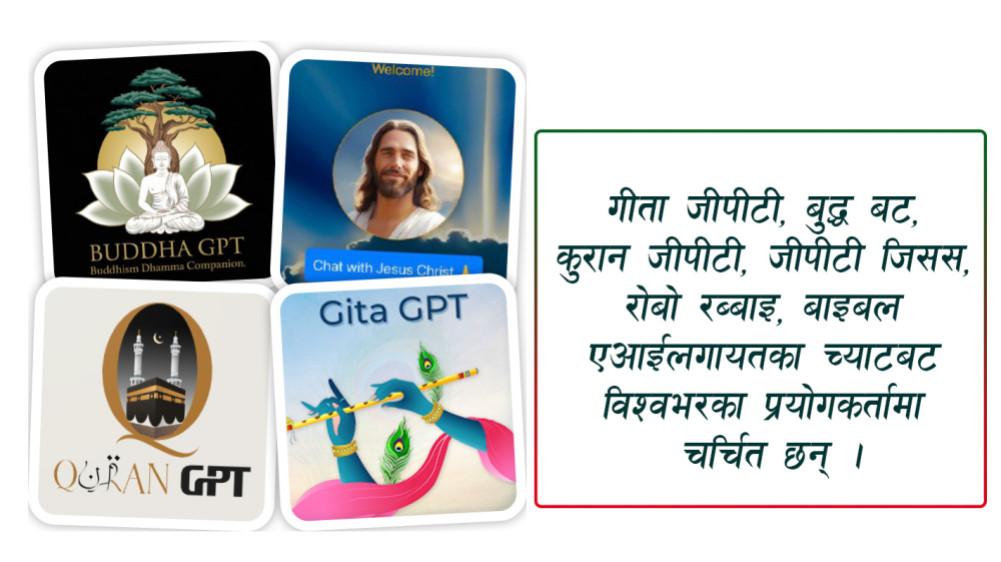
The popularity of 'God Chatbot' is increasing as 'God' himself answers the questions asked about faith, spirituality and religious practices. Gita GPT, Buddha Bot, Quran GPT, GPT Jesus, Robo Rabbi, Bible AI and other chatbots are popular among users worldwide.
We use Google Cloud Translation Services. Google requires we provide the following disclaimer relating to use of this service:
This service may contain translations powered by Google. Google disclaims all warranties related to the translations, expressed or implied, including any warranties of accuracy, reliability, and any implied warranties of merchantability, fitness for a particular purpose, and noninfringement.
The popularity of chatgpt is increasing as it provides accurate answers to the questions asked by the users. In recent times, religious texts, religious leaders and even gods and goddesses have been transformed into artificial intelligence (AI) technology.
For users, tools such as 'Gita GPT', built on a large language model like ChatGPT, 'Robo Rabbi', an AI version of Jewish religious leader Rabbi, and 'Buddha GPT', which identifies itself as a character representing Buddha's knowledge, are in the center of attraction. After the emergence of
image and video generative AI tools, it has become possible to create more in the same form as God wanted. Due to this, God's 'God Chatbot' created by AI is found on the internet. The most interesting topics that are being preferred by the users are the chatbots developed in the name of God and religious scriptures. In these chatbots, users can answer double questions with 'God'. Even if it's an AI, it's sure to be fun to get answers to the questions asked in the name of 'God Himself'. But unfortunately, some 'god chatbots' often crash (blocked) when many users try to run them at the same time.
In the early days (end of 2022) OpenAI's chatgpt also used to crash frequently due to heavy traffic (users). Due to this, OpenAI would also send a notification to 'wait for a moment' so that everyone could not run it at once. Now, ChatGPT has become capable enough to satisfy the curiosity of billions of users simultaneously.
Gita GPT developed by Vikas Sahu of India in Turbo GPT 3.5 technology is very manageable but it also crashes at times. In this, questions can be asked separately with Krishna, Radhakrishna, Yogeshwar, Dwarkadhish, Parthasarathy, Ganesha, Rama, Shiva, Buddha, Hanuman and Chanakya. A separate chat room with photos has been created for all Gods.
'When this website was launched in February last year, users from all over the world crashed after trying to run it,' Vikas told technology journalist Jas Antonio Lange for Emerge Newsportal, 'Such chatbots are very popular in India.' Available in 16 languages including Marathi, Bhojpuri.
20-year-old Rayan Khan, who lives in Calcutta, made 'Quran GPT' based on the holy book of the Muslim religion and launched it on the first day of Ramadan last year. After writing a post about it on LinkedIn at night, Ryan woke up seven hours later to find that his chatbot had crashed. Although there were many positive reactions to his post, some also made threatening comments. After
, Rayan took the chatbot offline, i.e. not visible to users, and later re-livened it. In a conversation with American science journalist Webb Wright, Ryan said AI will act as a bridge to connect humans with answers to their deepest spiritual questions. "There are people who want to be close to their religion but don't want to spend a lot of time to understand it," Ryan said.
Bible dot AI, Buddhabot, Bible GPT, Ask Quran, Hadith GPT are now found on the Internet by training thousands of series and editions of religious texts such as Gita GPT and Quran GPT. They identify subtle linguistic patterns within the text and respond to user queries in natural language processing. These chatbots synthesize spiritual knowledge within seconds.
God chatbots designed to satisfy users' curiosity about religious beliefs, spirituality and religious practices are not a new concept. Brent Richard Dixon has written on the Happy Future AI portal that first developed a god chatbot named 'Buddy Christ' in 2004. He recalled that the chatbot was made in such a way that religious questions were very irrelevant and answered when laughing.
According to him, the real God chatbot that responds according to the context of the user's question by making the AI trend in religious texts and sermons was developed by the Islamic Education and Research Academy in 2016. The organization developed a chatbot called 'Yuma', which was trended on Quran and Hadith texts and interacted with more than 100,000 people who wanted to know about the Muslim religion. According to
Dixon's article, in 2018, a Christian organization called World Challenge also created a chatbot called 'Savior Bot' to provide spiritual guidance and help to users. Recently, the world's biggest technology companies have entered into the competition of AI chatbot development. Most chatbots prefer not to answer religious questions, as some of the responses that AI technology provides are controversial. The Meta AI tool of Meta (Facebook) is an exception. Just last month, the tool provided by Meta to Indian users was discussed and criticized after telling jokes about Hindu, Christian, Muslim and other religions and gods.
In India Today, journalist Divyanshi Sharma has written in the news titled 'Meta AI is cracking jokes on Hindu Gods and Islam' with examples of what kind of jokes Meta AI tells about Hindu Gods. "When we texted Meta AI via WhatsApp asking it to tell us a joke about the Hindu God, it responded immediately," Sharma wrote. Because he was the only elephant there.'
Journalist Sharma mentioned that Meta AI has created various jokes about Prophet Mohammad, Jesus Christ, Lord Buddha. Before creating a joke, Meta AI calls it a 'respectful joke'. However, on God Some are criticizing for making
jokes. Google's Gemini and Microsoft's Co-Pilot chatbots were widely criticized after they started giving misleading answers about religious beliefs. Since then, these chatbots rarely answer questions related to religious beliefs. They don't even make jokes related to any religion. When a journalist inquired, Gemini responded, "Creating content that insults or insults any religious belief or person may hurt or offend many people."
Some religious people and theologians have also been opposed to mixing scriptures, religious sermons and sermons with AI technology. Ilia DeLeo, the head of the theology department at Villanova University in the US, criticized God chatbots developed as a 'shortcut to God' by combining religion with AI technology and considered it a matter of serious concern. In a conversation with journalist Webb Wright, Delia said, “Such techniques undermine the spiritual awareness traditionally gained through long-term study.” However, many religious communities around the world, and those interested in learning about different religions, are embracing many forms of AI use. .
(with agency help)