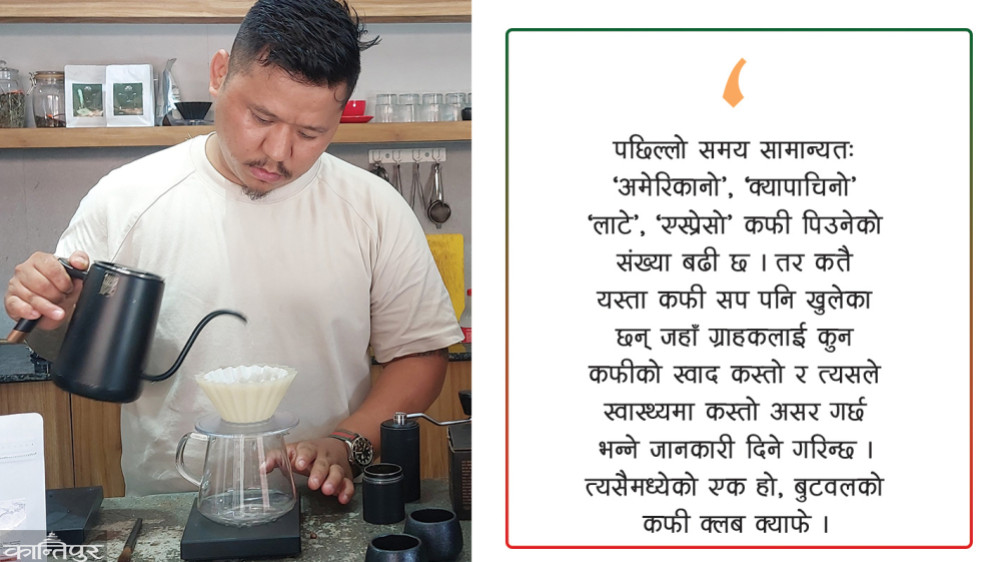
Lately, 'coffee culture' is flourishing in Butwal and its surroundings. Whether it's a campus student or a morning, afternoon and evening gaffe with friends, everyone is enjoying sipping coffee.
We use Google Cloud Translation Services. Google requires we provide the following disclaimer relating to use of this service:
This service may contain translations powered by Google. Google disclaims all warranties related to the translations, expressed or implied, including any warranties of accuracy, reliability, and any implied warranties of merchantability, fitness for a particular purpose, and noninfringement.
It is said that once upon a time the people of Butwal were addicted to 'tea'. It was common to get together occasionally to drink tea in groups and gossip for hours. But the tradition of drinking tea is changing now. At this time, the youth group has started drinking coffee.
Lately, 'coffee culture' is flourishing in and around Butwal. Whether it's a campus student or a morning, afternoon and evening hangout with friends, everyone is enjoying sipping coffee.
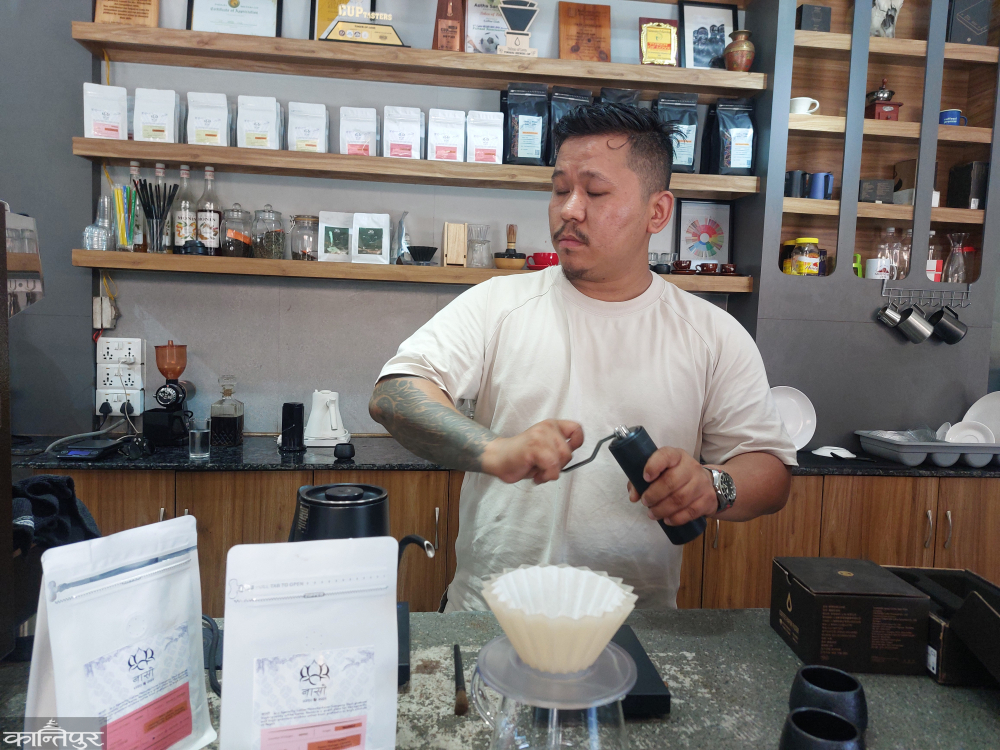
However, the number of people who discover the taste and flavor of coffee and demand that flavor is still less. Nowadays, the number of coffee drinkers are usually 'Americano', 'Cappuccino', 'Latte', 'Espresso'. In the meantime, some such coffee shops have opened here where customers are given information about the taste of coffee and how it affects health. One such is the Coffee Club Cafe at Highway Crossroads in Butwal. Founded in 2015, the owner of the coffee club is Purna (Napu) Gurung. He is also busy making and tasting special coffee for customers, branding the coffee and experimenting and studying how to create new flavors.
 Poorna initially made and sold ordinary coffee. But since three years, the trend of his coffee making, tasting and doing business is different. "Now I work to make a new flavor every time I make a cup of coffee," he said The tradition of demanding has not settled yet. Purna sells them by giving information about the flavors they have made. He said that he is getting good response from the customers after drinking this coffee. "After that, the trend of customers coming to the club increased," he said. Although
is a coffee club, his shop is equally crowded with tea connoisseurs. He is making and selling hibiscus (bell) flower tea. They dry the bell flower and immerse it in water for 24 hours, the next day they put ice in the same water and give it to the customer to drink. 'This tea is hibiscus ice tea,' he said, 'which has become the favorite choice of tea connoisseurs.'
 He was born in Butwal-7, Deepnagar in a family of followers of Gautama Buddha. Therefore, as soon as he left, he became a monk and lived in a monastery. "I loved that ritual," he said. After going to Kathmandu to study 'Plus Two', he worked as a waiter for some time. After reaching Pokhara, he worked in the British camp in Pokhara in 2064. He started studying as an overseer along with work but did not complete his studies. After some time, he dreamed of going to Japan and doing business there. Fate did not favor that.
In the meantime, after getting married, he thought of doing something himself. He bought it when he found out that the shop where he used to drink coffee was on sale. "I got into this business after seeing the coffee craze among the young generation," he said. is in his shop. Until now, he is making coffee produced in Nepal as his business brand. Gulmi to him,
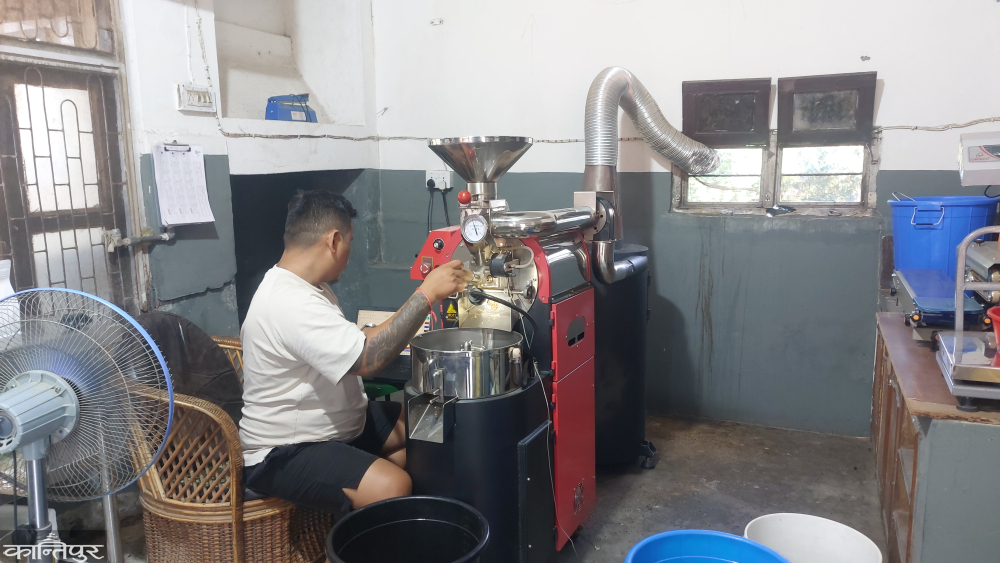
Coffee cherries come from Syangja, Palpa, Arghakhanchi. After roasting it in the coffee shop's roasting room, it is ground in front of the customer and served as a tasty coffee.
Poorna has completed sensory studies in Chitwan under Barista, Specialty Coffee Association while gathering knowledge. Now it is possible to find out the taste of the coffee, its quality and how long it has been stored. It also includes topics such as which farmer's farm it was brought from, how many products, what kind of coffee beans were produced, what flavors can be made. He says that the taste he is studying and developing belongs to the third wave in coffee culture around the world.
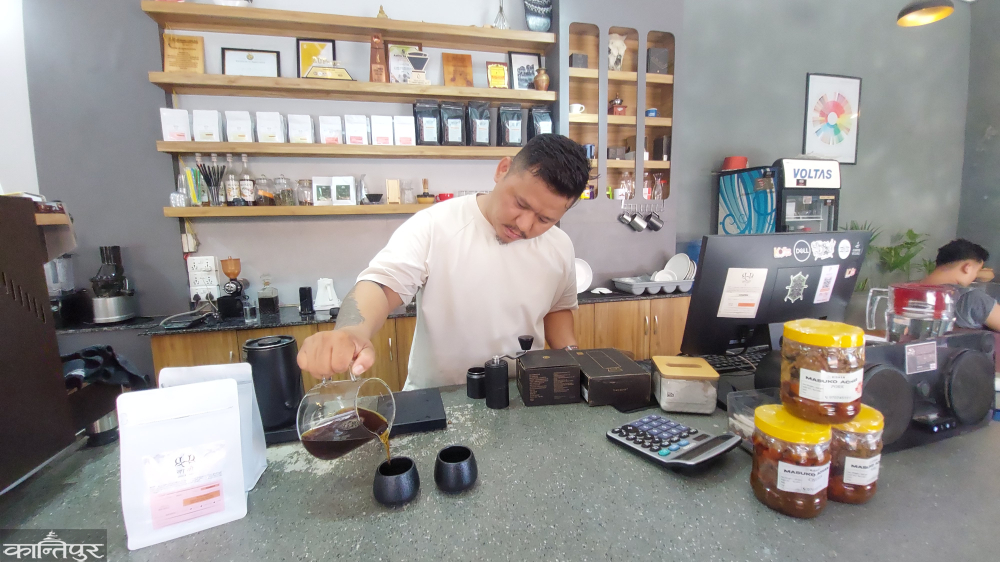
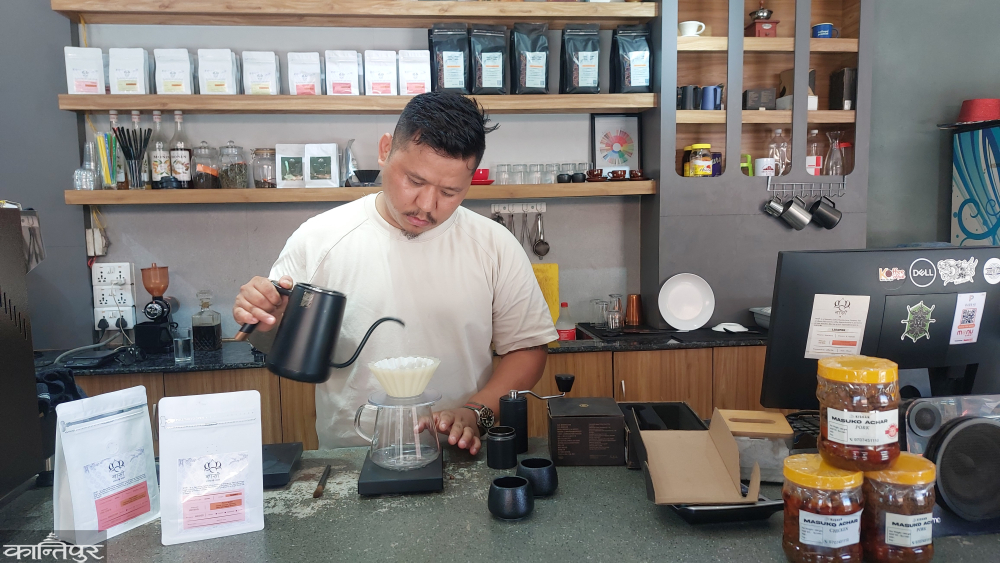 'The fifth wave of coffee is going on in the world,' he said, 'I am also slowly learning.' Although he did not go abroad to see and learn about it, he said that he also got some knowledge from a Nepali coffee maker living in Dubai. He said that he also got information about what kind of coffee culture can be established in the Nepali market. Ceramic cups are also popular in coffee club cafes where coffee is sold for Rs 90 to Rs 450 per cup. He said that ceramic cups are used because they help to retain the taste of zinc.
Recently, Prakash Thapa has been added as Purna's professional partner. He is also learning about coffee culture and flair with Purna. Along with this, Poorna also runs an institute for barista classes. The class is running in collaboration with Chitwan-based 'Coffee O Clock'. He said that most of the students who study there come to learn barista skills in order to go abroad for employment. His wife Chenusa Gurung is also helping him in the work.
 Poorna has also started coffee farming in Dumre, Palpa. He says that Nepali coffee (Arabica) can be established as a brand. "I have grown so fond of coffee that I want to read, find and taste the coffee produced in our country," he said He plans to help the local people in coffee cultivation and marketing in order to make it easier for them.