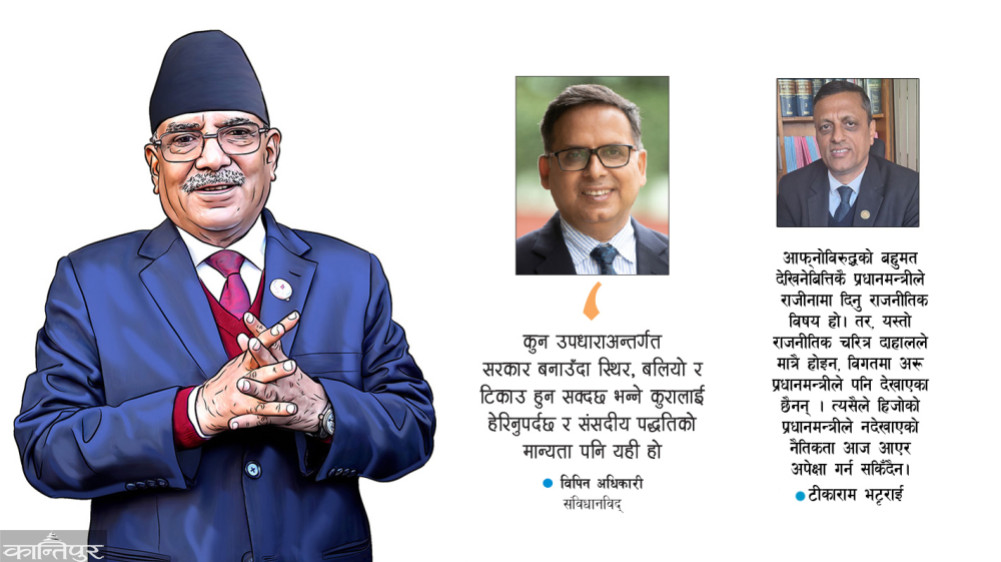
Dahal's plan to thwart the new equation by finding loopholes in the constitution, but constitutionalists say, ”There is no obstacle to forming a government according to Article 76 (2)”.
We use Google Cloud Translation Services. Google requires we provide the following disclaimer relating to use of this service:
This service may contain translations powered by Google. Google disclaims all warranties related to the translations, expressed or implied, including any warranties of accuracy, reliability, and any implied warranties of merchantability, fitness for a particular purpose, and noninfringement.
Prime Minister Pushpa Kamal Dahal, who is in the minority after the agreement of two major parties in the parliament to form a new equation with the blueprint for the formation of an alternative government, has decided to move forward under the constitutional facilities instead of choosing a natural exit of power.
Congress and UML leaders have suspected that Prime Minister Dahal is planning to thwart the new equation by entering into the holes of the constitution. The statements made by the Maoist leaders regarding the formation of the government have also strengthened that suspicion.
The Maoist leaders are putting forward the argument that the President cannot call for another government based on the same article as soon as the Prime Minister formed under Article 76 (3) of the Constitution does not receive a vote of confidence. According to the source, Prime Minister Dahal, while meeting President Ramchandra Paudel on Tuesday morning, drew attention to this. Sources say that the President has indicated that he will seek legal advice on the matter but has not given a clear answer. After that, the Maoist Secretariat meeting reached a decision to take a vote of confidence in the Parliament without the Prime Minister resigning.
Both UML president KP Sharma Oli and Congress president Sher Bahadur Deuba had asked Dahal to pave the way for a government of national consensus in separate meetings on Tuesday. Dahal replied that he would not resign to both the leaders but take a vote of confidence in the parliament. Instead, he proposed Deuba himself to run for the Prime Ministership. However, Congress leaders say that Deuba did not take Dahal's proposal seriously.
Congress leader Ramesh Akhtar said that even if Prime Minister Dahal tried to play with various excuses, it would not be possible. If you want to play without resigning, it is not possible. Congress won't be right/left with Monday's signing. It is under Article 76 (2) of the Constitution that the government is called by the President and from this Article UML President Oli becomes the Prime Minister, he said.
According to one of the leaders of UML, until the agreement was reached with the Congress, there was a great suspicion that Oli might call the government under Article 76(3) of the Constitution after replacing the Dahal government. According to that, Oli was suspicious that Congress president Deuba could become the prime minister as a large party. "It was signed only after being assured by the President," said one of the leaders of UML.
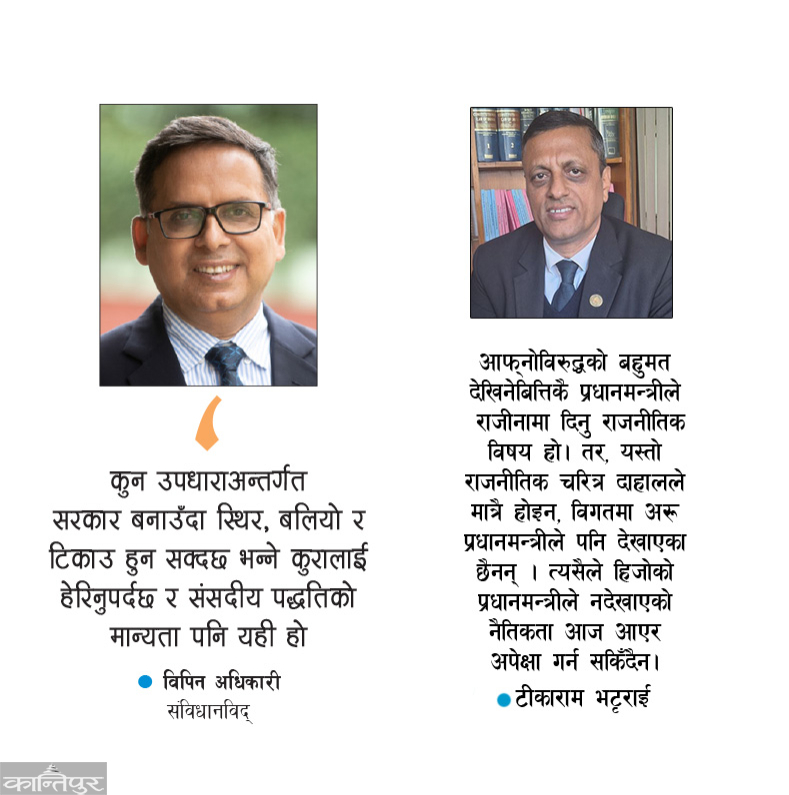 A Maoist official argued that the government formed in 76 (2) cannot be formed by the same clause as the government formed in accordance with the provisions of the Constitution and the example set by the Supreme Court in the case related to the dissolution of the House of Representatives. The leaders of Congress and UML are at stake whether Prime Minister Dahal Congress President Deuba can be fooled by putting forward this argument. Experts in constitutional affairs say that although it is natural that the Prime Minister takes a vote of confidence within 30 days, it is wrong to argue that the government formed under Article 76(2) cannot form another government after receiving a vote of confidence. Constitutionalist Bipin Adhikari and Tikaram Bhattarai both said that it is wrong to say that the Prime Minister cannot form a government on the basis of Article 76 (2) if he does not receive a vote of confidence. The Prime Minister says that there is a ulterior motive behind this argument without resigning despite the overwhelming majority of officials against him.
'Government is formed by using any of the clauses under Article 76. It has been used. It does not mean that the other has not been used. The main basis of government formation is not under which articles and sub-articles, but how the government will be stable, strong and durable, the president will call under that, he said. Do not go in the direction that should be done. This cannot be the purpose of the constitution. There is no basis for the President to form the government under Article 76 (3) of the Constitution. The option to go to 3 is only if the government is not formed after giving the option under Article 76 (2). If the government is formed under Article 76 (2), there is no need to go to (3).'
Another constitutionalist, Bhattarai said that the Prime Minister's decision to take a vote of confidence within 30 days should not be taken as unnatural, but the argument that the government will not be formed in Article 76(2) is not constitutional. Bhattarai says that the petition given by the then Chief Minister Kedar Karki claiming that once Article 168(5) has been used in Koshi state, another government cannot be formed from the same article, Bhattarai says that this argument is refuted by the Supreme Court.
It is a political matter for the Prime Minister to resign as soon as the majority against him is seen. However, not only Dahal, but also other Prime Ministers have not shown this kind of political character in the past. Therefore, the ethics that yesterday's Prime Minister did not show cannot be expected today. Taking the vote of confidence should be taken as a matter of course for the Prime Minister to attend the Parliament and answer the allegations made against him and to use the Parliament as an opportunity," said Bhattarai. "The argument that another government cannot be formed under Article 76 (2) after failing to take the vote of confidence is wrong. , not constitutional.'
He said that such an argument would be attracted only if the Prime Minister appointed under Article 76(2) could not take the vote of confidence within 30 days. Dahal has taken the vote of confidence within 30 days of becoming the Prime Minister for the first time on January 10, 2079. Even after that, he has received the vote of confidence many times. Therefore, it is not a constitutional question whether the government will be formed under Article 76(2) if the vote of confidence fails. The constitutionalist officer says that government formation is not like climbing a ladder as understood by political party leaders. There is an understanding that building a government means going from one to two, from two to three, from three to five like a ladder. It doesn't mean that you can climb the ladder but you can't go down. The main thing should be seen under which article the government can be stable, strong and durable and this is also the recognition of the parliamentary system.'
An official of the Congress said that he is in the final exercise to see if Congress President Deuba can be fooled with the support of various forces. "We understand that the Prime Minister is trying for a few days to see if we can support the Prime Minister by using this hole in the constitution," said the Congress official, "but the party president has clearly told the Prime Minister to be a 'Sari'."