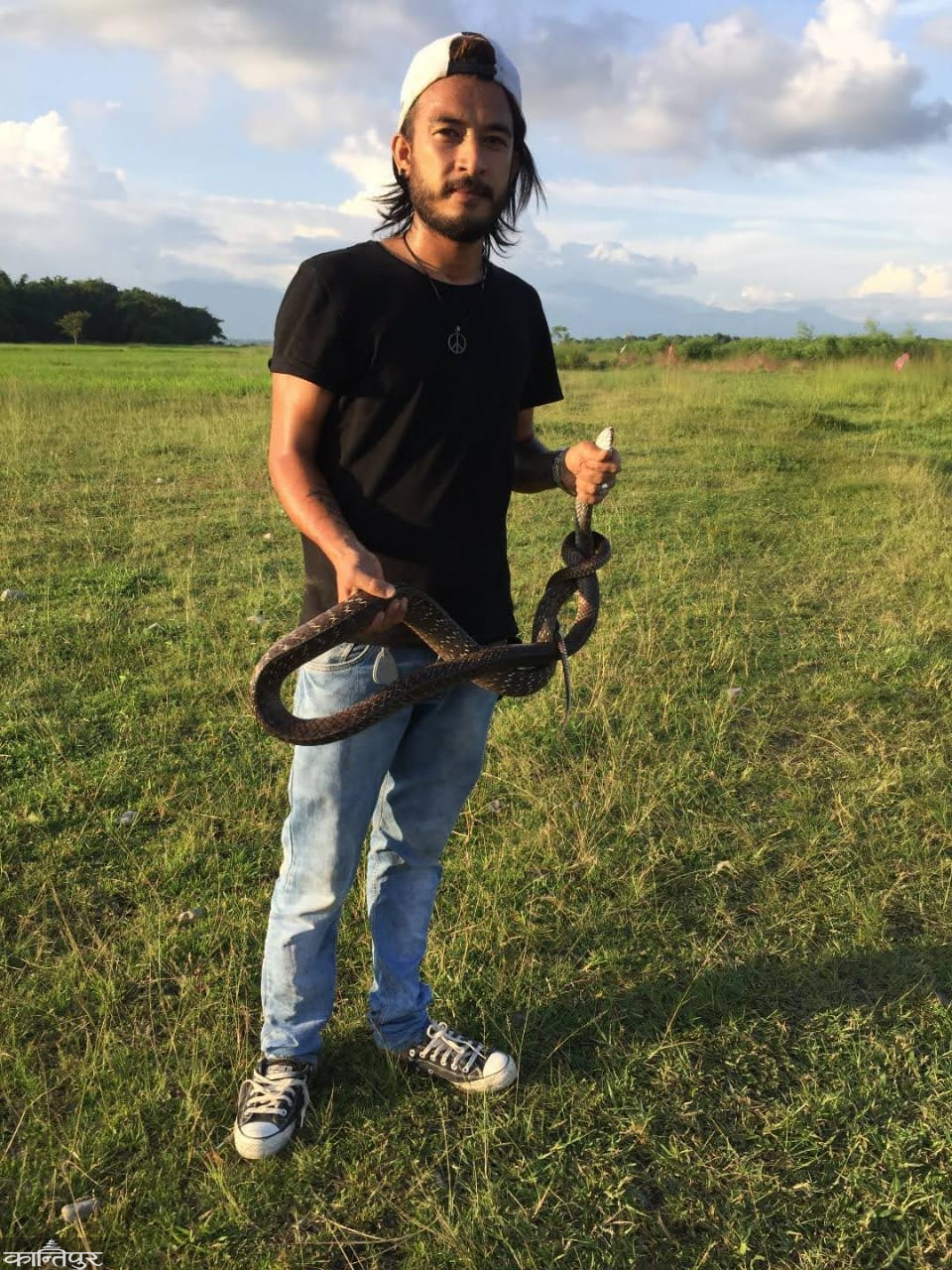
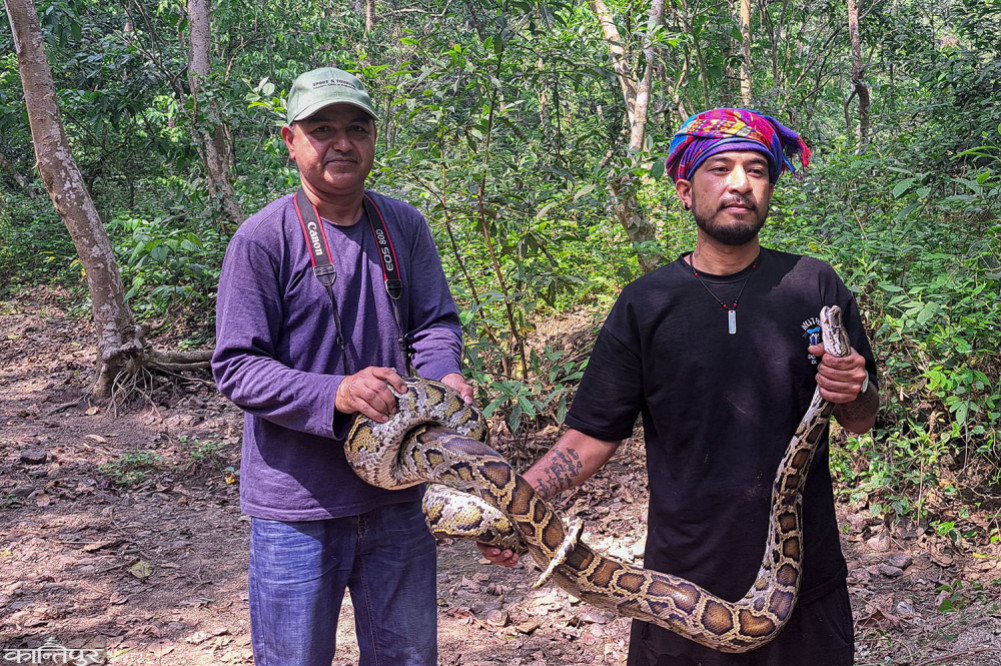
Prahlad Karki (Munna) of Jhapa is active in the rescue of snakes since he knows that snakes should not be killed, but should be loved. For 11 years, he catches hundreds of snakes that have entered human settlements and takes them to the forest or other safe places and releases them. He releases giant snakes into dense forests and non-venomous or less venomous ones into wetlands.
We use Google Cloud Translation Services. Google requires we provide the following disclaimer relating to use of this service:
This service may contain translations powered by Google. Google disclaims all warranties related to the translations, expressed or implied, including any warranties of accuracy, reliability, and any implied warranties of merchantability, fitness for a particular purpose, and noninfringement.
It is very hot in Jhapa, even the snakes are big. Conflict between humans and snakes is rampant. There are snakebite treatment centers at four places in the district. According to such centers, at least 10 people die from snake bites every year. Especially in summer, the conflict between humans and snakes increases. A little less in winter.
Pralhad Karki (Munna), a 32-year-old youth from the border town Mechinagar-6 Kakdavitta, is engaged in reducing this conflict. He has been a selfless activist for over a decade. In the past, it was customary to kill snakes as soon as they came to the village. However, after Munna's single effort, that thinking is gradually improving. Munna reaches the destination as soon as he gets the news of the snake. "If you arrive late, either a snake can kill you or a person can be bitten by a snake," Munna shared his experience, "that's why I will go as soon as I get the news." Munna, who was born in Kakdvitta, studied in Lalitpur, Kathmandu for grades 9 and 10. Jaulakhel Bird House was near Gyan Shikha High School. The zoo used to be very crowded for school field trips. Other classmates choose different animals in the zoo for study. To him fell reptiles, i.e. creatures that live both in water and on land.
In that too he chose a snake. From that time he became fascinated with snakes. The awareness that snakes should not be killed, should be loved. At the same time, we also got an opportunity to learn about the role of snakes in balancing our ecosystem. "That's when my love for snakes especially started," Munna said with a laugh, "later it became more intense." 20-year-olds dropped out of school and flew to Malaysia to earn. 14 years ago, he worked in Malaysia's Slama state. The area where he works is considered to be the 'capital' of snakes. He was happy because he had developed a fascination for snakes during his stay in Nepal. Munna learned that in that state, where dozens of giant snakes can be found, the Malaysian government teaches ways to prevent snakes from dying and sticks from breaking, with the main slogan of 'Live and Save'. After that, he repeatedly trained for a long time. He learned the trick of catching snakes at that time. Learn more about not killing snakes. After getting the
training, go on to understand the snake's movements. Learned ways to lure snakes. According to him, snakes can be caught after they are made to feel that they have come not to kill, but to save. "Otherwise he can attack," he said. Snakes resist when attacked by humans. As other creatures resist to save life. He says that biting, beating and beating the snake is fatal. "At the time of mating, snakes are aggressive like all animals, at that time it means to invite Kaal."
Munna's left hand was bitten by a snake once in the course of work. He was admitted to the treatment center in seven minutes. "I survived by getting treatment on time," he shares his experience, "Even with snakes, Tokiha will pay attention to treatment, don't waste time trying to find snakes." After spending 27 months in Malaysia, he almost did a "PhD" on snakes. He escaped after returning to Nepal after being caught up in the narcotics industry while he was in Malaysia.
After coming to Nepal, he has been active in catching snakes for 11 years and has been steadfast in his resolve. He is active in the protection of animals, both humans and snakes. Some people try to give money for catching snakes. However, he does not agree to take money immediately. "I did not choose this profession to earn money," he adds, "I chose it for service." Mahendra Katiyala of Pokhara passed away during the Covid period. He was the motivator of Munna. He said that a nationwide organization of youth active in snake rescue should be formed. However, he kept all the plans and passed.
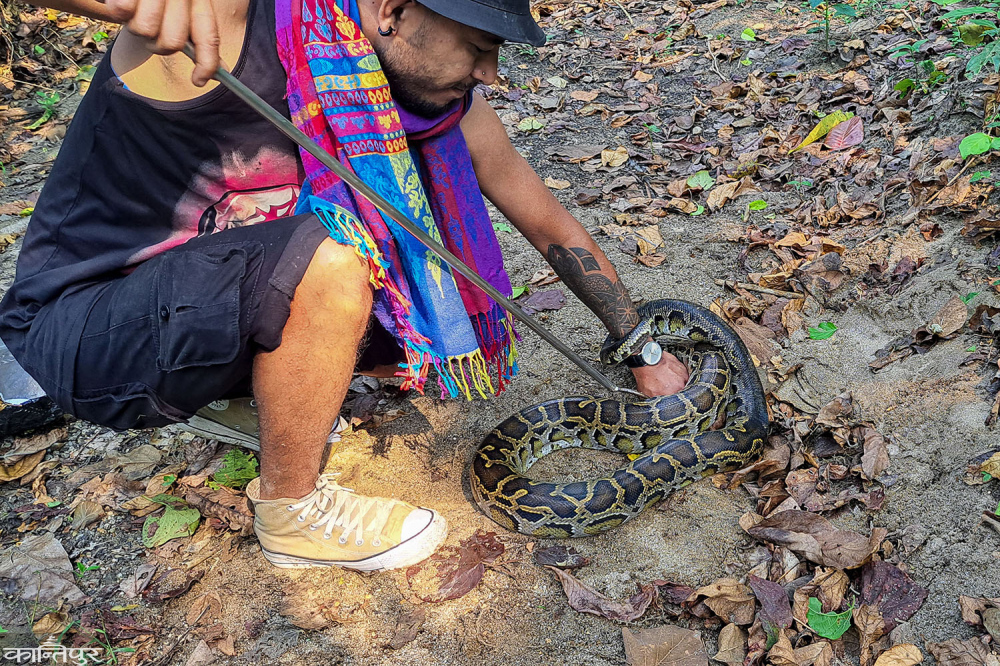 Dozens of snakes such as goman, dhaman, karet, bendet karet and others are found in Jhapa. He claims that some migratory snakes are also seen in the border area from time to time. "Sometimes we see snakes that are not compatible with our climate," he says, "those snakes cross the border and move around." According to him, the same way people migrate from one place to another. Similarly, snakes also migrate. Nepalese snakes can come to India and Indian snakes can come here.
Catching snakes is considered very risky. However, Munna is doing selfless work at the risk of his life. He doesn't even have enough tools to catch snakes. They are also holding with open hands. The risk is high. Requires globes. He doesn't have all that. With the help of his bare hands he catches the snake and takes it to a safe place towards the forest and releases it. Last month, two pythons were caught under his leadership and released in the border area. "Poisonous snakes are taken to dense forests and non-poisonous and less poisonous ones are released in areas such as seeps."
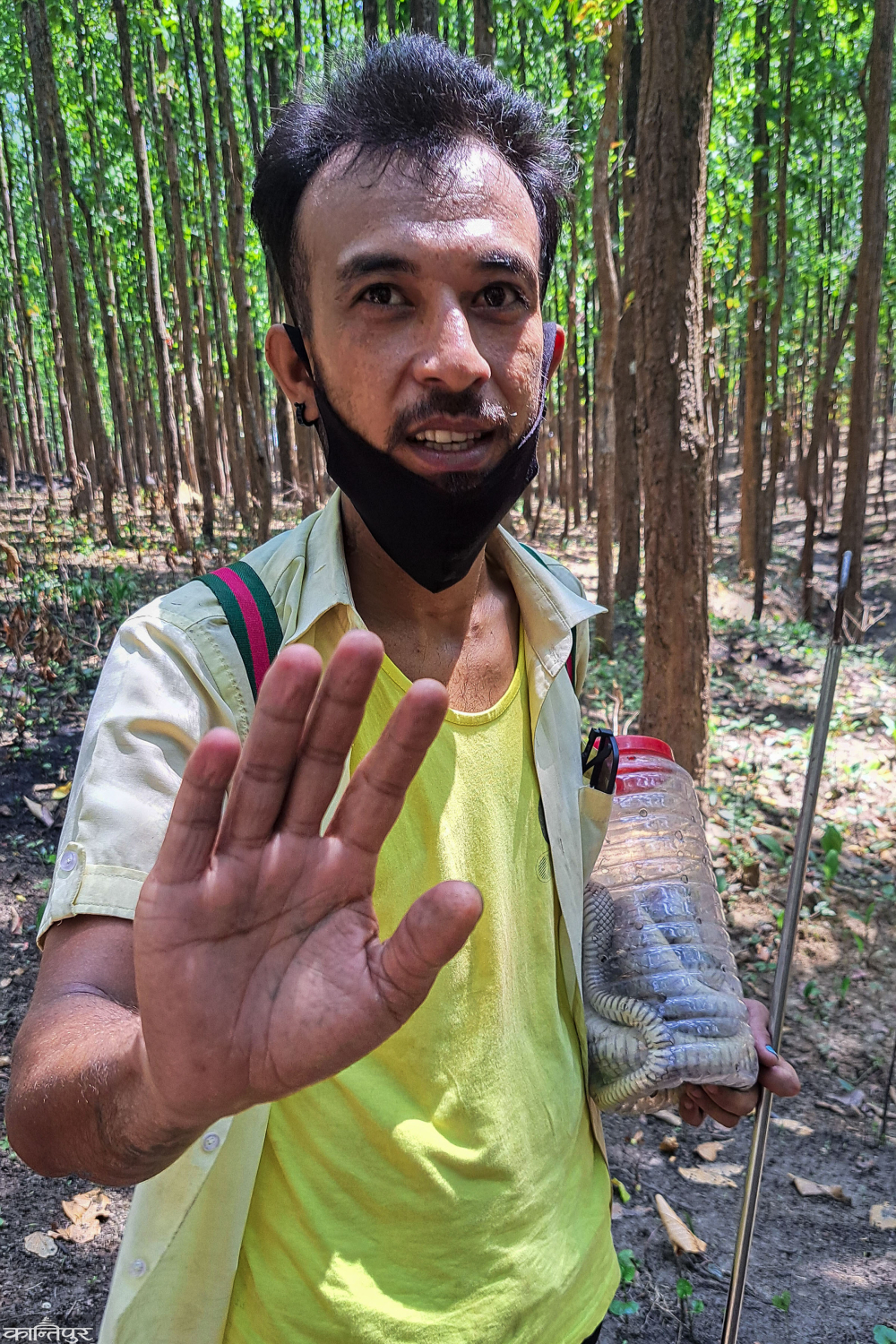 He had a graver, a snake cutter, and an iron dandy tongue to hold the snake. Now the graver is broken. The tongue is holding a snake. With the help of tongs, they put the snake caught in a black cloth bag and release it towards the forest. He has caught a lot of snakes in 11 years. He thinks that some snakes are helpers of farmers. It eats rodents and other things that get in the grain crops. Snakes are essential to nature. He says that the role of Goman snake will be great for the eco system. "If only this can be explained to people, snakes can be saved," Munna added, "and the conflict between people and snakes can also be reduced."