In the Jatra, not only the historical aspect, but also various tableaus were presented by satirizing the political and social situation
We use Google Cloud Translation Services. Google requires we provide the following disclaimer relating to use of this service:
This service may contain translations powered by Google. Google disclaims all warranties related to the translations, expressed or implied, including any warranties of accuracy, reliability, and any implied warranties of merchantability, fitness for a particular purpose, and noninfringement.
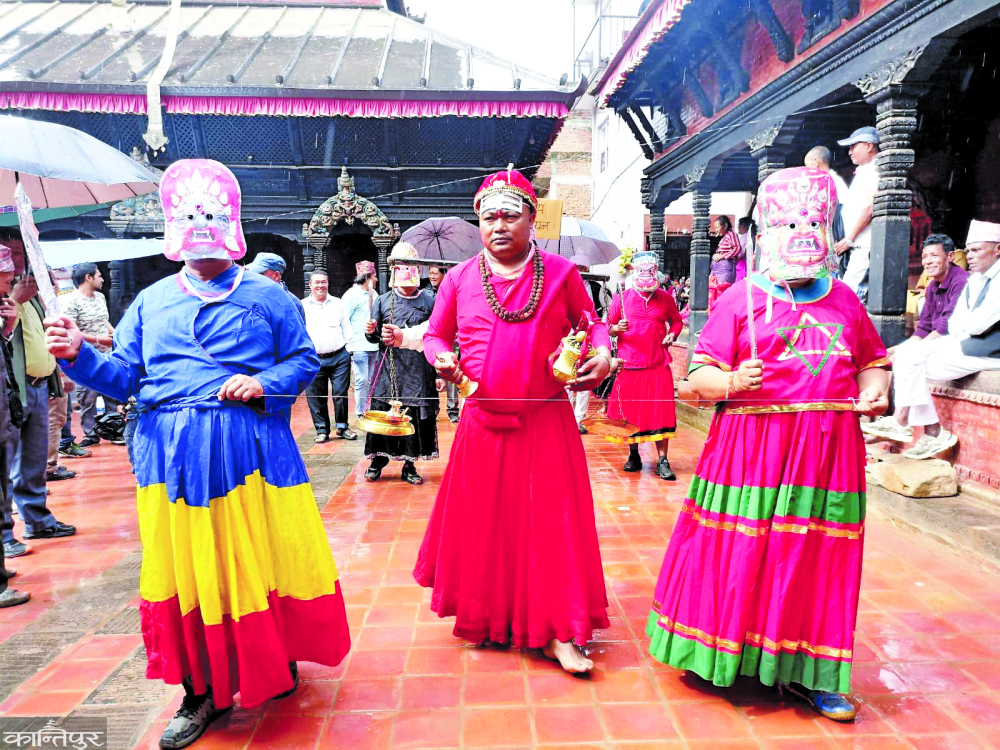
A young man dressed up as King Narendradeva of Lichchavi period. At the same time, two other young men came forward in the guise of Tantrik Bandhudatta Achaju of Kantipur and Lalit Jaipu called Rathchakra. They were surrounded from all four directions by youths disguised as Tikabhairava, Svetabhairava, Krodhabhairava of Harsiddhi and Chandabhairava.
This is the scene when King Narendradev, Bandhudatta and Lalit brought the red Matsyendranath to Nepal from Kamarupakamaksha Mountain in Assam, India, to make it rain because there was a famine in Nepal for 12 years. Which was presented by Maligan Dhime Khalah of Lalitpur Thechwa on Wednesday during the Matayah (Light Yatra) Jatra.
The Newars celebrate Mataya Jatra every year on the day after Gaijatra. Mataya: Jatra is special in Godavari Municipality-12 Thechwa of Lalitpur. There are 12 Baja Khalaks in Thechu. Each of these organizes a Jatra every year in turn. This year the festival was organized by Kutuzhva Bansuri Khal. Mataya: Jatra is conducted under the leadership of Thechwa Cultural Heritage Protection Committee.
In this festival, not only the historical aspect, but various tableaus were presented by satirizing the political and social situation. In the front row was a group of young men playing Nai Khin instruments. Then a young man disguised as a young woman with dark glasses, heeled shoes, and fake hair came forward dancing. After the
, there was another group of young people playing flutes and holding banners that read 'Jhigu Tzilji Jhigu Mhasika' meaning 'Our Culture Our Identity'. Then another person came in the guise of Ganesha, carrying an elephant-headed crescent moon. Later there was a dance. This scene belongs to Kutuzhvah Bansuri Khalak. Although these cultural heritages, which help boost the economy through tourism promotion, are gradually disappearing, this is a satirical scene for the state not making a solid plan for protection.
On the occasion of Jatra, five men dressed up as Brahmins and performed a yagna named 'Corruption Against Kotihome' in Tahnani village. They blew the conch shell and worshiped saying, 'Let wisdom come to the leaders, prosperity to the country'. Saraswati Dhime Khalah celebrated Ganthemangal festival by burning Gantakarna of demonic form. This festival is celebrated after planting. Krishna Mali, a local who celebrated this festival this year, said satirically that the arable land is shrinking and it is inevitable to declare agricultural pocket areas.
 Nhychen Dafa Khalah said that four men were dressed in the garb of growth and made them fast. Some of the women dressed up like new brides and paraded around the city in costumes like tas cholo and fake gold jewelry. According to the Newari tradition, the first marriage of a girl between the ages of 3 and 12 or those who have not menstruated is to be done with Bel.
Purusha is considered capable of performing celibacy and fasts after 8 years. However, the practice of celibate marriages and vows for children born abroad in connection with foreign employment and studies is disappearing. Satirizing this too, Maharjan, a learned devotee of the Dafa Khal, said that he used to circumambulate the city by taking vows and vows.
In the same way, the custom of Maiti Khalak to take care of newborn babies and pregnant mothers is also gradually disappearing. Saying that it should be protected, Tathani Bansuri Khalah carried food, clothes and other things needed by the baby in a kharpan and showed the care that Maiti Khalak takes after the birth of a baby according to Newar tradition. It is believed that such care will prevent the death of the mother and disability of the child.
Another group exhibited Tharu culture saying that everyone should be interested in preserving Tharu culture which is disappearing. A man went around the city collecting kawadi on a bicycle, giving the message that they should earn money by tendering kawadi items stored in government offices and sell them as kawadi instead of burning plastic items. Likewise, a man stayed as a salik in Lower Pukhusi village for the duration of the Jatra, saying that he should become a salik as a sign of respect for those who have been contributing to the preservation and promotion of cultural heritage for a long time. Women dressed in various traditional costumes participated in the
jatra. Kutuzhwa: In the village, the door was made by covering the roof with thatched roof and decorating it with old utensils. Which caught the attention of those who came to observe the pilgrimage. Apart from these, Navadurga Dhime Khalah, Khancha Dhime Khalah, Kusiko Bansuri Khalah, Bramhayani Cultural Manka Khalah, etc. gave cultural performances.
Baburam Maharjan, chairman of Thechu Cultural Heritage Conservation Committee, said that if culture is linked with tourism, income can also be generated. "We are trying to coordinate with various agencies for this," he said, "We are also trying to bring the bazaars that have been closed to operation again." Godavari Municipality Mayor Gajendra Maharjan said that the municipality has been helping to conduct the Mataya Jatra since its inception. "The work has progressed according to the plan to build a museum in Thechu for the protection of cultural heritage," he said. Among the participants in the
Jatra, Nhyachen Dafa Khalah was the first, Tahanani Bansuri Khalah was the second and Mali Gan Dhime Khalah was the third. The beautiful tolls of the singariya have fallen into disarray.

