Earlier, candidates did not go door to door like they do now. They used to walk the streets wearing microphones. At that time, there were no cars, so they would come on foot to ask for votes. Later, large public meetings began to be held. People were seen carrying flags on the roof of buses.
We use Google Cloud Translation Services. Google requires we provide the following disclaimer relating to use of this service:
This service may contain translations powered by Google. Google disclaims all warranties related to the translations, expressed or implied, including any warranties of accuracy, reliability, and any implied warranties of merchantability, fitness for a particular purpose, and noninfringement.
चुनाव एक नेताको जित–हारको विवरण मात्रै होइन
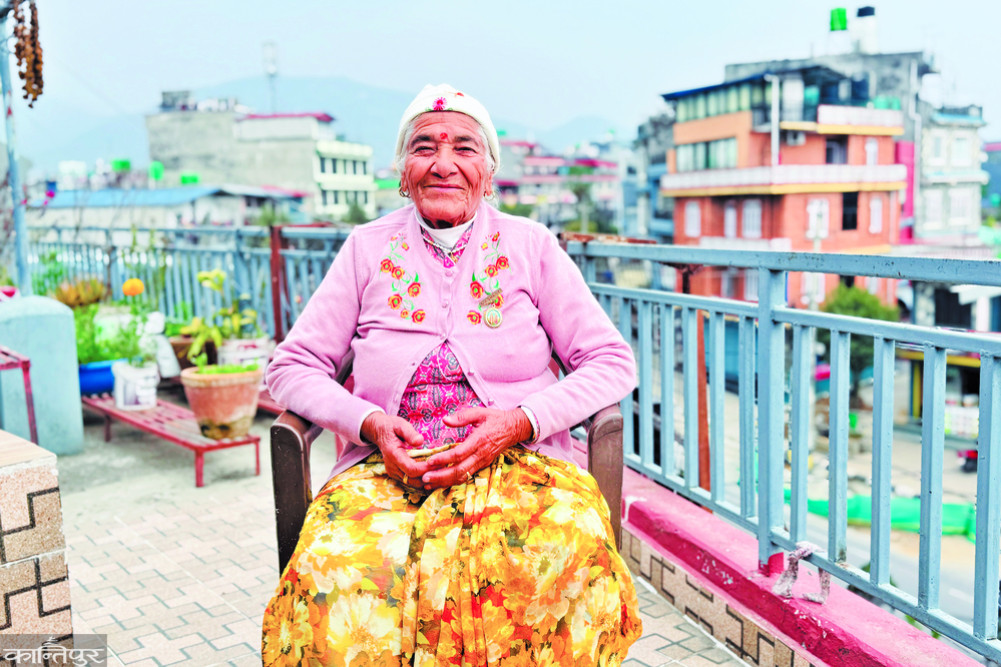
– Nandakali Baral (92 years old) Nuwarthok, Pokhara
I live in Pokhara-7, Nuwarthok. Now it is election season again. The news is playing on the radio, flag-draped vehicles are rushing on the road. Seeing all this reminds me of my old days. I am 92 years old, but my mind is still closely following the country's politics and elections.
I have forgotten the exact date when I first voted. But, I remember that first general election in 2015 BS! Pokhara was not like it is now. We had a hotel at Jahaj Giran (old Pokhara airport), where I cooked and served rice for 25 years. At that time, these Chila roads were not open. There was no road from Pokhara to Batauli (Butwal), Khasauli or Kathmandu, only ships came.
At that time, the king (Mahendra) was a very gentleman. When the king came to Pokhara, I left cooking rice at Giran and went to welcome him with flowers in my hand. I still remember standing in line and giving flowers to the king. Even now, it is difficult to remember many things due to my age. I may have voted in 2015. Since then, I have not left any election blank. Whether it is a panchayat, a non-partisan referendum or the elections after the republic, my fingerprint and swastika mark have always been there.
It was not as easy as it is now. I could not read, I did not know how to recognize letters. But, even though I haven't read, I've cooked rice for so many years, and I know how to count money. Earlier, to vote, you had to go to the District Administration Office (Maal Adda) or to Pokharipatan (now Masbar), which is the ward office. There was no tradition of hanging ropes and fencing to line up the voters like now. There were fewer people, and the houses were also thinner. The election office would give you a paper with your name registered, you would take that and vote by putting your fingerprints on it. Later, you could vote only by showing your citizenship. Around 2035, I got temporary citizenship. Now, you have to put on a swastika stamp! I can't even see, so now my grandson casts my vote. He leads me, maybe because I'm old, I don't even have to wait for my turn.
Earlier, candidates didn't come door to door like now. They would walk the streets with microphones. At that time, there was no car, people came to ask for votes on foot. A little later, large public meetings started taking place. People were seen carrying flags on the roof of buses. Some said, 'We will bring in a multi-party system.' Later, they also said, 'We will increase the allowance.' My husband, Gangadhar Baral, had also become a member of the municipal council. He used to teach me who to vote for.
I remember voting for Somnath Pyasi on the bucket symbol. I also voted for the Congress during the prohibition period. Sometimes the candidate I voted for won, sometimes he lost. But one thing is the same, during elections, all the candidates are very soft. They bow their heads saying, 'Ama...', bow down and ask for blessings. I also bless everyone. I wish everyone well. But, they don't come back immediately after winning. They say a lot when they say it, but they don't do anything when they do it. Now I go to Om Shanti. There too, party people come and give speeches, ask for votes. They say we don't switch off the lights (we don't do load shedding). Some say, 'You are old, why are you sad?' But I never thought of saying 'I won't vote'. If someone is better and the country runs with my one vote, why should I back down? Earlier, I used to vote where my husband told me, now I vote wherever my grandson tells me. I believe that my grandson will also choose good people.
What has changed with my vote? That is something that only grown-ups know. But, when I see the remote Pokhara of yesterday and this city of today, I feel that times have changed a lot. Even at the age of 92, I am equally excited. In this election too, I will reach the polling station holding my grandson's hand. I wish that the good people of this country will win with the imprint of my hand.