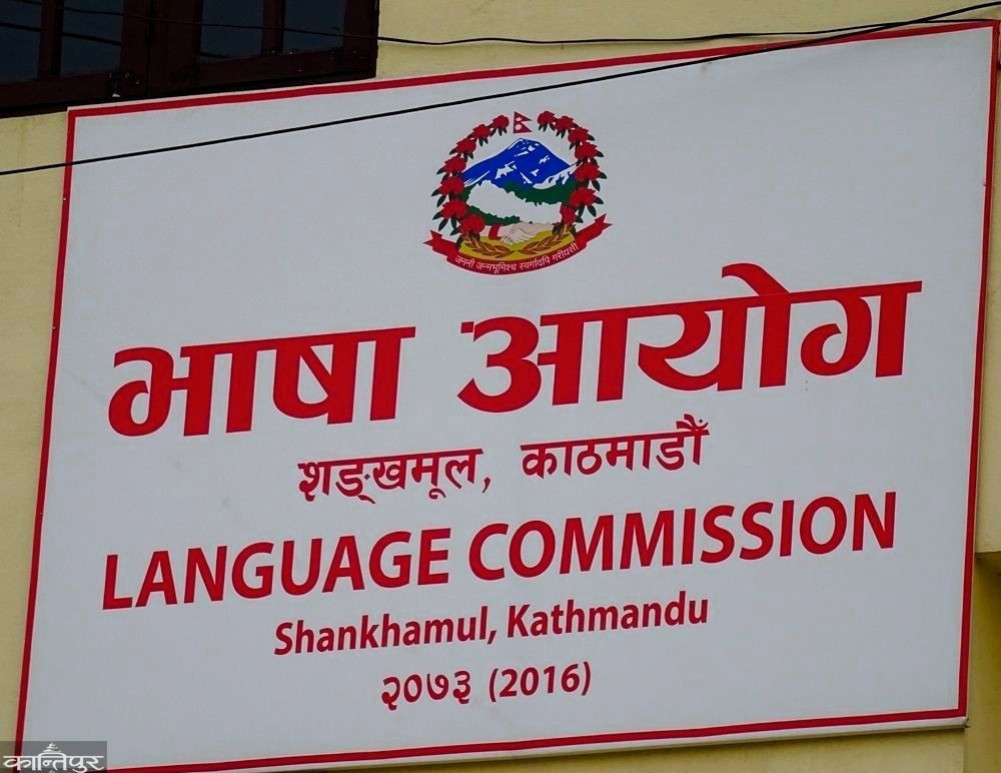
The provincial and local governments are passing language-related laws. However, a federal language-related law has not been enacted. An initiative was taken to formulate a language policy 30 years ago, but the federal government has neither a language law nor a language policy! The Language Commission is trying to bring a 'Federal Language Act'.
We use Google Cloud Translation Services. Google requires we provide the following disclaimer relating to use of this service:
This service may contain translations powered by Google. Google disclaims all warranties related to the translations, expressed or implied, including any warranties of accuracy, reliability, and any implied warranties of merchantability, fitness for a particular purpose, and noninfringement.
भाषा : संस्कृतिको धागो, पहिचानको आधार
Once, there was a lot of talk in the Nepali media about Rajamama, the last speaker of the Kusunda language. He was the last speaker of a dying language, after whose death the entire language was going to die. As far as the context of tracing the linguistic family of Kusunda is concerned, it is not possible to determine which linguistic family it belongs to, so there was a danger that ‘if Kusunda dies, not only a language, but an entire family of languages will die’. Therefore, there was pressure on Rajamama to save an entire linguistic family.
According to the 2078 BS census, there are 124 speakers of languages in Nepal. Of these, 46 belong to the Indo-Aryan language family, 72 belong to the Bhot Burmese language family, three belong to the Southeastern family, and one belongs to the Dravidian family. Which family does Kasunda belong to? It has not been determined yet. That is why linguists also call it a ‘single family’ (Chudamani Bandhu) or ‘Kusunda family’ (Madhav Prasad Pokharel). That is, a family of one language. That is why it was and is a unique language for the world.
Rajamama, the only speaker of a unique language in the world! When Rajamama was alive, the population of the Kusunda caste in Nepal was 213, while there were 28 speakers of the language. There were only three people who knew the language perfectly – Rajamama of Tanahun, Gyanimainya Sen Kusunda of Dang, and Kamala Sen (Khatri) Kusunda of Rolpa. After Rajamama's death, Gyanimainya and Kamala remained. Later, Gyanimainya also passed away and only Kamala remained. At that time, she was working in a hotel. Saying, 'Now something must be done to preserve Kusunda,' the Language Commission made her a teacher of the Kusunda language and arranged for her to teach the language to others. At that time, the Corona epidemic spread all over the world. Classes teaching the Kusunda language were closed. Where did Kamala go? No one knew.
After the Corona epidemic, the Language Commission started looking for Kamala again. After searching many places, she was found working in a brick kiln in Thimi. The commission took her out of the brick kiln and made her a teacher again and started the Kusunda language class again. 12 young Kusundas in Kamala's class learned the language.
Linguists praise the Language Commission's efforts to save a dead language.
This example explains what the Language Commission actually does. The Constitution of Nepal has basically given the Language Commission the authority to do four things. This was one of them. The four powers granted to the Commission are:
1. Determination of the bases to be fulfilled to be recognized as the language of government work. 2. Recommendation of measures to be adopted for the protection, promotion and development of languages. 3. Measuring the level of development of mother tongues and the feasibility of using them in education. 4. Study, research and monitoring of languages.
The government had formally established the Language Commission by its decision dated Bhadra 23, 2073. Article 287 of the Constitution provides for the formation of the Language Commission. The Language Commission Act, 2074 has also been formulated to operate the Commission. Among the various provisions mentioned in the Constitution promulgated in 2072 BS after the state restructuring, the formation of the Language Commission can be considered a milestone achievement.
Article 7 of the Constitution mentions three matters related to language: 1. Nepali language written in Devanagari script shall be the language of official work. 2. Provinces may make laws to use one or more languages as official working languages. 3. Other matters related to language shall be as decided by the Government of Nepal on the recommendation of the Language Commission.
Clause 7 (3) of Article 7 has made the scope of work of the Language Commission very broad. That is, except for the two things mentioned in clauses 1 and 2 of Article 7, the government cannot do any work related to language without the recommendation of the Language Commission.
As soon as the Commission was formed, the first task that fell to its shoulders was to determine the bases that must be met to be recognized as the language of official work in the province and recommend the language to the Government of Nepal. This work to be done by the Language Commission is also mentioned in the Constitution. The Constitution also mentions that the Commission should complete this work and submit the recommendation within 5 years.
The provincial and local governments are passing language-related laws. However, a federal law on language has not been enacted. An initiative was taken to formulate a language policy 30 years ago, but the federal government has neither a language law nor a language policy! The Language Commission is trying to bring a 'Federal Language Act'. The Commission set about this work with dedication. And, within the specified time period, it submitted to the Government of Nepal a list of languages that could be implemented as the language of official work in the provinces. According to the recommendation submitted by the commission, in addition to Nepali language in Koshi Province (then Province No. 1), Maithili and Limbu, Maithili, Bhojpuri and Bajjika in Madhesh Province, Tamang and Nepal Bhasa (Newa) in Bagmati Province, Magar and Gurung in Gandaki Province, Tharu, Vadhi and Bhojpuri in Lumbini Province, Khas and Magar in Karnali Province, Doteli and Tharu in Sudurpaschim Province can be used as official languages by making laws.
Based on the recommendations of the commission, the Bagmati Province Government has passed and implemented the ‘Province Government Language Act, 2080’ from the Provincial Assembly (Parliament) with effect from 24th Baisakh 2081. This language act brought by Bagmati Province is the first language-related act in the history of Nepal. This is a great achievement for linguistic federalism. To mark the issuance of the act, the Bagmati Province Government has now started the practice of celebrating ‘Province Language Day’ on 24th Baisakh every year. It is an old custom to celebrate the day on the day of the promulgation of the constitution. However, this is the first and only time that the day on which the act is issued is also celebrated as a day.
After Bagmati Province, Gandaki Province has also issued a language act. In Koshi Province, the language bill has been tabled in Parliament. In Madhesh Province, the language bill was introduced in Parliament but was withdrawn due to controversy. Lumbini Province has already drafted a language bill, but it has not been submitted to the parliament. The Language Commission is taking the initiative to advance the language act in Karnali and Sudurpaschim provinces.
The Constitution of Nepal (2072) has also defined the local government as a body that can exercise the sovereignty of the country. Therefore, some local governments have also started to advance language-related work by adopting language acts or special decisions related to language. In this way, the provincial government and local governments are currently making and implementing language-related acts.
However, the irony is that even though the provincial and local governments are passing language-related acts, the federal language-related act has not been made yet. The federal government has neither a language act nor a language policy. An initiative was taken 30 years ago to make a language policy, but it has not been successful. Keeping this issue in mind, the Language Commission has started efforts to bring a 'Federal Language Act'.
The draft of the Federal Language Act prepared by the commission in consultation with experts has now reached the Ministry of Culture and the Ministry of Law. If the government takes a little initiative, the act will be implemented. Nepal has been multilingual since historical times and the preamble of the current constitution has already mentioned Nepal as a 'multilingual country', so it is necessary to have a separate language act for the state.
Let's talk about the International Mother Language Day being celebrated today. The United Nations has announced that it will celebrate a decade, not a Mother Language Day. The United Nations has declared that the ten years from 2022 to 2032 will be celebrated as the 'International Decade of Indigenous Languages'. In 2020, the United Nations had sent instructions to its member states to 'submit their national action plans' on the topic of celebrating the Indigenous Languages Decade. The United Nations planned to submit an action plan in 2021 and work for indigenous languages for ten years from 2022.
The main reason why the United Nations is targeting indigenous languages is that indigenous languages are currently at the top of the list of languages that are disappearing in the world. UNESCO data shows that there are 6,700 languages in the world. 6 percent of the world's total population are indigenous. These 6 percent of indigenous people speak 4,000 languages in the world. There are many spoken languages, but few speakers. Therefore, the possibility of extinction is high.
Education is the main means of protecting the mother tongue. Unless the mother tongue is implemented in education, it will be difficult to protect that language. Nepal's education policy is not mother tongue-friendly. Indigenous languages contain the treatment methods they use, medicinal knowledge, environmental knowledge, knowledge about how to avoid natural disasters, etc. The United Nations celebrated this decade by reflecting on the need to not only preserve that knowledge, but also to bring it into the mainstream and protect their languages.
There are 124 languages in Nepal, out of which 93 are spoken by 14 percent of indigenous people. However, even after 2026, Nepal has not been able to prepare a 'National Action Plan' for the Language Decade. Four years have passed, but since no one has paid attention to this, the Language Commission itself has prepared an 'Action Plan' and recently submitted it to Prime Minister Sushila Karki. It is necessary to implement it immediately. Otherwise, there is a risk that Nepal's commitment will be questioned when the issue of indigenous peoples is raised in international forums of the United Nations.
Education is the main means of preserving the mother tongue. Until the mother tongue is implemented in education, it will be difficult to protect that language. Nepal's education policy is not mother tongue-friendly. Due to the failure to implement the mother tongue in education, Nepal's teaching system is currently moving away from Nepali and towards English. This has posed a threat not only to other mother tongues, but also to the Nepali language. The Language Commission has raised questions about English-medium education. Even those who do not need English are being forced to drop out of school. Therefore, the use of mother tongue in education is mandatory. The Language Commission has recently submitted a recommendation to Prime Minister Karki regarding mother tongue education. The state cannot deviate from this recommendation under any pretext.
In addition, the Language Commission is currently active in the collection of words, collection of texts, use in education, linguistic studies, documentary production, etc. of endangered languages. The only language laboratory in Nepal is also in the Language Commission, but it is not being used regularly. Nepal is actually not only a country of Everest and Buddha, but also a country of languages. Having many languages is not our misfortune, it is a beauty. If we could decorate the country by using the beauty of language, it could not only be our beauty, but also a means of prosperity.