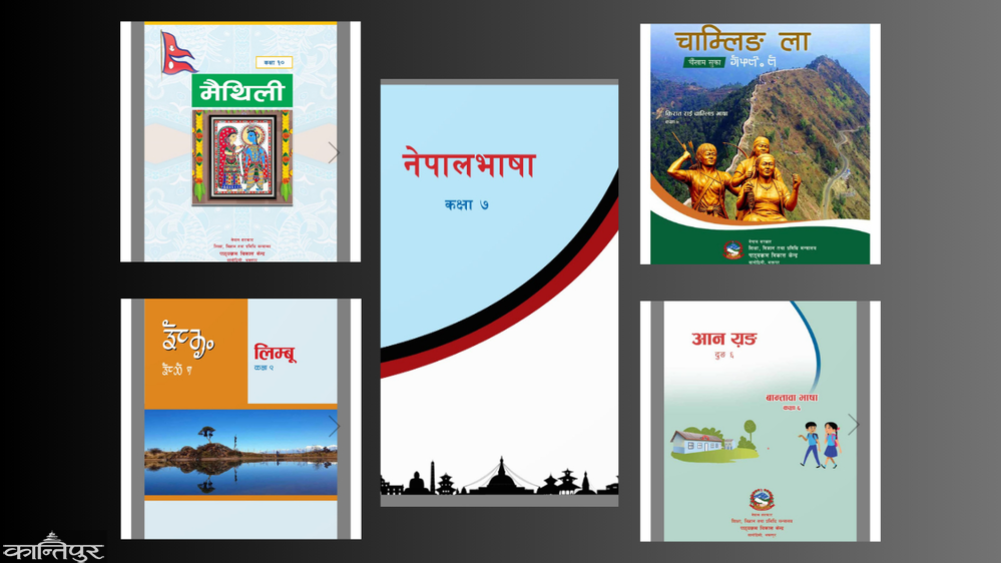
The constitution guarantees the right of every Nepali community to education in their mother tongue, but its implementation is extremely weak.
We use Google Cloud Translation Services. Google requires we provide the following disclaimer relating to use of this service:
This service may contain translations powered by Google. Google disclaims all warranties related to the translations, expressed or implied, including any warranties of accuracy, reliability, and any implied warranties of merchantability, fitness for a particular purpose, and noninfringement.
भाषा : संस्कृतिको धागो, पहिचानको आधार
The Curriculum Development Center has prepared 29 mother tongue curricula and textbooks. Local levels have been preparing mother tongue curricula as local curricula since 2074 and are teaching from basic level up to grade 8. Tribhuvan, Kathmandu, Nepal Open and Nepal Sanskrit Universities have also started higher education in mother tongue separately.
According to the center, curricula have been prepared for Tharu, Rana Tharu, Kirat Yakkha, Kirat Kulung, Maithili, Awadhi, Bhojpuri, Tamang languages in Tamgiya/Sambhota/Devanagari script, Limbu (Yakthung), Bantawa Rai, Chamling Rai, Khaling Rai, Wayung Rai languages. Similarly, curricula and textbooks have been prepared for Sherpa, Gurung, Magar, Nepal Bhasa, Sunuwar, Rajbanshi, Mugali, Dhimal, Magar Athar, Chepang, Majhi, Doteli, Thakali, Bajjika, Hindi and Urdu languages.
Kathmandu University has been running Tamang and Nepal Bhasa programs since last year. This year, it has called for admissions for Maithili and Limbu languages. The university is developing a curriculum for conducting Gurung and Magar language classes next year.
Balchandra Luintel, member of the curriculum council and dean of the School of Education, informed that language teaching has been started in the one-year B.Ed. ‘Local levels want to provide education in the mother tongue.’ Some have already started teaching,’ he said, ‘We have started the program in terms of both preserving and teaching the mother tongue.’ But there is a shortage of mother tongue teachers.’ The university has stated that 15/15 people can be admitted in each mother tongue.
The Constitution has ensured the right of every Nepali community to receive education in their mother tongue, but its implementation is very weak Luintel said that the aim is to connect communities, schools and universities through language. ‘But except for ethnic and linguistic organizations, the government has not been able to do much work in the mother tongue,’ he said, ‘Foreign students want to come to study the language, culture, knowledge and traditions of Nepal. We want to protect, preserve and promote all kinds of mother tongues.’
The Constitution has provided the right of every citizen to receive education in their mother tongue as a fundamental right. The Education Act 2028 and the Education Regulations 2059 state that education in the mother tongue can be provided up to the primary level. The National Curriculum Framework 2076 has determined the curriculum for mother tongue/local subjects from grades 1 to 8. The authority to develop and implement the curriculum has been given to the local government. The Ministry of Education, the Ministry of Federal Affairs, and the Language Commission do not have accurate data on the local levels that provide mother tongue education.
Some municipalities have been teaching the mother tongue as a local curriculum and some have taught some parts of the mother tongue within the local curriculum. Some municipalities have complained that they have not been able to implement the local curriculum or mother tongue curriculum due to lack of subject experts and resources.
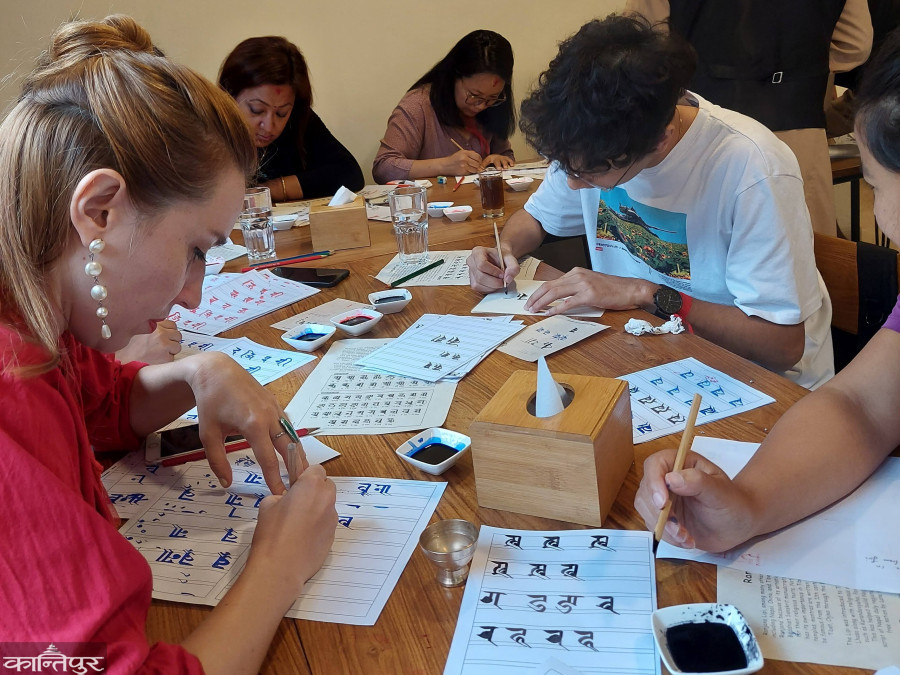
Kathmandu Metropolitan City has implemented the Nepal (Newari) language curriculum in community and private schools since the academic session 2077. Nepali language is being taught in schools in the metropolis in grades 1-8. Tokha Municipality in Kathmandu and Bhaktapur Municipality in Bhaktapur have also been teaching Nepali language. Nepali language instructors have been appointed for teaching.
Barbardiya Municipality in Bardiya is preparing a curriculum for Tharu language and providing it. The curriculum implemented in grades 1-3 since 2080 aims to develop the skills of listening, speaking and writing in the mother tongue for children. Earlier, the municipality had also taught the language in some schools. Limbu, Tamang, Kham Magar languages are also being taught by local levels.
Sunchhahari Rural Municipality in Rolpa has implemented the curriculum and textbooks of Magar Kham language in schools. The municipality has also issued a procedure for managing Magar Kham language teachers in 2080. The procedure states that the Kham language has been implemented in teaching and learning as most of the children studying in schools within the municipality speak Magar Kham dialect and do not understand other languages including Nepali.
According to Lok Bahadur Lopchan, Acting Secretary of the Language Commission, about 40 local level schools teach in their mother tongue. According to an article he wrote in Multilingual Education Online, Tamang language programs have been implemented in 13 municipalities. These include Roshi Rural Municipality of Kavre, Mandandeupur Municipality and Khanikhola Rural Municipality. Tamang language is taught in Konjyosom Rural Municipality of Lalitpur, Thaha Municipality and Hetauda Sub-metropolitan Municipality of Makawanpur, Nijgadh Municipality of Bara, Rapti Municipality of Chitwan, Marin Rural Municipality of Sindhuli and Doramba Rural Municipality of Ramechhap.
Jugal Rural Municipality of Sindhupalchowk, Kispang and Panchakanya Rural Municipality of Nuwakot also teach in Tamang language. According to Lopchan, the program was started on the initiative of Tamang Ghedung. ‘The central and provincial governments are indifferent to teaching in the mother tongue,’ he said, ‘the mother tongue has been implemented on the initiative of the language activist.’ Rapti Municipality of Chitwan has also started teaching in the Chepang mother tongue along with Tamang.
According to the mother tongue activist, Bantawa Rai language subject programs are being run in about 70 schools in the local levels of Panchthar, Bhojpur, Khotang, Ilam, and Dhankuta districts. Kirat Rai Kirat Yayokka has also mapped the local levels where Rai Kirat people's representatives and language speakers are in majority. Sunuwar Sewa Samaj has been collaborating for the language policy and mother tongue education program of Khijidemba Rural Municipality of Okhaldhunga.
Tamu Hyul Chyonj Dhi Gurung National Council has also been working with local levels to expand the Gurung language subject. Nisdi Rural Municipality of Palpa has been teaching Magar language to teachers and students. Mother tongue is also being taught as a form of multilingual education in some schools. According to the Ministry of Education, Rajbanshi and Santhal subjects are being taught in some schools in Jhapa. Aathpahariya is used in Dhankuta, Urav, Tharu and Maithili in some schools in Sunsari, Magar in some schools in Palpa, Awadhi is used in community schools in Kapilvastu, and Tharu is used as the medium of instruction in Kanchanpur. Classes 1-3 are partially taught through the mother tongue.

The Language Commission had made recommendations to Prime Minister Sushila Karki regarding mother tongue education. A study was conducted in 24 local levels of all seven provinces on the identification of the level of mother tongue, linguistic mapping of schools, and the feasibility of using mother tongue in education. It is mentioned that most municipalities are indifferent to mother tongue education. ‘With only Nepali and English being the medium of instruction in schools, it does not seem that mother tongues have been given external encouragement,’ the report says. ‘Although awareness of mother tongue has increased in the community, the generational transmission of mother tongue is decreasing.’ The
Curriculum Development Center prepared 29 mother tongue curricula and textbooks, teaching from municipalities to basic level, separate arrangements for higher education in mother tongue at Tribhuvan, Kathmandu, Nepal Open and Nepal Sanskrit Universities commission has recommended the government to provide mother tongue education in all 124 languages spoken in Nepal. The commission has stated that mother tongue should be implemented as a medium and subject in communities, schools and higher education in collaboration with the federal, provincial and local levels. The report states that 109 languages should be taught as mother tongue in Koshi, 62 in Madhesh, 109 in Bagmati, 75 in Gandaki, 68 in Lumbini, 49 in Karnali and 74 in Sudurpaschim Provinces.’
The commission had studied the feasibility of using Chepang language in Raksirang of Makawanpur, Awadhi in Suddhodan of Kapilvastu, Sherpa in Solududhkunda of Salekhumbu, Limbu in Phidim of Panchthar, Thami in Kalinchowk of Dolakha, Urav in Gadhi of Sunsari, Kumal in Gorkha of Gorkha and Kholasothar of Lamjung in Gurung language education.
Similarly, a feasibility study was conducted on Magar in Nishdi of Palpa and Doteli in Adarsh of Doti. A study was conducted on the use of Bhojpuri in Parwanipur of Bara, Bantawa in Hatuwagadhi of Bhojpur, Urdu in Mayadevi Gapa of Kapilvastu, Bajjika in Ramnagar of Sarlahi, and Nepali language in Dhulikhel of Kavre.
The commission's secretary Lopchan said that although the government was recommended to study and teach the mother tongue, it has not paid attention so far. 'The local level has tried to teach in the mother tongue.' The federal government, the Ministry of Education and the provinces have not paid attention,' he said. He said that the mother tongue has been taught in some local levels more because of mother tongue activists than the government.
Raju Shrestha, director of the Language Branch of the Curriculum Development Center, said that the center does not have data because the local government has been given the responsibility of implementing the mother tongue according to the constitution. 'We have prepared 29 mother tongue curricula and textbooks.'
The center has also prepared some mother tongue children's learning materials. Stories, biographies and culture are included in the materials. The center has stated that curricula and textbooks have been prepared for most mother tongues up to grade 5 and some up to grade 10.
Director Shrestha said that the curriculum has not been able to cover all languages. 'The mother tongues have not been exposed, promoted, protected and developed as much as they should have been,' he said. 'While preparing the mother tongue curriculum, there has been a lack of linguistic essence, uniqueness, originality, vocabulary, and script.' He said that curricula and textbooks have been prepared for as many languages as possible. Even though the curricula and textbooks have been prepared, there is also a shortage of manpower (teachers) to teach them in the classroom. There is no provision for appointing mother tongue teachers from the Teacher Service Commission. The local level or municipality has to appoint the concerned mother tongue teacher itself. Language activists say that it is difficult to find manpower as the university does not produce teachers of the mother tongue.
Some local levels have been urging the center to create a mother tongue curriculum. Due to lack of expertise in it, even the Curriculum Development Center has not been able to create one. 'There is also a demand that the curriculum should be created by the center. The center only creates models. It seems that there is less expertise at the local level,' he said, 'The community and parents are as inclined towards the English language as they are towards the mother tongue.'
Some local levels have been urging the center to create a mother tongue curriculum. Due to lack of expertise, even the Curriculum Development Center has not been able to create it. Hindi is taught at Tribhuvan University. Nepal Open University has started undergraduate level teaching in social sciences by including the languages of the Magar, Tamang, Kirat, and Newar communities. But the mother tongue has not been made mandatory in teaching.
Dean of the Faculty of Social Sciences and Education Khagendra Prasai said that the teaching of the entire subject has been started, not just the language of those communities. ‘There will be a contraction than just the language. There will be no human resources to teach, no students to study,’ he said, ‘We have started teaching the languages of the Magar, Tamang, Kirat and Newar communities, along with the origin, development, religion-culture, anthropology, history, social traditions, and economic systems.’
Nepal Sanskrit University offers studies in Sanskrit up to the doctoral level. Sanskrit, Arabic and Islamic languages are also taught at the school level.
The concept of education in the mother tongue in Nepal came after the political changes of 2046 BS. The 2047 Constitution recognized the Nepali language as the national language and all languages spoken as mother tongues in Nepal as national languages. Provision was made for education up to the primary level to be provided in the mother tongue. The National Education Commission, 2049, had recommended the government to encourage children from multilingual communities to study the local mother tongue. The primary education curriculum prepared in 2050 mentioned that mother tongue could be taught as a subject. Some schools started teaching mother tongue in a way that was convenient at that time. The report of the High-Level National Commission, 2055, had suggested giving priority to the use of mother tongue in pre-primary education.
The primary education curriculum 2062-065 has made provision for choosing the mother tongue spoken by the majority of students in the school in terms of mother tongue. It has also been said that the mother tongue/local subject curriculum and curriculum materials can be developed by the school itself with the support of the Resource Center and the coordination of the District Curriculum Coordination Committee.
From 2064-066, a multilingual education program was tested in 7 schools in 6 districts with the support of the Finnish government. कञ्चनपुरमा रानाथारू, पाल्पामा मगर, रसुवामा तामाङ, धनकुटा आठपहरिया राई, सुनसरीमा पूर्वेली थारू र झापामा राजवंशी र सन्थाल कार्यक्रम परीक्षण गरिएको हो । तत्कालीन शिक्षा विभागले मातृभाषामा आधारित बहुभाषिक शिक्षा परिचय पुस्तिका २०६९ जारी गरेको थियो । शैक्षिक जनशक्ति विकास केन्द्रले नेपालमा बहुभाषिक शिक्षा शिक्षक स्वाध्ययन सामग्री, २०७२ निर्माण गरेको थियो ।
संविधानको धारा ३१ (५) ले मातृभाषामा शिक्षा पाउने मौलिक हकको व्यवस्था गरेको छ । अनिवार्य तथा निःशुल्क शिक्षा ऐन २०७५ ले प्रत्येक नेपाली समुदायका नागरिकलाई मातृभाषामा आधारभूत तह र माध्यमिक तह (कक्षा १–१२) सम्मको शिक्षा प्राप्त गर्ने अधिकार हुने भनेको छ । सरकारले मातृभाषी शिक्षा प्रदान गर्न विद्यालय वा शिक्षण संस्था स्थापना र सञ्चालन गर्न सक्ने व्यवस्थासमेत गरेको छ ।