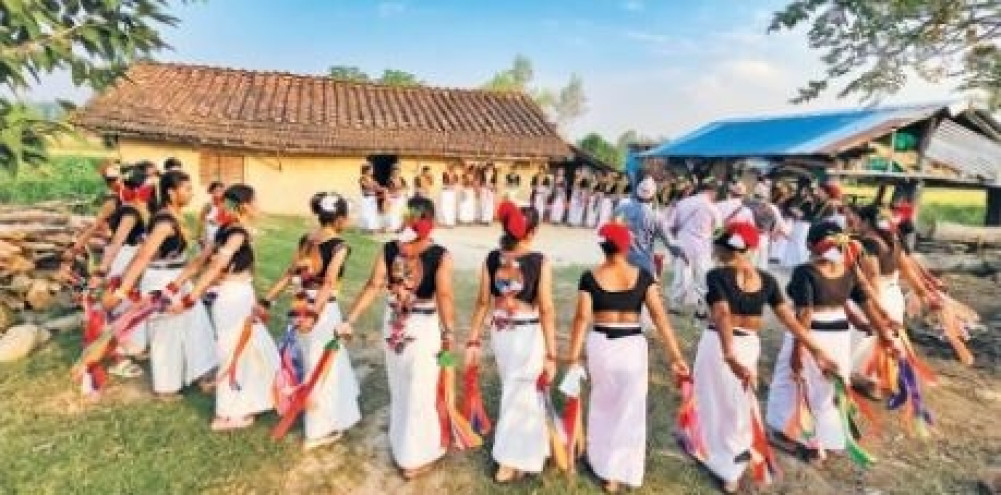
Latthi dance is popular in all areas of Tharuhat. Hurdungwa dance is danced to the tune of folk songs. Sakhiya dance is based on the Bhagavad Purana of the Tharu people.
We use Google Cloud Translation Services. Google requires we provide the following disclaimer relating to use of this service:
This service may contain translations powered by Google. Google disclaims all warranties related to the translations, expressed or implied, including any warranties of accuracy, reliability, and any implied warranties of merchantability, fitness for a particular purpose, and noninfringement.
A Tharu language song titled 'Maan Lenu Saathi Tuhin', created using AI, was uploaded to YouTube this week. The video of this song, with lyrics and music by Mahesh Kuchila, is being discussed everywhere.
Following this trend, Tharu artists are increasingly using AI to sing their songs, uploading them on YouTube without videos. In fact, there has been a debate that AI does not pronounce the word Tharu correctly. Tharu songs made with the help of AI have certainly attracted the Gen-G generation. However, in particular, it is further overshadowing the traditional music that carries the essence of Tharu original music.
Naveen Bibhas has uploaded the Latthi dance of Chitwan and Nawalparasi regions on his YouTube as a Tharu traditional folk dance. Any tourist who goes to Sauraha and spends a night in a hotel there must have seen the dancers dancing with great enthusiasm, swinging sticks to the beat of the dholak. According to researcher Sushil Chaudhary, Latthi dance is specifically related to martial arts. This dance is believed to have developed while practicing to chase away wild animals and defeat enemies.
The dance rhythm is different. However, Latthi dance is practiced in all areas of Tharuhat. In Tharuhat west of Dangdeukhuri, Latthi dance is performed to the rhythm of Madal, not Dholak. Madal is used in all other dances except for Duff music. Music such as Manjira, Jhal, Kastar, Basiya and others are used according to the style of the dance. In Birah music, a dove-shaped instrument made by potters was played, which is no longer seen.
Jhumra, Latthi, Mungrahwa, Hurdungwa, Jharra, Maghauta, Barka, Chokra, Kathghori and other dances are practiced in the western Tharu community. There is also an Akhari Tantric dance performed to become a new Guru (Dhami). It can be compared to the Tandava dance performed in the fierce form of Shiva. Those who want to become Guruwa dance to the rhythm of ‘Jwang Jwang Nak’. Along with this, the main Guruwa recites the Pachara mantra.
In 2062 BS, this poet was the producer of the Tharu language radio program ‘Hamar Sahidan’ at the Nepalgunj Media Center. While the collected Pachara mantras were being edited in the studio, Somlal Chaudhary, a member of the drama team of the ‘Hamar Sahidan’ program, was approached to climb the Guruwa. Only after stopping the mantras did he gradually stop shaking. This proves the power of Tharu folk songs and music.
Hurdungwa dance is a famous dance performed while singing Phulwar folk songs. Barkimar i.e. Barka dance of the Tharu Mahabharata is a classical dance of the Tharu community. Barka dance, Latthahawa,
Munggrahwa, Sakhiya dance are danced on the Barka Pai Khot (Taal). Sakhiya dance is a dance based on the Bhagavat Purana of the Tharus. In Kathghori dance, Tharu dancers make a horse shape out of bamboo and carry it on their shoulders and dance to the rhythm of the Madal.
The dance performed with a wooden drum in the hand is called Mungrahwa. In Jharra dance, a drum made of thin bamboo is held in both hands and danced. When the drums are struck together, a rattling sound is produced. That is why it is called Jharra dance. The dance performed on the occasion of the Tharu new year, Magh (Maghi), is called Maghauta. For the Maghauta dance, the head of the household gives rice, food and cash as Dakshina on a dhakki, just like during Deepawali.
Dances such as Jhumra and Chhokara are danced every two months. Currently, as they are taken for exhibition at various programs, other dances have also started to be danced every two months. In Jhumra dance, there is one madle, one or two women who dance. Sometimes, there is also a songiya (clown) character for entertainment. Chokra/Chhokara means boy in one sense.
A folk dance in which male dancers wear women's clothes such as lehenga, cholo, aghran, chura, tikuli, etc. and dance to a special rhythm is called Chokra. In fact, in Jhumra dance, men used to dance in women's clothes earlier. Jhumra is also called Jhumri, Jhumar, Dhumar, Dhumra dance depending on the place.
Barka dance, which has historical importance in the Tharu community, is danced by incorporating the story of the Mahabharata. This all-male dance group can have more than a hundred or so dancers. That is why it is called Barka, meaning a big dance.
This dance, which is performed on the occasion of Dashain, requires a lot of financial burden, clear knowledge of tantra, many members and commitment. Before performing this dance, the Gurus (Dhamis) perform various types of pujas and offer sacrifices. Barka dance has been preserved only by the group of Chandra Prasad Chaudhary of Dang, Jalaura.
In dances like Latthi, Barka, Latthahawa, Mungrahwa, and others, the dancers and the dancers wear colorful shirts, peacock feathers on their backs, red scarves on both arms, a hat with a tassel on their head or a white or colorful turban, a turban with a tassel on their wrists, a ghariya with a tassel on their neck, a short dhoti on their waist, slippers or shoes on their feet, a large belt with a woven girdle around their waist, and various kinds of jewelry. The dancers also wear a special decoration on their waist and wear a Madal. This also represents the traditional attire of the Tharu community.
22 Talas of Madal
While pursuing his PhD from Nepal Sanskrit University on the title ‘Study of Krishnacharitra Tradition in Tharu Culture’ (2076), this poet had the opportunity to study Tharu songs and music in detail.
22 Khot (beats) of Madal are played in the Sakhiya dance performed during Dashain. Kali Prasad Chaudhary of Rajpur village in Ghorahi Sub-metropolitan City of Dang, where I work, was able to play only 14 Khots of Madal while documenting the rhythm of Madal. In the village, only 7 Khots of Madal were found to be played during group dances.
Jhongnak-Jhongnak, Tong Ghadonak Tong, Jhongnak Ghildok Nak Madal rhythms are automatically understood as soon as one hears the rhythm of Madal. While searching for who would perform all 22 khots of Sakhiya dance, Sushil Chaudhary of Mayurbasti, Bahraiyatal Rural Municipality, Bardiya, solved the problem. He also named the tal while performing 22 tals. Just by hearing its name, you can know the style of the dance.
For example, Chola Budi Mad Piye, that is, walk, grandmother, drink alcohol, the tals of the tals cheer up the old and the young. There are tals that are danced like the elephant's walk, from lamb-roasting to chicken fighting. There are tals that are danced by jumping into the line with one foot, dancing with the dancer and the dancer's head together, and chasing the dancer.
Similarly, there are tals that are danced by pointing at the ear, dancing like a military parade, jumping and crossing the ditch, and secretly planting. On the other hand, there are tals that are danced like a gun, a bird flying style, and a pair of pigeons making love in Sakhiya.
Govinda Acharya of Dang, who has done his first PhD in Nepali folklore, says that he feels a sweet sleep when he listens to Tharu Sakhiya and Painya songs, which are danced on the occasion of Dashain and Tihar. He says, “It is sad to see the new generation of Tharus getting addicted to modern songs that spoil their sleep by abandoning their original folk music that calls for sleep.”