The day after Lakshmi Puja, the new year of Nepal Sambat, i.e. the national calendar, begins. On that day, there is a special tradition among the Newar community to perform Mha Puja. In Nepali, Mha Puja means worshipping one's own body.
We use Google Cloud Translation Services. Google requires we provide the following disclaimer relating to use of this service:
This service may contain translations powered by Google. Google disclaims all warranties related to the translations, expressed or implied, including any warranties of accuracy, reliability, and any implied warranties of merchantability, fitness for a particular purpose, and noninfringement.
Nepal Sambat is the national calendar. This time, 1146 is coming as the new year. We can experience happiness and excitement at this time because of the new year. There may be some doubt about which calendar was in use long ago during the Lichchhavi period. After that, it seems that a new calendar came into use in Nepal and this is the Nepal Sambat. There is no doubt about this. By the time of the Malla period, the use of the Nepal Sambat had become widespread.
The biggest proof of this is that most of the records from that time use Nepal Sambat. That is why it has so much importance and historical significance. Whenever any cultural tradition is adopted and celebrated by the general public, it cannot be ignored, and calling it Nepal Sambat is also like that.
Especially during the Rana period and later during the Panchayat system, the government started ignoring it with its own efforts. But it never disappeared from the practice, because every custom in Nepal is based on Nepal Sambat. There is a long story of the struggle to get Nepal Sambat recognized by the government. Despite all this, Nepal Sambat never lost its cultural value.
The reason is clear, it is steeped in Nepal's culture and tradition. It is the original Sambat of Nepal. Its biggest feature is that almost all festivals, fairs and celebrations of Nepal are celebrated based on it. Similarly, if we want to see auspicious signs or establish something new, it is decided on the basis of Nepal Sambat. Moreover, all the methods that have to be followed from birth to death are based on dates.
Shankhadhar Sakhwa is considered the originator of Nepal Sambat. He is the one who started Nepal Sambat. There are two types of legends about him. The first of them is that at a certain site, the sand he brought home turned into gold. With the help of that, he paid off the people's debts. In memory of that, Nepal Sambat began.
Another is that Shankhadhar was a businessman, and although he earned a lot through business, some were jealous of him and made many accusations against him. The then ruling class took action. But what everyone later found out was that Shankhadhar had done nothing wrong. He also got back the property that had been taken away. With that, he paid off the people's debts. After that, Nepal Sambat began.
Swanti Nakha
There is a tradition of celebrating Tihar for three days in the Kathmandu Valley. Tihar is called Swanti in Nepali. The first day of Swanti is Lakshmi Puja. The second day is Mha Puja. The third day is Kija Puja. Kija Puja is Bhaitika. According to the Nepal Samvat, Lakshmi Puja is the last day of the year. The day of Mha Puja marks the beginning of the new year.
With Lakshmi Puja, the financial transactions of a year also end. It is also called doing Salatamami. Moreover, it is an opportunity to end a financial year of one's business. In this way, the new financial year also begins with Mha Puja. Therefore, practically, on the day of Lakshmi Puja, the accounts of one's financial transactions for the year are closed.
New accounts are started in the new year. This tradition was practically maintained even a generation ago, but nowadays it is not like this. There are many reasons behind it. But symbolically, the tradition of starting a new financial year on the new year is still alive. It has not disappeared.
Thus, the new year begins from the day after Lakshmi Puja. There is a special tradition of performing Mha Puja among the Newar community on that day. In Nepali, Mha Puja means worshipping one's own body. This tradition is unique in itself. And equally original.
On the day of Mha Puja, one wakes up early in the morning and takes a bath. If there is no bathing opportunity, one washes one's hands and face to make oneself clean. And then new or dry clothes are worn. Once the place for Mha Puja is determined, it must be cleaned. The worship materials are also cleaned.

The floor is smeared with cow dung. The number of members in the family depends on the number of members, the worship materials and materials are required. This is another important fact. A special Puja thali is used for the day of Sagun. It is called Kotah. The flowers are Sayapatri, Bhimsenpati, Makhamali and Godavari. Sindoor, Akshata, Naivedya, Ita, Jajanka are used in the worship. Out of these, Ita became a small lamp. And Jajanka became like Janai. The flower used in Sagun should be Hasakai. Fish is also required whole.
Mha Puja should be performed facing west before sunset. It is said that Mha Puja should not be performed facing south or north. It may not always be possible to do so, in such cases, at least one head of the household sits facing west. During Mha Puja, a water circle is made in front of each family member. Five oil wheels are made in the middle.
This is called Chikamand in Nepali. The one near the mandala is worshipped in that. If any of the family members is sick or has gone abroad, then in such a case, a mandala is made representing that member and worshipped. During the puja, most men wear a cap. And women put their right hand out and cover their back.
Kheluitah and emptiness
There is a unique and original tradition of wishing for good luck at this time. During Mha Puja, it is customary to accept symbols of Mars. Such as fruits, fish and flowers. In particular, this tradition of worshiping one's own body also has philosophical aspects. It is prayed that one should not get injured, not get sick, and be happy and peaceful for the whole year ahead.
For this, the worship is done through Tantric methods. Therefore, all the family members gather in one place. And they worship collectively. On the day of Mha Puja, Buddhist Newars worship the Kuldevata and East Devata along with Buddhism and Sangha. Hindu Newars worship Bali Raja. Despite being so different, the basic meaning of both the worships is the same.
That is, the spirit of sacrifice and charity. It is remembered that a person can dedicate his life for the welfare and salvation of all beings. Mha What is the worship itself like? What is its philosophical aspect? During the worship, a mandala is made. In it, the work of burning Kheluitah is done. Our life is said to be made up of the Panchaskandha and the Panchatattva. Then after death, everything is said to dissolve in the earth.
In other words, it is dissolution into emptiness. It is also explained that life itself is emptiness. Mandala and Kheluitah work to give this feeling. What is Kheluitah? This is actually a long lamp. It is really longer than other lamps, so it is different. It is also special. It is said that its length should be as long as our face.
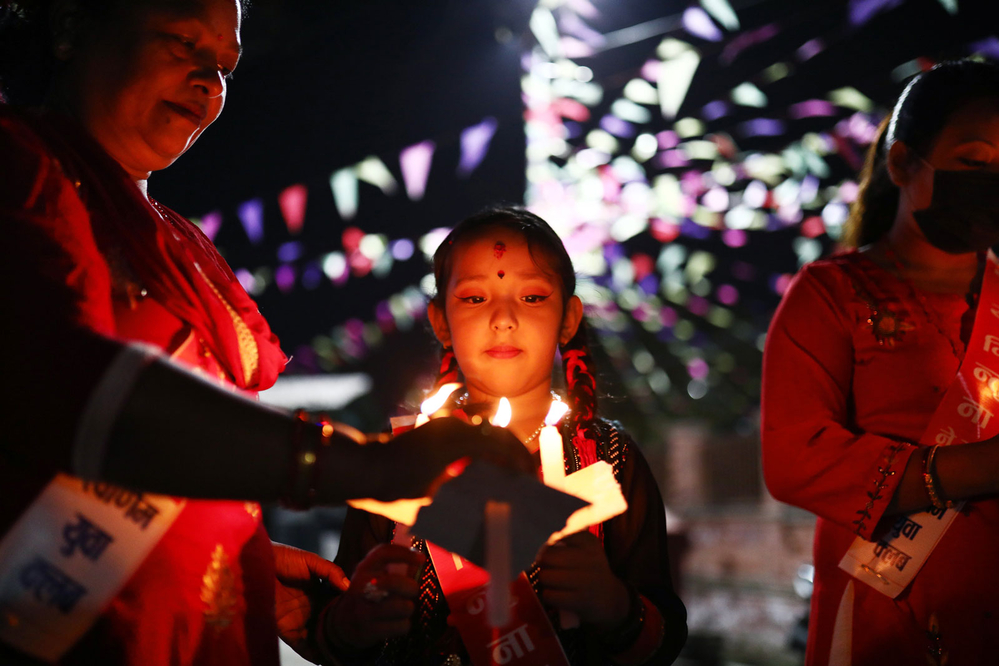
The face is someone's introduction. Kheluitha turns to ashes after burning. Two facts are connected with this. First, we should be able to spread light in all directions through our actions and our efforts should be focused on this. Second, our body will turn to ashes one day. Therefore, this should also be understood and should continue to be so.
In this way, Mha Puja is performed so that all beings can be saved. For this, we have to give up all the greed, attachment, and craving within ourselves. Velvet flowers and walnuts are also used in Mha Puja and this also has a special meaning. Both of these inspire the feeling of sacrifice.
Walnuts never rot, which means that it is a wish for good health. Flowers, fish, and fruits are a combination, a symbol of power. Fish is considered a symbol of wisdom. Similarly, flowers are considered a symbol of compassion. Small water vessels are also used during the puja. This is a symbol of Yamuna.
It is said that the eight parts of the lotus flower represent the eight directions and the eightfold path. Sukunda is also special and has Ganesha in it. Similarly, the snake, the kalash and the lamp. They have different symbols. For example, Ganesha is the symbol of Mangal, the snake is the symbol of Kalash Lakshmi and the lamp is the symbol of Prakash. Eight dishes should be eaten after the puja. In Nepali, it is called Chhyata Ghasa and this is a symbol of the eight mothers.
Nhu Daya Bhintuna
Recently, Nepalese people are increasingly celebrating Nepal Sambat as their original year. Until some time ago, it was seen as a festival celebrated only by Newars. Today, the perception is also changing. Therefore, whenever the new year begins according to the Nepal Sambat, everyone wishes each other well. Everyone says from the bottom of their hearts – Nhu Daya Bhintuna, meaning Happy New Year.
Related:


