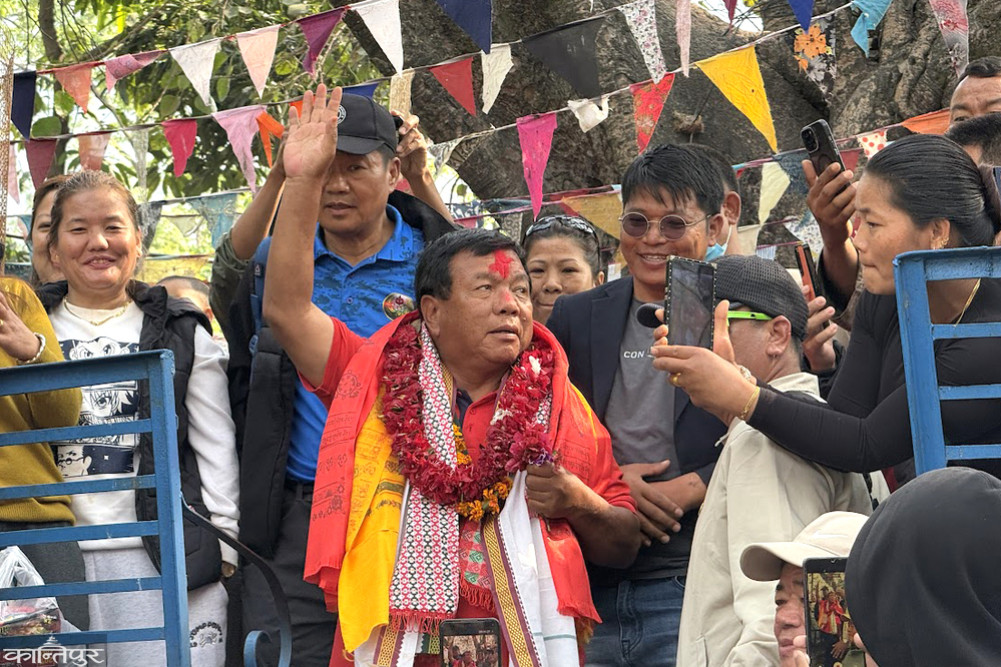
Mahavir Pun's surprise entry in Myagdi Nirvachan not only completely upset the district's traditional electoral arithmetic, but also made the electoral competition very interesting. When the final election results were announced, Pun won by a margin of almost three times the votes.
We use Google Cloud Translation Services. Google requires we provide the following disclaimer relating to use of this service:
This service may contain translations powered by Google. Google disclaims all warranties related to the translations, expressed or implied, including any warranties of accuracy, reliability, and any implied warranties of merchantability, fitness for a particular purpose, and noninfringement.
In Nepali politics, winning an election is a celebration of power, pomp and pageantry. However, in the 2002 election, a different scene was seen in Myagdi, which changed the traditional political style.
After Mahavir Pun won by almost three times the margin of votes and received the certificate, his supporters were eager to celebrate the victory. However, the newly elected MP Pun rebuked him on the contrary. He said, ‘I have come to work, not to celebrate. Celebrating the victory will hurt the minds of the competitors more, and people’s money and time will be wasted.’
In the recently concluded election, Mahavir Pun’s simplicity, low-cost and low-profile style of campaigning was seen as meaningful. Mahavir’s campaign, which was completely different from the traditional and original election style, created a moral crisis pressure on other candidates as well. They too, instead of holding election rallies and power shows, were limited to visiting voters' doorsteps in a small core team.
Pun did not promise any plans to the voters to get their votes. He did not make any commitments. He did not spend time criticizing other candidates, but rather explained why he became a candidate, saying, 'Voting is not about giving under pressure, vote if you like it, vote for the candidate you like if you don't.'
Mahavir's style of making elections purely ideological and voluntary, made politics dignified, and forced other candidates to change their strategies after candidates reached voters' doorsteps with a humble attitude and communicated their plans.
Other candidates, influenced by Pun's election campaigning style, also abandoned expensive and large election rallies and limited themselves to small-scale door-to-door programs and community gatherings. Pun, who discouraged wasteful spending, power display, and the culture of making 'special expenses' to impress voters, entered the election field without any flamboyant campaigning, flags, and slogans, and the people of Myagdi made Mahavir travel to parliament.
Pun, who was the Minister of Education, Science, and Technology in the Sushila Karki-led electoral government, resigned in a 'shock' after failing to get some education-related laws and regulations approved and filed an independent candidacy from the Myagdi constituency at the last minute, concluding that 'the place for policy-making should not be in Parliament'.
After winning the election, after receiving his certificate from the office of the Chief Electoral Officer, Pun said in a brief conversation with media persons, 'Once I reach Kathmandu and return, I will go to the doorsteps of the people.' Plans should not be selected by MPs from the center, but plans that local governments feel are necessary should become the plans of MPs. Rather than distributing the budget, I will take the local government's plans to the center and facilitate budget management. I will work together with all parties and the local government.'
Mahavir Pun's 'surprise entry' in Myagdi Nirvachan not only completely upset the traditional electoral arithmetic of the district, but also made the election competition very interesting. When the final election results were made public, Pun won by almost three times the margin of votes. While Pun got 22,850 votes in the election, his closest rival Harikrishna Shrestha of UML was limited to 7,919 votes.
Mahavir's simplicity and style of walking with his slippers on has become his personal identity. Myagdi voters expect that his working style will be connected to the people and practical, respecting the dignity and rules of parliament. Even after winning the election, Mahavir's style did not change. Neither a victory rally, nor a burden of garlands and garlands. When Mahavir tried to celebrate the victory, his supporters were forced to remain silent. After receiving the certificate of winning the election, Pun addressed the supporters gathered at Birendra Chowk in Beni and said, "I have not come to celebrate, but to work. People's time and money should not be wasted on rallies." He then went straight to his workplace.
Pun has given a signal before and after the election that he will not change his position and status. Even after being elected, he has started selling his autobiography on the streets of Pokhara.
Mahavir's role in Parliament will no longer be that of just an MP. He is expected to advocate for the 'knowledge economy' and 'innovation'. He has said that he will prominently raise the old agenda of spending 1 percent of the budget on research in Parliament.
Not a three-way street, many are interested in what will happen to the Innovation Center and the Birgunj Agricultural Tool Factory after becoming an MP? Mahavir's close aide and election commander Chitra Bahadur Tilija says, 'Before the parliament meeting, the Innovation Center and the Birgunj Agricultural Factory will be reached again. There is a plan to understand the situation. And now these institutions will be stronger. There will be an effort to transfer the institutions that used to run on donations and donations to government policies and budgets.'
Mahavir's simplicity and style of walking with slippers on has become his personal identity. Myagdi voters expect that his working style will be connected to the common man and practical, respecting the dignity and rules of the parliament.
Born in 2011 in Annapurna Rural Municipality-8 Nagi, Mahavir's childhood was not spent in comfort and convenience. Even though his father was in the Indian Army, Mahavir spent his time living in a cowshed in the Jaljala and Hampal valleys with his grandfather Maite Pun.
In Nagi village, he had to wait for Dashain to eat rice or exchange potatoes with the villagers in the valley. There was neither paper nor pen to learn letters. Early education began with writing with embers on wooden tablets. The proverb 'Chal Tigri Kha Jibri' taught by his grandfather Maite Pun became the basic philosophy of life while he was living in a cowshed until the age of 13.'
Nagi is a Magar settlement. After moving to Mallaj, a 'Khshatriya'-dominated area 6 hours below to study eighth grade, Mahavir first came to know the ethnic and cultural diversity up close. Mahavir's life took a new turn when his father Krishna Pun moved to Chitwan for the education of his children. In 2026 BS, his family left their ancestral home after a 9-day walk and moved to Birendranagar in Chitwan. When they descended from the snowy highlands to the Terai, everything was new, language, culture and geography. However, the sharp-minded Mahavir got admitted in Chaitra and stood first in the Jestha examination.
While studying at Amrit Science Campus, he did not give up his identity of wearing janga and slippers even in the crowd of children of the elite class of the capital Kathmandu. While studying in janga, he endured the ridicule of the elite class. He was immersed in his own world among the hippies of Thamel and the squeamish friends of the city.
Dr. Saroj Dhital, one of the classmates of Amrit Science Campus, remembers Mahavir like this, ‘We were students from the economically lower class group in the campus. Where the status of a student was measured by dress and style.’ However, there was another student in the same group, whose appearance and nature were more extraordinary than the others, the same pudky Mahavir wearing ordinary slippers and black jeans.'
After completing his ISC, Pun, who left his 13-year teaching career in Chitwan and moved to the capital Kathmandu, spent a few years wandering around the bakeries of Bagbazar, enjoying the taste of Tongba and Sukuti. Mahavir, who was eager to go to the Gulf countries, was introduced to the American Library by a former student. From there, he received a scholarship and went to the University of Nebraska in the United States. In 1992, he left the comfortable life of America and returned to his birthplace, Nagi. After returning to the village, Mahavir incorporated the KJ Method 'Local Participation' philosophy brought to Nepal by Japanese anthropologist Prof. Jiro Kawakita into his 'Nagi Model'. The geography in which Roman Magsaysay Award winner Jiro Kawakita lived (Annapurna Rural Municipality, 5-6 Wards) and built a physical ropeway to improve the living standards of the locals. Mahavir, who adopted the development model KJ Method developed by Kawakita, also established a long-distance wireless internet ‘digital ropeway’ technology in the same geography. Mahavir received the prestigious Roman Magsaysay Award in 2007 for bringing internet to a settlement under the clouds 40 km away from Pokhara.
Mahavir says, ‘Yes, I have followed Jiro Kawakita’s development model.’ However, I never physically met Myro Kawakita. However, it is a coincidence that both of them received the Roman Magsaysay Award.’
Mahavir Pun’s life is a clear message that deprivation does not make people weak, but rather makes them creative. Old slippers and simple clothes do not hide a person's personality, but rather highlight it.