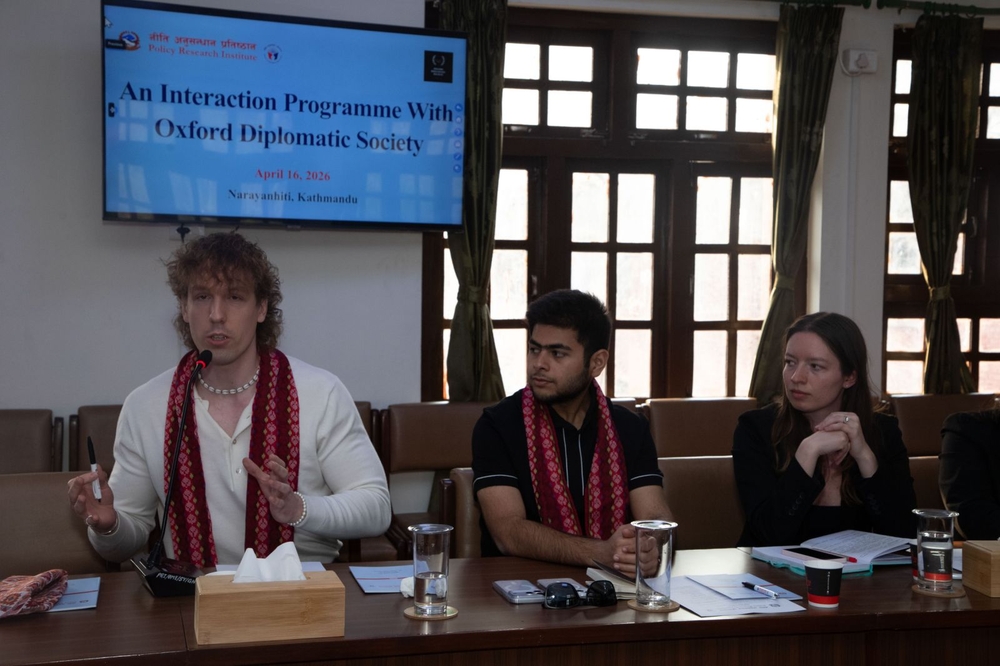
After students from Oxford and the London School of Economics visited Nepal, they shared their experiences about the country's youth power, technology, culture, and leadership.
We use Google Cloud Translation Services. Google requires we provide the following disclaimer relating to use of this service:
This service may contain translations powered by Google. Google disclaims all warranties related to the translations, expressed or implied, including any warranties of accuracy, reliability, and any implied warranties of merchantability, fitness for a particular purpose, and noninfringement.
Jack Markey, a young British man who was thrilled by the news that a famous rapper had won the election and became the Prime Minister of Nepal, was even more surprised when he arrived in Kathmandu two weeks ago. He only learned after arriving here that Balen is not only a rapper but also a former mayor of Kathmandu and a PhD candidate. ‘I only had a partial knowledge of Balen and Nepal,’ he said, ‘I am now understanding the reality. The Western media is identifying Balen as just a rapper. The way he won the election has caught the attention of people all over the world. Now it seems that the hopes of the entire country are resting on the shoulders of him and his team.’
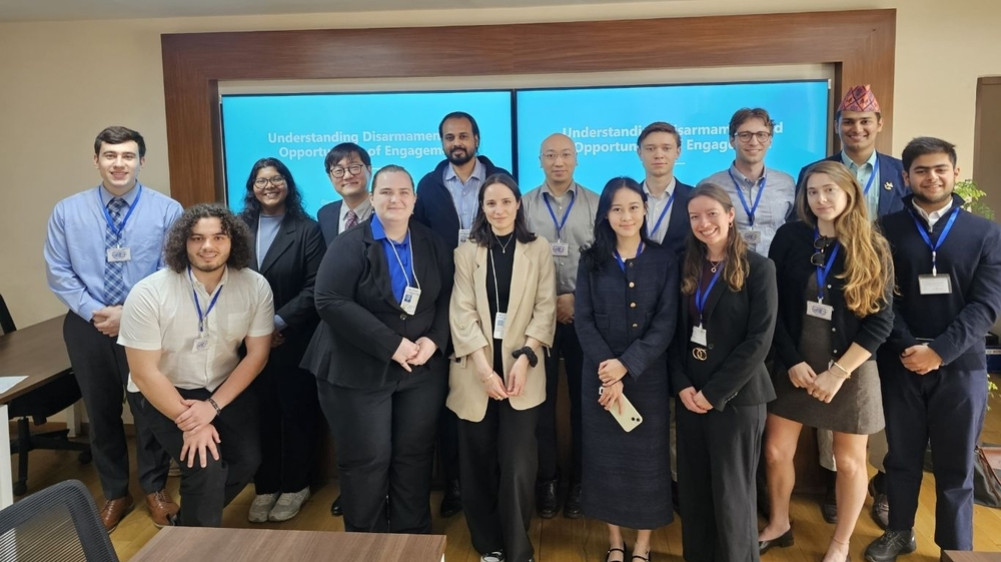
Last week, Jack and a dozen students from Oxford University and the London School of Economics in the UK came on a 10-day diplomatic visit to Nepal to take a closer look. The team consisted of 15 young people from the UK, US, Canada, Malaysia, Germany, India and Nepal. They are studying subjects such as diplomacy, technology and development policy, and some alumni were included in the tour. Even though the formal program is over, Jack and his friends are still wandering around Kathmandu. Carter from Canada is preparing to go hiking in the mountains around Kathmandu.
Jack, who holds a master's degree in mathematics from Oxford, is also visiting the tourist attractions here by inviting his parents to Kathmandu. Currently working as a statistician and machine learning engineer for the British government, he first came to Nepal in 2024. After seeing the technical skills of local youth, he even opened a company called 'At K Tech' in the UK. Although this company is registered in London, it has been providing employment to Nepalese software engineers. ‘I currently have 8/10 Nepali youth working for clients in Europe and America,’ he said. ‘I have Nepalese Asmod Khakurel and Awan Shrestha as co-founders in the company. We all work remotely for the company.’ He said that the company was named ‘At K’, which means 8,000 kilometers high, in honor of the mountains of Nepal.’
Impressed by the ability and enthusiasm of Nepali youth, Jack finds that Nepali youth have more optimism and energy towards the future of the country than the youth of the UK. ‘Nepali youth are more positive than the youth of our country,’ he assesses. ‘Because they themselves are the carriers of change and have brought about change, there must be more optimism and energy among Nepali youth.’ Jack was surprised to hear about the arson and physical damage that occurred during the Gen-G movement last Bhadra and to see the burnt buildings. Since he is also a government employee, he said that it would be difficult to imagine a movement in the UK that would involve setting fire to government offices or houses.
Carter Danget, who resigned from his government job after working as a foreign and defense policy advisor in the Privy Council Office of Canada from 2023 to 2025 and is currently studying in the UK, has the most interesting and emotional experience in Nepal. In 1983, his grandmother came to visit Nepal. Carter brought with him a 40-year-old photo that he had taken with a Buddhist monk here. ‘I found the monk while searching in the Buddhist area by showing him that photo,’ he said happily, ‘He is also old, but he is younger than my grandmother. When I showed him the photo, he recognized my grandmother.’

Carter's 84-year-old grandmother, who lives in Vancouver, does not use a mobile phone. Carter, who is completely disconnected from the technological age, was unable to communicate with the monk via video call. Since there was no way to contact her directly, he told her the news of his Buddhist monk friend through Sanima. 'He was so happy, he was surprised,' Carter said, 'It was a rare event. It's amazing to find someone I've heard about in stories and seen in photos since I was a child after searching for a while. I didn't have any hope, but I'm glad that the effort was successful.'
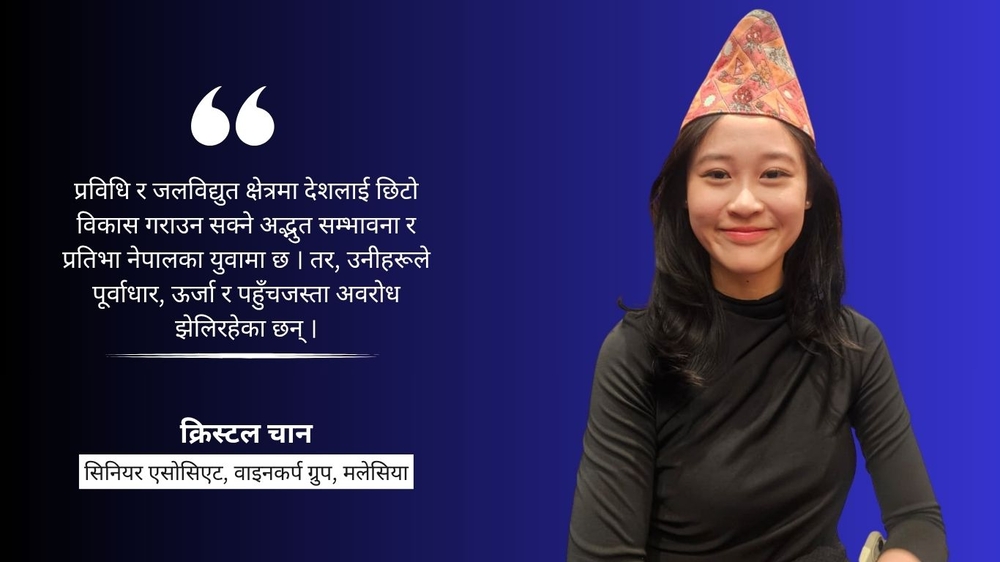
Other participants of the Oxford team, who visited Nepal for the first time, explored various aspects of the country's development and potential. Crystal Chan from Malaysia described Nepal as a 'frontier market' that can make leaps in the fields of technology and hydropower. Crystal, a London School of Economics alumnus and senior associate at Malaysia's leading corporate advisory firm, Winecorp Group, has also been impressed by the potential of Nepal's young workforce. "The youth here have incredible potential and talent to drive the country forward in technology and hydropower," she said. "However, they face barriers such as infrastructure, energy and access." The
team included Carter, Jack, Asmod, Catherine, Nicklaus Benjamin Hines, Laxman Bista, Crystal Chan, Paul Benedict Hygis, Natalia Lalin, Kusum Kalikote, Grant Giangrasso, Sharan Mahat, Nicola Marie Anselmo, Tej Gohil and Marcus Bach.
American student Catherine Kuhr, who is studying for a master's degree in international relations at the London School, said that Nepal is currently in a very important and exciting time and that the new generation is bringing change and people are feeling great hope for the future. She considered playing in the snow in Kalinchowk in Dolakha a rare and beautiful opportunity in her life. 'Many Americans know Nepal only as a place to climb mountains, but Nepal is also rich in history and culture,' she told Kantipur, 'The handicrafts here are also very good. I am confused about which souvenir to take from Nepal, I feel like buying everything.'
During this visit organized by the Oxford Diplomatic Society in collaboration with the Institute for Rural Development and the Britain Nepal Society in Nepal, the participants engaged in various diplomatic, educational and cultural activities. They met with officials from the Ministry of Foreign Affairs and parliamentarians. They visited the rural settlements of Nuwakot, the hydroelectric project, and the Dupcheshwor temple.
Roundtable discussions were also organized on foreign investment, startups, and Nepal's foreign policy, said Asmod Khakurel of the Institute for Rural Development. 'It is a very positive thing for the Oxford Diplomatic Society to send such a team,' he said, 'This visit has increased the confidence and courage to carry out larger and more innovative programs in the future. The students who came to this team are future leaders, it was a great opportunity to bring them to Nepal and explain the reality here.' This was the second Nepal tour organized by the Oxford Society.