The one who loves to 'apply ointment to the wounds' of the injured has now reached Parliament. She vows - I will fulfill my responsibility.
We use Google Cloud Translation Services. Google requires we provide the following disclaimer relating to use of this service:
This service may contain translations powered by Google. Google disclaims all warranties related to the translations, expressed or implied, including any warranties of accuracy, reliability, and any implied warranties of merchantability, fitness for a particular purpose, and noninfringement.
Two months ago, Ashika Tamang made a satirical video of herself sitting with Gen-G injured people.
The injured Prakash Bohora, the heir to the iconic shoes of the Gen-G movement, was told by a witness on the street, ‘His shoes are on the street. The owner of Goldstar, who makes those shoes, is in the House. Look at the country’s current situation. The politics of shoes.’
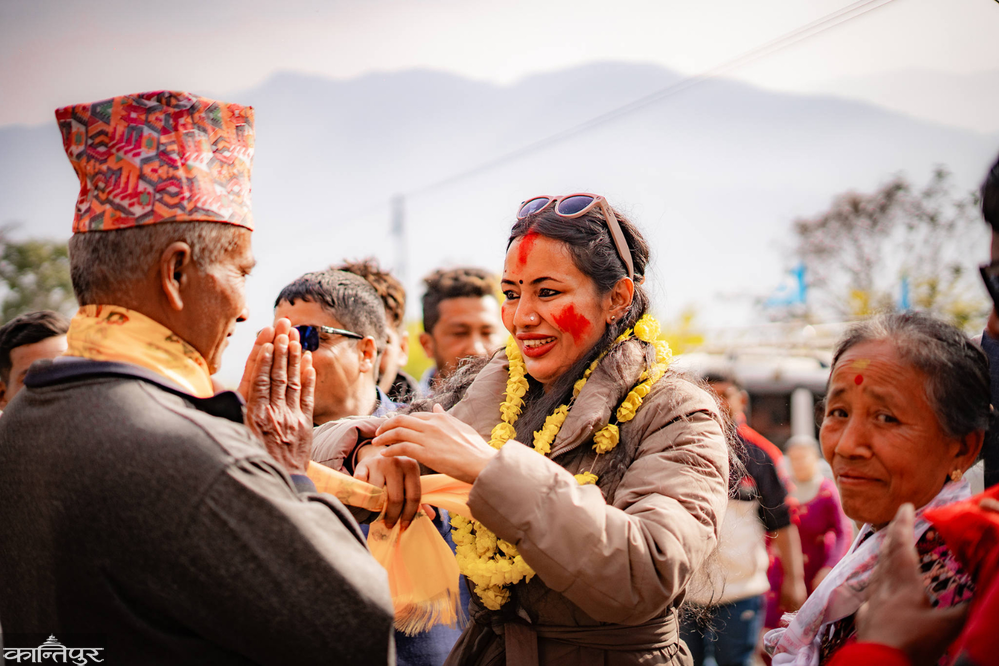
The same Ashika, who was sitting on the street yesterday and warning against wrongdoings and trends, has now reached the House. She was elected to the House of Representatives by getting 39,128 votes from Dhading Constituency No. 1 as a candidate of the Rashtriya Swayamsevak Sangh (RSS) candidate. After being elected, she thanked the voters through a Facebook post and said, ‘Now, not only wish me well, but give me work, make me accountable, give me orders.’
The public is familiar with Ashika’s style of ‘dressing the wounds’ of the injured on the street yesterday and raising her voice against wrongdoings. It has been about 8 years since Ashika has dominated social media with her expressions and activities that have spread in the digital world. In 2018, she had asked a heartbreaking question in a video while crying about why innocent goats were slaughtered. Her performance was found dramatic and unnatural, and Facebook users even started trolling her. She went viral under the nickname 'Khasini Didi'.
After that, Ashika, who had been attracting the attention of social media users at various times, started appearing aggressively on the streets in the last two years. Wearing sunglasses, she went from roads, hotels, bus parks to airport parking lots. The camera on the glasses recorded her activities. Sometimes she would go to hotels and ask tough questions about the price of bottled water. She would go to the parking lot and scold the employees there, saying that parking should be free.
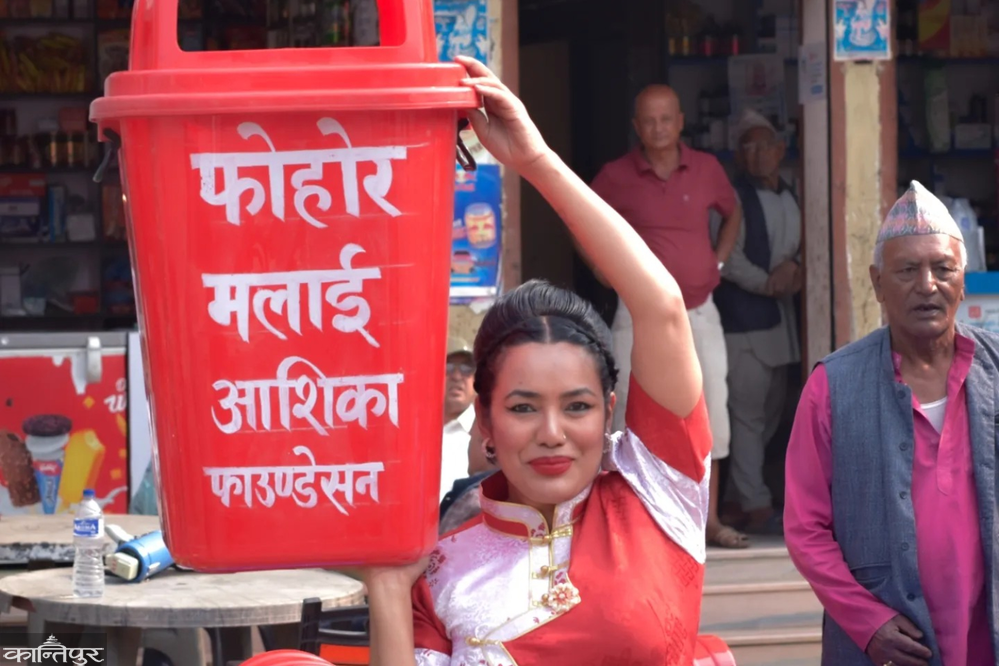
She would go to hotels near the highway and warn them about selling substandard food at high prices. She seemed angry about the charges for defecating. She would publicly warn those who were littering or defecating on the streets through videos. Wherever she went, she would capture controversial scenes and make them public.
Her work was praised, abused, and trolled on social media. Her style of work was criticized and against the law. Her activities were violating the privacy of some employees and individuals. Many also commented on her activities as 'cheap popularity' and 'stunt'. And she suddenly started to attract the attention of the state.
Ashika was arrested twice on charges of abusing people.
On Magh 2, 2081, the police arrested her for the first time from Swayambhu in Kathmandu. She was charged with indecent behavior. Her group had protested at the Pashupati Development Fund office on 24 Poush, 2081, alleging that a female employee had been fired without reason. She remained in the custody of Kathmandu Police for about 13 days. She was released from the District Administration Office, Kathmandu on a bail of 10,000 rupees.
She was arrested again from Kathmandu for the second time on 14 Magh. Immediately after being released on bail, she was taken into custody by the Bhaktapur Police. The Suryabinayak Municipality of Bhaktapur had filed a case of 'criminal nuisance' against her. She was accused of tearing and burning receipts and vandalizing the municipality's notice board while protesting the 20 rupee fee imposed by the municipality on the suspension bridge in Sanga. On 18 Magh, the Bhaktapur District Court ordered her release on a bail of 20,000 rupees.
Those who used to troll and abuse Ashika. Suddenly, they started looking at Ashika with eyes of love. How did people's attitude towards her suddenly change? For this, we need to go back to the scenes after the Gen-Gi movement. In the Gen-Gi movement on Bhadra 23 and 24, 76 people lost their lives and hundreds were injured. While the injured were lying in the hospital. Their families were struggling with financial hardship. When the state's presence was weakening, Ashika treated the injured with love and reached the hospital beds and the houses that were empty due to lack of food. She made that scene public on her Facebook page.
She reached the hospitals and houses and distributed food and money to the victims. Not only did Gen-Gi help the injured in the hospital, she also provided financial assistance to those who were helpless and whose treatment and medicine were stopped due to lack of money. People were moved to tears when she saw Ashika's gentle and affectionate appearance, which she had seen as rough and angry in previous videos. When she reached the camp or hospital, she would call the injured from afar with affectionate words, ‘Babu, Kancha. How are you?’ Some of the injured started saying with tears in their eyes, ‘You are our sister. Ashika sister.’
Ashika expressed not only human love but also animal love. For example, she was seen distributing fruits to monkeys in the Pashupati complex. She was seen feeding the birds. Many people praised her for this. However, helping by taking videos of the injured would affect the privacy of the person. But Ashika was of the opinion, ‘I have posted videos only with their consent.’ She even called for financial support through social media to help the Gen-G injured. She received support from all over the country and abroad.
The election of the House of Representatives on February 21 was approaching. Suddenly, Ashika announced her candidacy as an independent candidate from Kathmandu constituency no. 1 or 9 on Poush 25. ‘Today I have reached an important decision. After a long period of support from the people and my introspection, I announce that I will be an independent candidate from Kathmandu constituency in the upcoming House of Representatives election. I do not want to be bound by any party or political ideology,’ she wrote. She mentioned that she did not want the flag of a political party, but wanted the support of the people. She said that even though she was alone, she had embarked on a journey of change.
Before announcing her candidacy, on Poush 13, senior leader of the National Independent Party, Balendra Shah, proposed her to become a candidate from the proportional representation side. But she rejected this proposal.
Ashika, who initially gave her candidacy as an independent candidate, did not keep her word. She said she would stand without a political party and later joined the National Independent Party. On Magh 5, RSP leader Ganesh Parajuli handed over the Dhading-1 ticket to Ashika at the central office.
Ashika, who got the ticket from the RSP, had to face some difficult situations. Since Ashika's husband Thomas is a German citizen, rumors were spread that she had a German PR. That is why questions were being raised against her. According to Nepali law, a person who has a permanent residence permit or green card from a foreign country is ineligible to be a member of the House of Representatives of Nepal. Therefore, a legal question arose about the eligibility of her candidacy.
This question had led her to the Election Commission. She had been denying these allegations. She had clarified that she was a Nepali citizen and did not have any foreign identity card except her Nepali citizenship and passport. During the election, false or misleading information was spread that her candidacy had been rejected. When the Election Commission investigated her documents, it was found that the legal criteria for candidacy were met, and her candidacy remained intact.
Ashika did not stop being trolled even during the election. In a video that went viral on social media, she was seen sometimes asking for votes from a rooster and sometimes from a goat. This video of Ashika, who treats animals with love, was trolled. Shortly before the election, she slipped her tongue while giving a speech and tried to say something else, ‘I have come here to commit corruption.’ In fact, her intention was to say that she has come to stop corruption. Amidst a wave of trolls, abuse and praise, Ashika was finally elected by the voters there. She won the election by a landslide.
 From child laborer to social activist
Aashika had said in a podcast with Sanjay Silvas Gupta a few months ago, ‘If anyone sees a child laborer, they should remember her as their sister.’ She does not want anyone to work at a literacy age.
Because Aashika has experienced the pain of child labor in her childhood. Aashika was born on Asoj 1, 2045, in Malekhu, Dhading. Her mother and father divorced within a few years of her birth. Aashika lived with her father. Growing up in poverty and deprivation since she could understand, Aashika did not know for many years that the house they were living in was not hers. ‘In Malekhu, she was living as a maid in Ba Kandel’s house. In her life, she worked in someone else’s house. I found out much later that it wasn't our home,' she had said in a podcast. Due to the neglect of her other mother and the lack of finances at home, Ashika also had to leave her father at the age of 8.
She started school in Chitwan as a child laborer in someone else's house. She enrolled in Laxmi Mavi in Lankhu, Chitwan. She worked from 5 am until school, so she had no time for herself. 'I was always 10 minutes late for school,' she says.
After living in Chitwan for a few years, she returned to Malekhu. But her other mother could not tolerate it. After that, she was taken to her uncle's house. A small room was built for Ashika to live in the house. 'I passed my SLC while living in that house,' Ashika remembers.
Ashika came to Kathmandu to study nursing after SLC. Ashika, who initially studied biology, failed in everything except English in the first year. She had a desire to study nursing. She joined nursing again. She had studied on a scholarship from a German organization since school. The expenses were borne by the German organization.
Instead, she also had a monthly expense of 3,700. She covered her expenses in Kathmandu with that expense. As soon as she completed her nursing course, she saw a work visa in German in a weekly newspaper. She went to a consultancy and started studying German. She made good progress in the language.
Ashika's father wanted to see his daughter board a plane. He had also helped her get a passport. They used to tell Ashika, ‘You have a big dream of going to Germany.’ Unfortunately, the day Ashika got her visa, her husband left the world.
Ashika went to Germany. But initially she could not stay there for more than 6 months. She came back to Nepal. She saw that her siblings in Malekhu were worried. She brought them to Kathmandu and started teaching them. At that time, she had started a consultancy herself. But as the financial burden increased, she prepared to go to Germany again. Ashika had met Thomas the previous time. They used to talk. After reaching Germany for the second time, Ashika married Thomas. She was impressed by Thomas’ honesty.
There came a day for Ashika, who had once struggled greatly due to financial constraints, when she had many hobbies. She wanted to get to know him. She chose the film. She made the film ‘Sushree’ in 2015 with her own investment. She shared the screen with actor Aryan Sigdel. But the film caused a loss. She incurred a loss of more than 10 million. Ashika wanted people to recognize her. But neither the film did not work nor did anyone recognize her. She was in deep pain. Then she returned to Germany. A well-wisher reminded her, ‘Thomas is also getting old. Now become a mother.’
In 2016, she gave birth to her first child, son Aaron. Ashika now has a 9-year-old son, Aaron, and a 4-year-old daughter, Anna.
After the birth of her son, Ashika realized something big. She had never considered herself a mother before. ‘It was only when I became a mother for the first time that I felt that I was also born from someone’s womb,’ Ashika said in a podcast with Sanjay Silwal. Then she started to rant about her mother. But Ashika doesn’t even know if her mother, whom she never saw, is still on this earth. ‘Now the world knows me, but my mother doesn’t,’ she said emotionally.
Ashika started the Green and Clean Foundation in 2016. It was only after she returned from Germany that she noticed the garbage in the country. Ashika realized what kind of country she was born in, where there was no program to not throw garbage. After that, she started an awareness and cleanliness campaign. During the COVID-19 pandemic, she also provided assistance through her foundation.
She worked as a wage laborer and distributed food to those living in Kathmandu. सुरुमा त उनले आफ्नै २ हजार युरोबाट सहयोगको हात अघि बढाएकी थिइन् । त्यतिबेला पनि आफूले सहयोग गरेको फोटो भिडियो उनले आफ्नो फेसबुक पेजमा राखेकी थिइन् । जाजरकोटका भूकम्प पीडितका लागि पनि उनले त्रिपालहरू सहयोग गरेकी थिइन् ।
आशिका आफू चिनिन चाहन्थिन् । फिल्मबाट त सम्भव भएन । तर २०१८मा सामाजिक सञ्जालमा एउटा दशैंमा राखिएको भिडियोले भने उनलाई भाइरल बनायो । आफू चिनिन पाउँदा उनी खुसी बनिन् । २०१९ देखि कुमार बेन, विक्रम केसी, भिक्टर पौडेल, सन्दीप बस्नेत लगायत रुटिन अफ नेपाल बन्द टिमसँग भेट भएपछि उनको सामाजिक काम अझ संगठित रूपमा अघि बढेको थियो ।
‘त्यसपछि सामाजिक कार्यहरू सञ्चालन गरियो । यस अन्तर्गत: व्यापक सरसफाइ अभियान सञ्चालन, वृक्षारोपण कार्यक्रम फोहोरमैला छुट्याउने जनचेतना अभियान, बालबालिकालाई लत्ताकपडा, शैक्षिक सामग्री र पुस्तक वितरण खेलकुद सामग्री वितरण बाढी पीडितहरूलाई राहत तथा सहयोग वितरण, कोभिड-१९को बेला लकडाउनका समयमा खाद्य सामग्री वितरण लगायत थुप्रै कामहरू गरेँ,’ कान्तिपुरले गरेको प्रश्नमा आशिकाले जवाफ पठाइन् ।
 राजनीतिमा लाग्ने सोच उनमा पलाएको भने धेरै भएको छैन । पशुपति विकास कोषका करार कर्मचारीहरूलाई एक्कासी हटाइएको विषयमा प्रश्न उठाउँदा प्रहरीले उनलाई पक्राउ गरेर हिरासतमा राखेको थियो । त्यतिबेला उनी सोच्न बाध्य भएकी थिइन् ।
‘यी घटनापछि व्यवस्था सुधार गर्न कानुनी र नीतिगत रूपमा काम गर्नुपर्छ भन्ने निष्कर्षमा पुगेँ । त्यसपछि ग्रिन एण्ड क्लिन फाउन्डेसनका उपाध्यक्ष सन्दीप बस्नेतसँग छलफल गर्दै उहाँमार्फत कुमार बेन र भिक्टर पौडेलसँग सम्पर्कमा रहेँ । त्यसपछि राजनीतिक रूपमा अगाडि बढ्ने निर्णय लिएँ,’ उनी सुनाउँछिन् ।
अबको पाँच वर्ष आशिका संसद्मा हुनेछिन् । पाँच वर्षको अवधिमा उनका योजनाहरू के छन् ? हामीले सोध्यौँ । ‘मेरा मुख्य प्राथमिकताहरू भ्रष्टाचारविरुद्ध शून्य सहनशीलता नीति अपनाउने, बालबालिकालाई विद्यालय जान प्रोत्साहन गर्ने, विद्यार्थीलाई लत्ताकपडा, जुत्ता, झोला तथा खेलकुद सामग्री उपलब्ध गराउने, डिजिटल शिक्षाको व्यवस्था गर्न पहल गर्ने, वातावरण प्रदूषण कम गर्ने तथा अवैध खानी दोहन रोक्ने कानुनभन्दा बाहिर भएका गतिविधिहरू नियन्त्रण गर्ने, घुस माग्ने र जनतालाई दुःख दिने भ्रष्ट कर्मचारीमाथि कारबाही गराउने, काम नगर्ने ठेकेदारमाथि कारबाही गर्ने जनतासँग नियमित संवाद गरेर नीतिगत सुधार गर्ने कुरामा हुनेछन् ,’ आशिका भन्छिन् ।
थप्छिन्, ‘विकासका काममा हुने ढिलासुस्ती अन्त्य गर्ने आर्थिक अवस्था कमजोर भएकालाई निःशुल्क स्वास्थ्य उपचारको व्यवस्था मिलाउने साथै धादिङलाई कृषि हबको रूपमा विकास गर्ने योजना छ ।’
‘मेड इन धादिङ’ अभियान चलाएर किसानलाई मल, बीउ तथा कृषि सामग्री सहज रूपमा उपलब्ध गराउने कानुनी व्यवस्था गर्ने लक्ष्य पनि आफ्नो रहेको पनि उनले बताइन् ।
सडकमा आफ्नै शैलीमा खबरदारी गरिरहेकी आशिका अब नीति निर्माण र जवाफदेही ठाउँमा आफैं उभिएकी छन् । अबको पाँच वर्षमा उनी कति सबल र सफल देखिनेछिन्, त्यसको लेखाजोखा भने हुन बाँकी छ ।

