A Cambridge University study says – '10 years of inactivity is a critical turning point for international intergovernmental organizations'
We use Google Cloud Translation Services. Google requires we provide the following disclaimer relating to use of this service:
This service may contain translations powered by Google. Google disclaims all warranties related to the translations, expressed or implied, including any warranties of accuracy, reliability, and any implied warranties of merchantability, fitness for a particular purpose, and noninfringement.
'If someone came to your country and killed people, would there be a meeting?' is the answer Nepal received from Indian Foreign Minister S Jaishankar regarding the SAARC Summit. During her visit to India last August, Foreign Minister Arju Deuba received this rude reply from Jaishankar when she discussed the SAARC meeting with her Indian counterpart.
The South Asian Regional Organization (SAARC), established in 1985, has been inactive for a decade. Nepal is the chairman of SAARC. Since the summit of SAARC has not been held for a long time, Nepal has not been able to hand over the chairmanship. Nepal is constantly trying to hold the summit as the chairmanship and the secretariat of SAARC are located in Kathmandu. As a continuation of that, Foreign Minister Arju raised the issue of the SAARC Summit in her meeting with Jaishankar. However, she got a clear answer that India is reluctant about it.
Arju narrated her conversation with Jaishankar on December 29 in the International Relations and Tourism Committee of the House of Representatives, "When I went to India in September, I openly raised the issue of the SAARC summit. Just as I raised the matter, Indian Foreign Minister Jaishankar responded. When he said, 'If someone had come to your country and attacked, if your citizens had been killed, would there have been a meeting?' I was not in a position to say anything. Even during the United Nations meeting, she informed that even though she tried for a 'side line' meeting of foreign ministers of SAARC countries in New York, it was not possible.
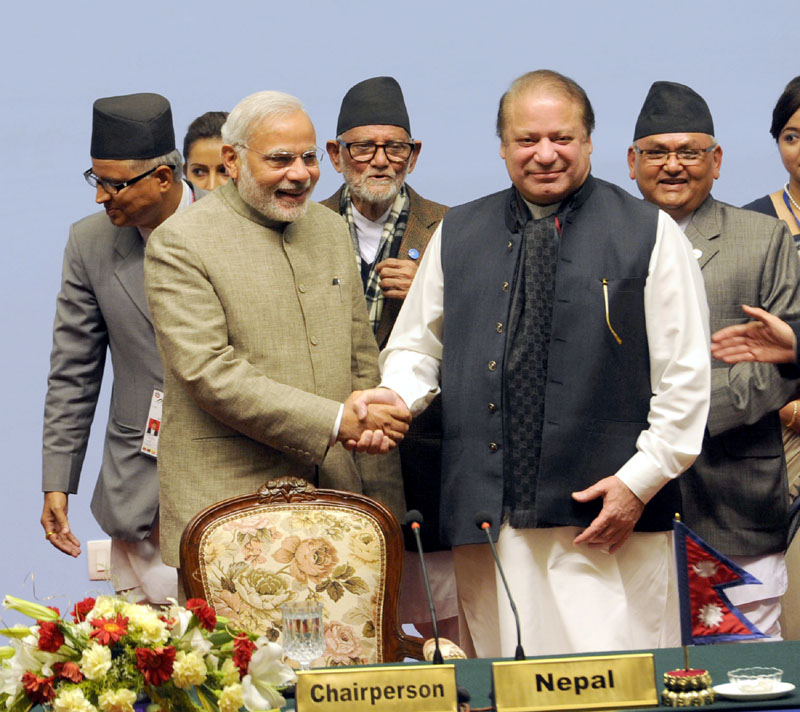
As the chairman of SAARC, we are in a difficult position. It has been tried many times. But, we don't just say that. The summit will be held only after the agreement of all the member states written in the charter of SAARC," she said in the committee, "Let's hope, the summit will be held after there is a better political environment in South Asia. It was not stopped because of us or because of less effort on our part.'
As a SAARC chairman country, Nepal proposed to hold a 'side line' meeting at the level of SAARC foreign ministers during the 79th General Assembly of the United Nations held in New York last October. Bangladesh also took initiative for that. However, it did not succeed due to India's reluctance. The SAARC summit, which should be held every two years, has not been held since November 2014 in Kathmandu.
The 18th summit decided to hold the 19th summit in Islamabad, the capital of Pakistan, in November 2016. However, three months before the scheduled summit, a terrorist attack in India on September 18, 2016, affected the conference. After the attack in Uri, Jammu and Kashmir, in which 18 Indian soldiers were killed, India blamed Pakistan and said it would not attend the summit in Islamabad. Since then, the SAARC summit has been mired in uncertainty. SAARC's charter stipulates that annual summits will be held. However, as it did not continue, it was announced that the meeting would be held in two years from the 18th summit. Indian Foreign Minister Jaishankar has been showing Pakistan as the reason for SAARC not being active many times from the public platform.
India will not be ready for the SAARC meeting as long as one member is involved in terrorist activities, he said. Since 2016, the Indian Ministry of External Affairs has been giving the official answer that the SAARC conference is not possible because the situation has not changed. Nilambar Acharya, the former Nepali ambassador to India, did not get a positive response from the government machinery and officials regarding the SAARC meeting until he spent two and a half years in Delhi. He is said to have had his say on the SAARC issue at all levels, including the foreign minister and foreign secretary. However, he says that he did not get a promising answer from anyone. He said that India has been continuously reluctant about the SAARC meeting.
SAARC has Afghanistan, Bangladesh, Bhutan, India, Maldives, Nepal, Pakistan and Sri Lanka as member countries in South Asia. The Secretariat of SAARC is established in Kathmandu. After the 2016 summit, the chairmanship of SAARC went to Pakistan. However, since the conference could not be held, Nepal could not hand over the presidency.
Former Secretary General of SAARC diplomat Arjun Bahadur Thapa Dakshia says that SAARC cannot gain momentum unless India, a big and influential country in Asia, wants it. "Until there is some kind of agreement between India and Pakistan, SAARC is considered to be in a sick state," he says, "SAARC has reached a state where it is not even possible to die due to suffocation and it is difficult to survive, as a result of which this organization is becoming useless." But there is no option to wait.'
SAARC was established with the ambitious goals of agricultural development, poverty alleviation, ease of transportation, increase in trade and running a single currency in the South Asian countries. However, due to frequent tensions between India and Pakistan, SAARC has become relaxed. This is not the first time that SAARC has been affected by tensions between the two countries. The 11th SAARC summit had to wait for 4 years due to the Kargil war. Before that, SAARC was also affected by nuclear weapons tests by both India and Pakistan. In 2014, the 18th summit was held in Kathmandu after 3 years. The problem of not meeting on time is an old one. But, there was never a gap of 10 years like now. And, there is no sign of a conference in the near future," Thapa said. "This gap is increasing, and questions are being raised about the legitimacy of the organization itself."
November 2024 marks the completion of a decade of SAARC summit. A study conducted by the University of Cambridge's Department of Politics and International Affairs considers 10 years of inactivity to be a critical turning point for any international intergovernmental organization. The study said that an organization can be considered dead if it has not worked for 10 years or more. If the study is to be believed, the future of SAARC is in crisis if there is no decisive dialogue or decision as soon as possible.
His 10 years of inactivity for any intergovernmental mechanism certainly does not bode well for his future, says diplomat Arjun Karki. He expressed concern that the long gap would negatively affect the institute. However, his analysis is that there is no need to lose hope as the member countries are still providing the necessary budget and staff for the SAARC secretariat.
India's role in the establishment of SAARC is considered less. Among the planners of its establishment, the names of Bangladesh and Nepal come up. India has been suspicious of SAARC since its inception. India was already suspicious that neighboring small countries would use the SAARC platform to surround itself and Pakistan could take advantage of it. Former Nepali Ambassador to India Nilambar Acharya says that India's role was less in the beginning of the establishment of SAARC and the role of Bangladesh and Nepal was more. "If India had initiated the establishment, the situation of SAARC would have been different," he says. India's reluctance towards SAARC is also considered to be the entry of China after Pakistan.
At the 13th summit held in Dhaka in November 2005, China was admitted as an observer to SAARC on Nepal's proposal. Afghanistan became a new member of SAARC on India's proposal. "India could not oppose or disagree with the proposal made by Nepal to China," said Acharya, "but the same proposal was made to tease India." It was seen as an attempt to reduce India's influence on the SAARC forum. He believes that this incident has also increased doubts about SAARC in India.
Although the then Indian Prime Minister Manmohan Singh continued to participate in the SAARC conference. During his tenure from 2004 to 2014, Singh kept SAARC in good stead. After the BJP won the elections in 2014, Narendra Modi became the Prime Minister. He invited the heads of all SAARC countries including Pakistan to his swearing-in ceremony. However, he has attended the summit only once as he enters the 11th year of his third term. After participating in the conference held in Kathmandu in the first year of becoming the Prime Minister, SAARC was not his priority. However, former ambassador Acharya believes that there is still room to hope for the future of the organization as India has no intention of ending it or separating from it.
India's focus seems to be on developing relations with powerful western countries and improving the damaged relations with China. "India, which is emerging as a world power, seems to want to stay with big and strong countries," Acharya said, "seems to be more active in Shanghai Corporation, BRICS, Quad, G-20." That's why SAARC may not be his priority. However, he believes that India, which is on the verge of becoming a world power, is making a mistake by not using SAARC's platform. He adds, "In terms of economic, social or global connections, India used to play a greater role as a SAARC member." He could have run this forum according to his interests, if not, he would not have allowed it to go against himself, India is losing that opportunity.'
India has been sharing the stage with Pakistan at the Shanghai Cooperation Organization (SCO) meeting. Jaishankar went to Pakistan to attend the SCO meeting in October last year. The previous year in May 2023, the then foreign minister of Pakistan Vilawal Bhutto had reached Goa to participate in the SCO meeting.
Since India is sharing a platform with Pakistan in the Shanghai Cooperation Organization, Acharya believes that the same can be expected with SAARC. But a long-term gap also builds a kind of ego. The slower it goes, the more difficult it will be," he said, "such an ego can also cause problems to wake up SAARC."
The election of the Secretary General of SAARC two years ago and the continuation of financial support, he also understands that there is a desire to keep SAARC alive in the member countries. Bangladeshi diplomat Mohammad Golam Sarwar was appointed Secretary General of SAARC two years ago.
Apart from the tension between India and Pakistan, the upheaval in Afghanistan, the youngest member of SAARC, is also seen to affect its future. The Taliban seized power in August 2021. The Taliban-led government has not been recognized by any country in the world. India has been increasing contact with the Taliban government in the name of humanitarian aid. Sharing the platform with the unrecognized Taliban government is another challenge for SAARC.
Diplomat Karki, the former Nepalese ambassador to the US, believes that any member state of any regional or intergovernmental organization should not block the organization itself by citing bilateral or geopolitics. He says that the United Nations is an example of that. Countries that are at war with each other also participate there. They keep their own things. This principle is also applicable for other organizations," he said, "in that sense, other member states who are counseling or lobbying for SAARC need to be proactive, including creating pressure for that."
Although SAARC was established to strengthen relations between South Asian countries and to identify and solve common problems, it has not been able to give results accordingly. SAARC's charter states that no bilateral issue shall be raised. Similarly, to hold a summit or to take a decision on any issue requires the consent of all the member states. "Sometimes the multilateral forum is not affected by bilateral tensions, although it seems so," said Acharya, the former ambassador to India, "but, after expressing dissatisfaction, work should have resumed." Since that is not happening, it is natural to raise questions about the future of SAARC. The tension with Pakistan has increased after India abolished Article 370 of the Constitution and brought Kashmir completely under its control. It seems that India wants to use a common platform with its neighbors only by isolating Pakistan.
At the summit held in Nepal in 2014, there was a discussion to create a direct transport network between the SAARC countries. However, in 2015, the BBIN project was signed to start transport services only between the four countries of Nepal, Bhutan, Bangladesh and Bhutan. India has been giving more importance to it than SAARC.
Likewise, India has prioritized the Bay of Bengal initiative (BIMSTEC) for multi-sectoral technical and economic cooperation in which Pakistan is not participating. Initially Bangladesh, India, Sri Lanka and Thailand jointly established the platform. Later, Myanmar, Nepal and Bhutan were added to BIMSTEC. The organization was established in 1997 to exchange assistance between the South and Southern Asian countries and the purpose of promotion to promote trade.

