Smartphone addiction can cause physical problems such as insomnia, obesity, unhealthy eating habits, headaches, migraines, and changes in some parts of the brain.
We use Google Cloud Translation Services. Google requires we provide the following disclaimer relating to use of this service:
This service may contain translations powered by Google. Google disclaims all warranties related to the translations, expressed or implied, including any warranties of accuracy, reliability, and any implied warranties of merchantability, fitness for a particular purpose, and noninfringement.
Anu Adhikari, Principal of Kids Campus Monteshwari in Ratopul, Kathmandu, rang one day. Nearby children watched intently. She stood on the ground of Monteswari and answered the phone. She was barely able to talk when a child ran up to her and asked for the phone.
She reminded that the officer should not use the phone in the school. When the child started crying and crying without getting the phone, the school teacher and other teachers barely stopped.
The child calmed down but the officer's mind could not be calmed down. She exclaimed, "In 15 years of experience, this has never happened. Why is it like this nowadays?''What is the fault of small children? The parents have made it a habit," said the official about the smartphone addiction among young children. "We told a parent who recently admitted her daughter that her daughter will not eat anything. If he shows the phone, he eats wisely. He told me to feed him even if he showed me the phone. This is how it went wrong. Children from 2 and a half to 6 years old are enrolled in
kids campus. The official said that now a lot of parents come to show their children that their children are wiser. Pediatrician Dr. Niva Rajbhandari shares her experience. According to him, a parent brought his daughter Abby (name changed), who is about 4 and a half years old, for examination. AB had a 'urinary tract infection'. He will recover from the infection and keep getting better. Dehydration was the cause of the infection.
'AB was fed while looking at his mobile phone. He has a habit of looking at his mobile no matter what he eats. Even to drink water and milk, you have to show your mobile phone,' says Niva, 'Abby started going to school just like that. The same problem happened at school. But the parents did not disclose the problem of their daughter to the teacher. The teacher has also told me many times to bring food from home. Abby drinks very little water even if she is given food and snacks. Because of this, AB got dehydrated and got a urinary tract infection.'
Savitri Koirala from Gokarna in Kathmandu is tired and unable to spend time with her child as she comes home from the office all day long. So she says that even if she doesn't want to, she has to give the screen or the mobile phone. She says, "Both of us are not spending time." What to do in this case? His friend at home is the phone.'
These are just some representative incidents. But now most of the houses have the same problem. How does smartphone addiction affect children? A study published in the National Library of Medicine, Frontiers in Psychiatry journal in 2021 on the effects of excessive smartphone use on adolescents and young adults. It has been mentioned that excessive smartphone use is associated with depression, anxiety, OCD (obsessive compulsive disorder), ADHD (attention deficit hyperactive disorder) and alcohol consumption.
Uncontrolled use of smartphones can cause problems such as difficulty in controlling one's emotions, showing impulsive behavior, inability to focus on work, inability to work with one mind, increase in shyness in children, decrease in self-esteem and self-acceptance. Similarly, physical problems such as insomnia, obesity, unhealthy eating habits, headaches, migraines, and changes in some parts of the brain can cause harm. According to the study, spending too much time on the screen affects the overall mental, physical and social aspects. Maximum screen use increases eye strain, neck and shoulder pain.
In 2015, a study by the Chinese Academy of Sciences, Wuhan, conducted an MRI scan to compare the brain structure of people with and without Internet addiction disorder. According to research, there are changes in some parts of the brain of people with internet addiction disorder. Changes were seen in parts of the brain associated with important roles such as decision-making, the ability to understand the emotions of others, and self-control.
According to Saroj Ojha, Professor and Psychiatrist of the Tertiary Teaching Hospital, many parents come with problems such as children's poor studies, not doing their daily work well, not doing homework, not eating properly, abnormal weight gain or loss, not sleeping at night or staying up late. "Many children have been found to have this problem because of excessive screen time," he says.
Some studies even say that the Internet and drugs work in the same way. According to University of Southern California (USC) Dornsife College of Letters, Arts and Sciences professor and neuroscientist Antoine Vishara, the brain works in the same way as cocaine and Internet addiction. "The Internet and cocaine produce dopamine, the neurotransmitter that makes you feel happy. Which keeps pushing us to find that happiness again and again,'' Vishara noted in a 2017 USC Today article on smartphone and drug addiction.
Similarly, explaining the argument that smartphone addiction causes obesity, Dr. Niva says, 'Smartphones do not directly increase obesity. Children also eat for fear of not being able to look at the screen. But they eat without even knowing what they are eating. They eat a lot without realizing that they are hungry. If you don't eat carefully, the body can't digest it quickly and well.
In 2022, Jama Pediatrics conducted a study on 422 children aged 3 to 5 years and their parents. The study showed that excessive use of mobile phones to calm children reduced their executive function and led to rapid agitation over small things and rapid mood swings. When children are constantly using mobile phones to calm them down, over time they may not learn to manage their emotions.
According to the World Health Organization, children under the age of one should not be exposed to screens. Likewise, children aged 2 to 4 should not be exposed to screens for more than an hour a day. According to many such studies, even for adults, watching screens for more than 3 to 4 hours apart from work is harmful. But according to a study conducted by UNICEF and Child Safe Net on children and young people in Nepal itself, one out of four children or young people use the Internet for more than 10 hours a day.
which was 7 percent before covid and increased to 24 percent after covid. Similarly, a study conducted on 500 teenagers aged 13 to 17 in Kathmandu Valley in 2020 showed that 83 percent of them have their own mobile or computer. In 2010, Steve Jobs announced that iPad was the best way to browse the Internet than laptops and phones. claimed.
A few months later, an interview with Steve Jobs was published in the New York Times. Steve Jobs was asked if your child would love the iPad. In it, Steve Jobs revealed that his children do not use iPads. He said he limited his children's use of technology.
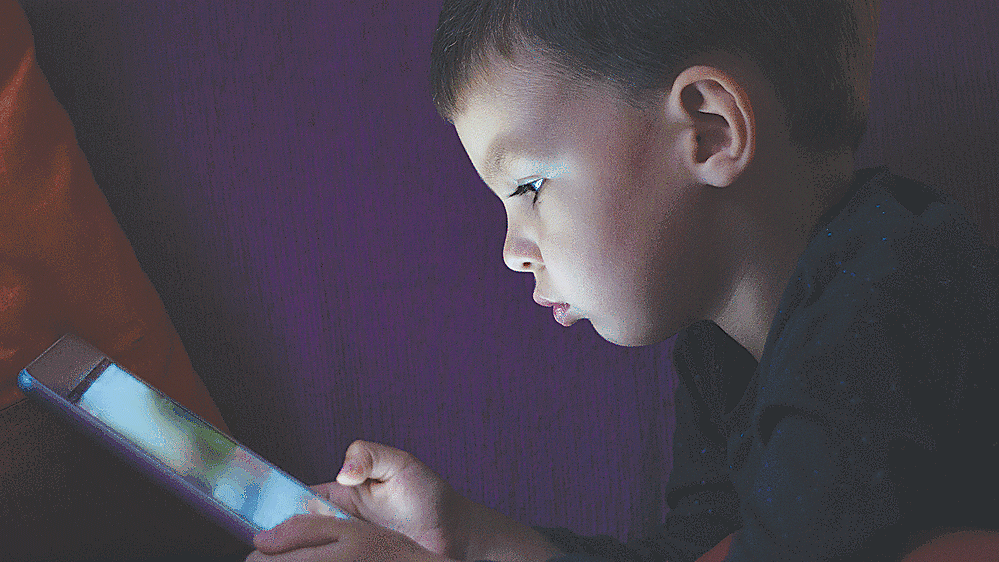
Why did the tech giant Jobs limit the use of technology to his children? Because, he is aware of the harm of excessive use of such things. On the other hand, according to various studies, content aimed at children is addictive. Psychiatrist Dr. Rachna Sharma also says that the content that children watch is very addictive. He says that after watching this material once or twice, he will want to watch it again and again.
What is the impact on young children?
Doctor Sharma says that since the first 3 years are very important in the overall development of children, they should not be exposed to screens. She says, 'At this age, they learn to listen to others' conversations, start speaking, think, learn to plan, interact, read facial expressions, and understand emotions. Therefore, if a child is exposed to many devices at this age, he will not develop any such skills, which directly/indirectly affects all areas. That's why the problem of visual autism is also increasing now.
Addiction to devices is also a cycle, says Dr. Arun Kunwar, a psychiatrist. If we talk about children, they don't want to go to school because they use the phone a lot and they stay at home and spend more time on the screen. Which increases problems like anxiety and even looks at the phone to forget it. In this way, this cycle of problems continues," he said.
Kunwar said that it is more harmful to let children look at the phone or screen to silence them as soon as they get angry. Therefore, Kunwar says that natural things like anger and stubbornness should not be suppressed, but should be taught to express them well. Sharma argues that
parents are role models. "With small families and busy parents, there is no one to give time to the children at home and they get used to any device," says Sharma, "slowly the daily life becomes that way. Sharma said that people get used to not having a device, they get angry and resentful when they don't have a device.
Parents are the first door to children's learning. Ojha says that children learn by watching their parents. But nowadays, children get used to the device even after seeing their parents using the phone. Rather than saying that the child is addicted, parents should think about whether they are becoming a role model.
Clinical psychologist Trishna Chhetri believes that phones and devices should not be seen as addictions, but as opportunities. According to Chhetri, parents need to be very careful in the current generation that is obsessed with technology. "Whether or not there is an addiction, whether it has affected the daily life of the child or not, what kind of content your child is watching on the screen - all this is something that parents should check. It is the parents' responsibility to guide them towards good learning,' she says, 'to make it like a source of entertainment, not a source of time pass. Even if children are given time to use the phone as a reward if they do their daily work, it turns the use of the phone into a positive rather than a negative thing.
Clinical psychologist Chhetri argues that the phone should only be used as an alternative. According to him, even if you use the phone, it is appropriate to exercise, get used to playing games indoors if there is no space outside, and do creative work such as painting, dancing, and learning to sing. "Anything is harmful when there is too much," she said. There is no problem if the parents monitor.'

