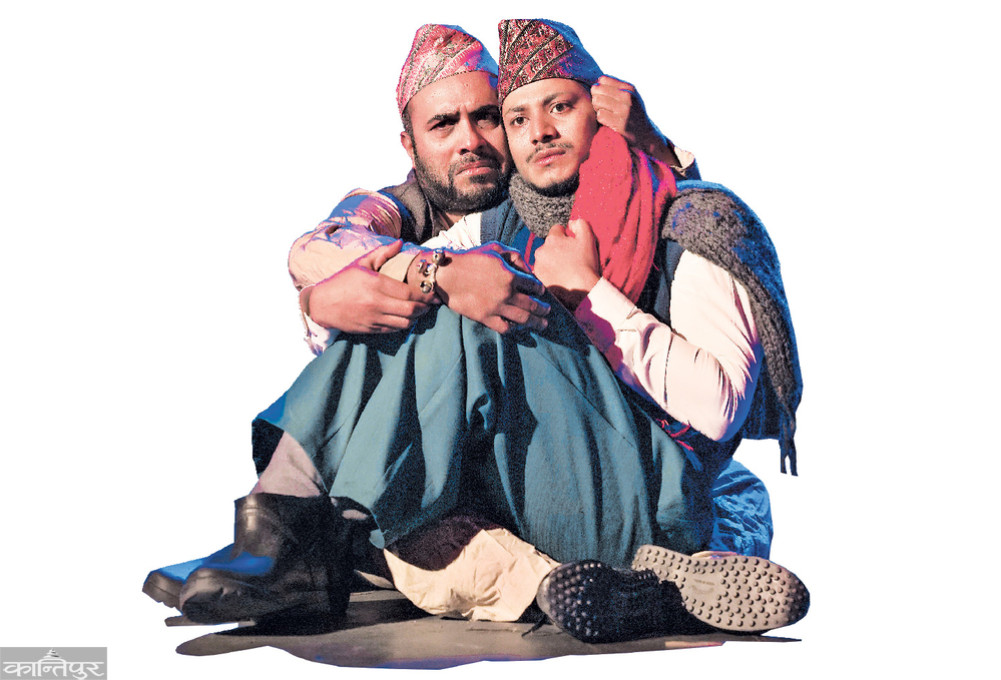
Written and directed by actor Nazir Hussain, the mix of poetry and chorus makes this play different and stronger than other plays on conflict.
We use Google Cloud Translation Services. Google requires we provide the following disclaimer relating to use of this service:
This service may contain translations powered by Google. Google disclaims all warranties related to the translations, expressed or implied, including any warranties of accuracy, reliability, and any implied warranties of merchantability, fitness for a particular purpose, and noninfringement.
A chorus is never missing in actor Nazir Hussain's play. Or rather, the chorus does not leave Nazir. Nazir is adept at using the chorus in storytelling. If you look at his plays from 'Kuroop Haas' to 'Hari Hazurba', Nazir's narrative style is made artistic by this element.
In the drama, the chorus sometimes comes to tell the story, sometimes to ask questions as a character! Sometimes it is presented as a collective song to advance the story and sometimes as a medium to reveal the emotions of the characters!
In the play 'Hari Hazurba' written and directed by Nazir, which is currently being staged at Mandala Theater in Thapagaon, the chorus takes the form of a storm, becomes a mountain and speaks the sentiments of the main characters. One evening, Huri, who came to Batti, says to the postman Hari (Nazir), 'You have to go this way, you have to meet someone.' Following the suggestion, Hari also chooses the upper path. However, Huri chases Hari down the path.
Hari's journey towards Bikaspur starts with the thought that the postman's job will be lost after delivering the last letter. In an empty village before reaching Vikaspur, Hari meets a character indicated by Huri, he is Grandfather (Vijay Baral). Who are waiting for the return of the granddaughter Bud, whom the 'Jungle' kidnapped in style, eyes on the road.
It is the grandpa's destiny to wait for the news of his granddaughter on the dull radio. His friend, who has been waiting alone in the leaky house for years, has the same old radio, discarded old batteries collected from Pallo village, a stick and a red sweater of Kapila carefully hung on the wall. The old man who says 'no one in the village talks to him' sits in a leaky hut like a nestling waiting for his mother. -break Hari and Grandpa meet in that courtyard, which has been waiting for someone's arrival for years. From where the bud that had just started to grow was plucked and taken away by the 'jungle'. The play shows the slowly building relationship between Hari and Grandpa, waiting for a letter with a message and the pain of the wounds of the past war.
Pain greater than separation awaits its arrival. Disappearance This story does not tell the story of the disappeared. However, it tells the story of those families and relatives who have been breathing heavily for years. In the empty village, the grandfather is alone, just like the lonely old tree with only one leaf shaking behind the house. In this drama full of
images, only this green leaf is left that shows the grandfather's hope. This story, told in the background of the war, shows the destruction and screams of that time without the bombs and gunpowder used in the war.
The time of war is observed through two characters appearing on stage. When the memory of the grandfather comes to mind in flashbacks of him taking his granddaughter to war, Hari Patra is shown by the chorus with a gun in his hand and a black sling over his shoulder. The character then immediately changes into a rebel disguise.
This is how the disguise has been changed to tell the story of the character who was disappeared by the army. Both these views try to balance both sides in the war. Vijay and Nazir's powerful acting can be seen in these two scenes. Vijay, who looks frail, kind, innocent in the guise of a grandfather, immediately becomes hardened in this scene.
The words of rebellion are echoed in a loud voice holding the foundation of the forest. That hardness is visible in the expression on his face. He immediately transforms back into a weak grandfather. With tears in his eyes, Nazir presents the harsh rule, exploitation and punishment of the army.
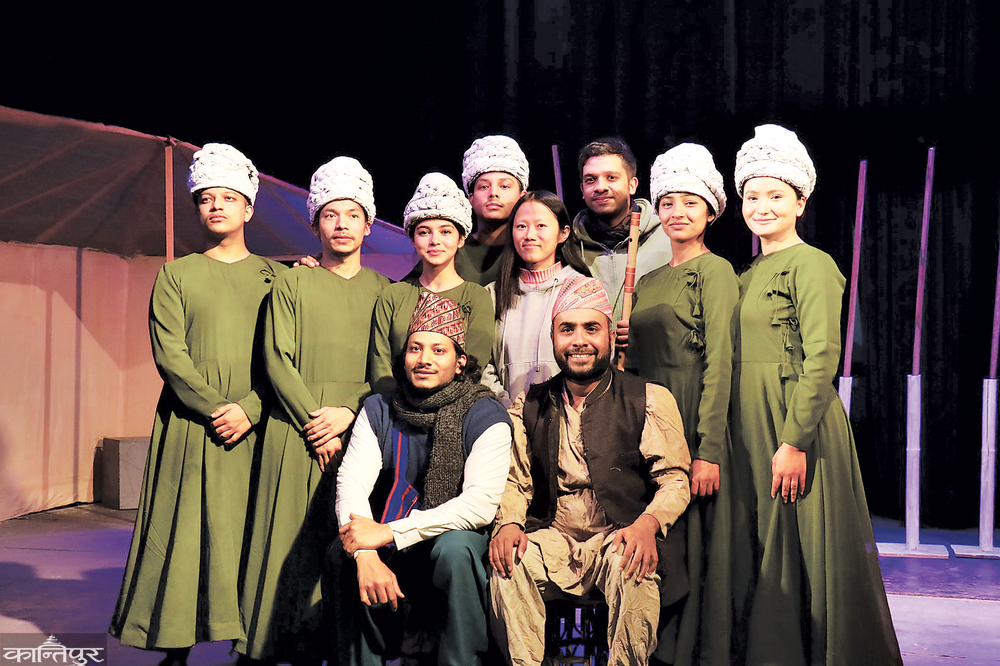
In this play which is about 1 hour long, the strong performance of these two actors proves the strong direction of Nazir to 'Hari, Grandfather'. The rhythm of Nazir's beautiful poems is mixed with it. So at the beginning of the story, the chorus sings in unison!
One day in the evening after the birds settled down
A bunch of people came from across the village
A bunch of people came from the forest
One day in the evening after the birds settled down
Both the bunches started killing each other
A javelin went, Khukuri Go on...
Dramas, poems, films and literature have not been written before on various topics of war. However, Nazir has expressed through drama the eyes waiting for the way of relatives in the mixture of his poetry and chorus. Similar elements used in the narration of the story set the play apart. The drama forces us to think about the wounds and achievements of war.
recalls a period of history. To tell this story, director Nazir has captured other beautiful aspects. Subplots keep the audience engaged as the story progresses. After each scene, the audience anxiously waits for the next scene. The similar aspect of story telling has made the play interesting. Various props including music, radio used in
plays have strengthened the story. In the scene where the hope of the character is dying, the same green leaf hanging on the old tree also falls to the ground. The story of 'Hari Hazurba' feels more powerful when the two main characters get closer to the truth.
gets caught up in confusion, then a skeleton is found in front of a bush, a red light appears on the stage. Such interesting events unfolding along with the story have made 'Hari Hazurba' strong in dramas based on war. Not only the families who disappeared during this conflict, but also those who are waiting for their displaced children will be able to empathize with this pain. In that sense, those who are waiting for relatives who are alienated by foreign employment will find themselves in it.
However, the drama seems to be in a hurry to get into the depth of such feelings. Had that pain and suffering been conveyed in slow motion, the play would have taken on a different dimension. Innovation is not found even in the same sky shown in the green leaf. In some scenes, if the character had used heavy words and only spoke the emotions, the weight of 'Hari Hazurba' would have increased even more. However, these aspects are made secondary by the story told by the chorus, the songs sung.