There is an increase in the number of young people participating in festivals and cultural events celebrated by the nature-worshiping Limbu, Rai, Sunuwar and other castes.
We use Google Cloud Translation Services. Google requires we provide the following disclaimer relating to use of this service:
This service may contain translations powered by Google. Google disclaims all warranties related to the translations, expressed or implied, including any warranties of accuracy, reliability, and any implied warranties of merchantability, fitness for a particular purpose, and noninfringement.
Angel Limbu from Phungling-3 Shimla also came to celebrate the Chasok Tangnam festival in the capital Fungling last week. She was studying in Class 8 in Kanchenjunga Residential High School and her friends Rista Rai and Zia also reached Nepal. To celebrate the festival, Angel, who dressed up in Limbu community dress, wanted to take her friends in Limbu dress as well.
"As we are good friends in class, I want to celebrate each community's festival as one," added Angel, "I can participate this year, next time I want to dress up in my community's clothes and take pictures together." She said that she prefers to go to her friends' festivals wearing the clothes of her community.
Angel, who came to Chasok, ate the dish of plums mixed with paneer (Yangmen) herself, and her friends also tasted it. Usually in the mountains it is cooked with goat meat. But she said that her friends did not eat meat so they ate the dish mixed with paneer. Fungling-7 Dokhuki Semi Palungwa Limbu did not go to Chasok Tangnam this year. She climbed the water tank of Tokmedanda to dance Sakela. Even though she is a Limbu, she went to the Sakela dance with her mother because her mother's mother-in-law is Rai. She, who studied in class 11 at Bhanujan Mavi Ambitar, also took her friend Kushalta Limbu, who studied in class 12. Mother Sita Rai danced the whole day with the people who came from Maiti village in Limbu with Seula in her hand and after eating roti, vegetables, pickles and other dishes, she returned with her mother.
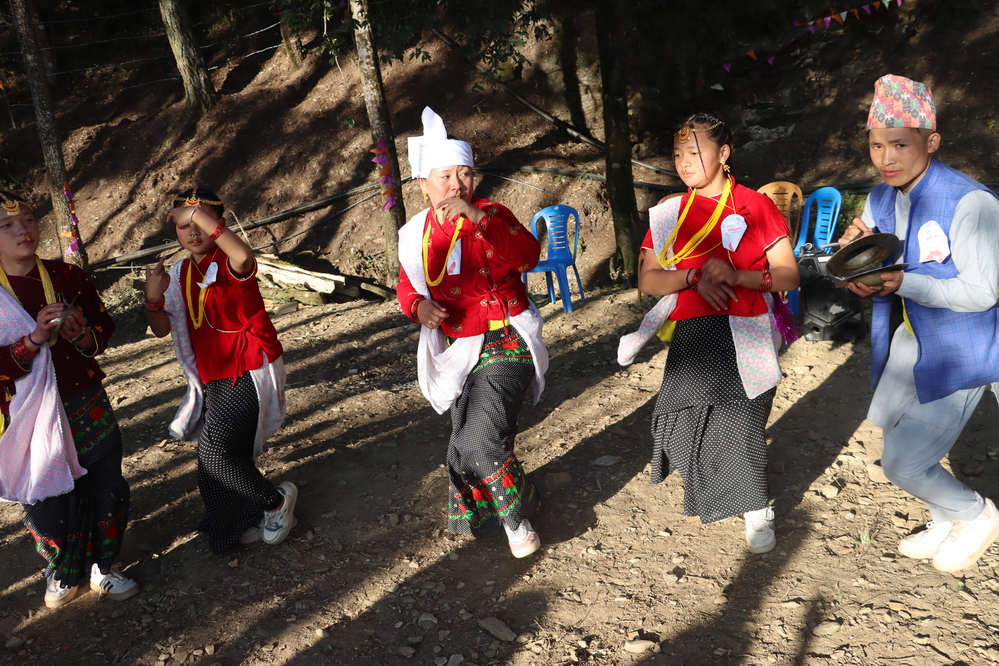
Cultures such as Chasok Tangnam, Sakela, Chandi celebrated by castes like Limbu, Rai, Sunuwar and other nature worshipers are being passed down from generation to generation. The young generation who go to the festival along with the elder members of the family, wear the corresponding costumes and enjoy activities such as dancing in harmony with the elders. Indira Menyangbo, president of Kirat Yakthum Chumlung, is happy that such practices preserve traditional culture. "We have also made some efforts to attract the young generation," Menyangbo said, "We have coordinated with the local level and other agencies to provide training in Chabrung dancing, take them to dance in the festival, and purchase costumes." Dumbar Palungwa, vice president of Chumlung, says that along with conservation, jobs will also be created.
Local Hangmaya Lecharbo, Bhakta Bahadur Palungwa and others have been organizing competitive programs by conducting training programs in an institutional manner. As a result, they say, the participation of the youth in such community programs is increasing. Bhakta Bahadur himself also says that he reached India's Simkim for the Chabrung competition and came back as second. "Nowadays, there is no one who does not know how to dance," he said, "However, the style of dancing is very different in different cultures." He says that because it is a combination of language, culture, and even rhythm, one should dance and sing in a way that does not cause harm.
Chabrung dancers must carry instruments on their bodies. You have to adjust the rhythm by hand. The one who teaches at the beginning is called Kusarakpa and is taken for granted. After that, there are different types of dances like pigeon, snake, dhami,'' said Hangmaya. Chabrung, a popular tool of the Limbu community, costs up to 25,000 rupees. A male dancer needs daura, suruwal, eastcoat, muffler, hat and shoes. For women, we need chaubandhi, saree, patuka, bag. There is a trend of wearing bulaki, dhungri, shirphool, shirbandi. Chabrung is played oddly in sadness and paired in happiness.
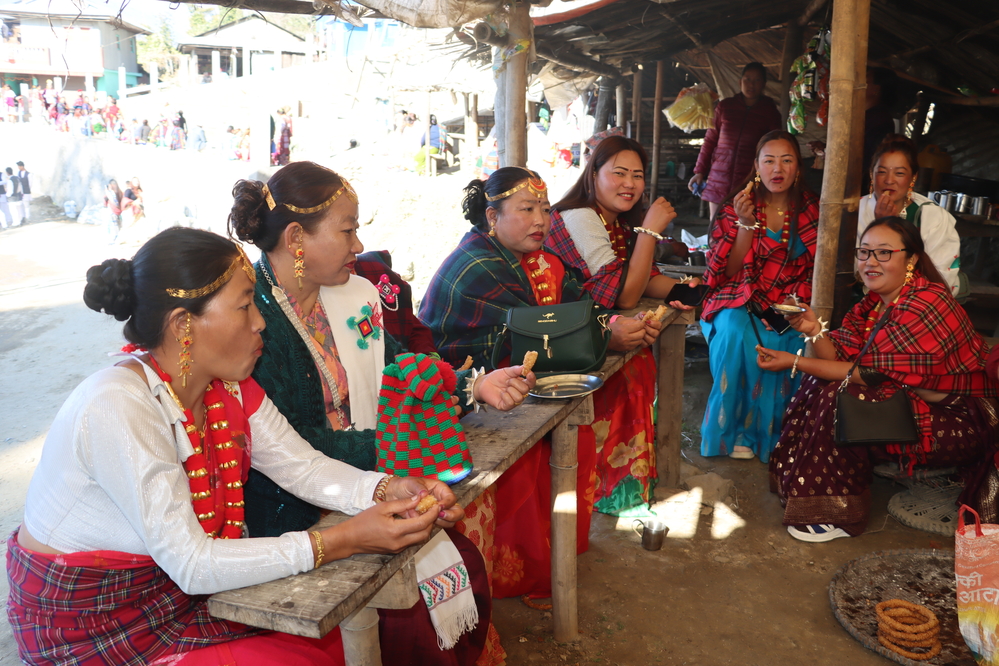
Rai's sakela and gold's Chandi are equally expensive. Tej Bahadur Rai of Yaokkha says that the difference between lemon and Rai is Kirat Rai Yayokkha. Rai puts a pair of dholaks in one place and everyone dances to the same beat. Every man in Limbu must dance with a chabrung and a woman with a jhamta. Chandi of Sunuwar is also reached with the same tool as that of Rai. But Kshitij Sunuwar, coordinator of social development committee of Fungling-8, says that a lot of money is spent on chamar and clothes. He claims that the municipality has also paid attention to the entry of the new generation.
Paddy dance was popular in Taplejung, home to 42 percent Limbu caste, until the development of communication. If the young generation did not want to be related, men and women held hands and danced paddy. They used to exchange their stories through Palam about how the family is doing, what are their plans for the future. This practice disappeared with the development of communication. Dumbar of Chumlung says that in the area where the majority of the Limbu community lives, activities that reflect their culture have somehow increased.

