We use Google Cloud Translation Services. Google requires we provide the following disclaimer relating to use of this service:
This service may contain translations powered by Google. Google disclaims all warranties related to the translations, expressed or implied, including any warranties of accuracy, reliability, and any implied warranties of merchantability, fitness for a particular purpose, and noninfringement.
Penjokla Sherpa of Ghunsaki in Taplejung Paktanglung Rural Municipality-6 Lelep is well aware of the habits of snow leopards. She came to Ghunsa after getting married from Gufapokhari in Sankhuwasabha. Penjokla has not only heard the sound of the snow leopard, she has seen the tears of the farmers after the snow leopard ate their livestock.
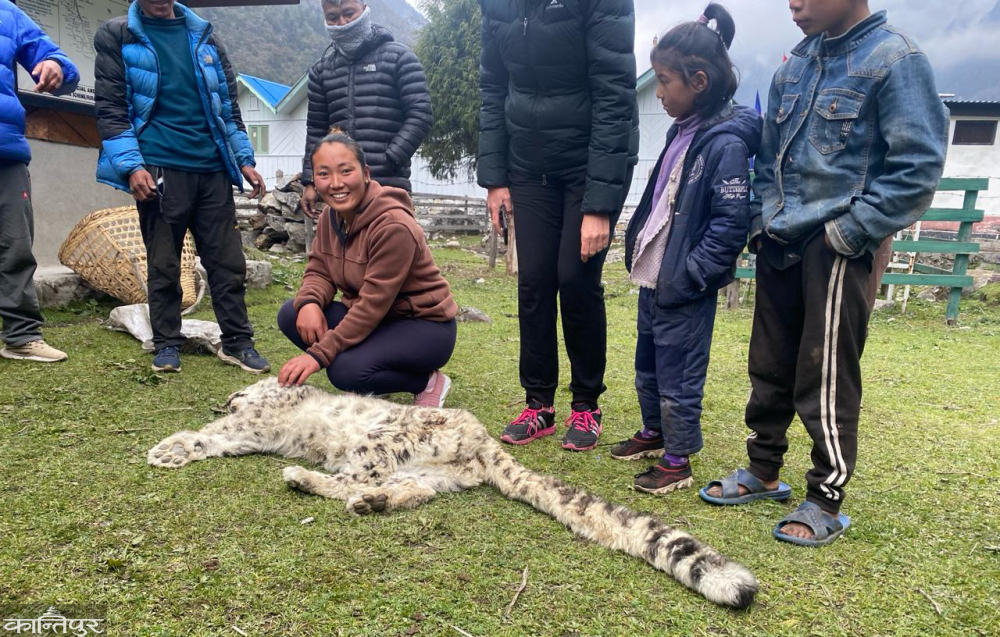
While returning from Khunsa with her husband, she saw a herd of chaunri who had been chased by a snow leopard. Her husband is busy running a hotel. Although she has not had the opportunity to see a live snow leopard yet, she has participated in the funeral of a dead snow leopard.
The 27-year-old Sherpa is now the chairman of the snow leopard conservation sub-committee in Ghunsa. There are other women in the seven-member committee. "Even when foreigners come, they ask about the snow leopard, the village people also talk about the snow leopard saying that it ate chaunri, nower ate," Penjokla added, "I decided to sit as the next president rather than form a sub-committee in late Baisakh."
Within three/four days of his becoming the president, there was a news that a snow leopard died in Khambachen. She was nursing her eight-month-old baby at the time. Since it takes three days to reach the spot where the snow leopard died, she could not go to the spot. Committee members, community forest officers and others went and brought the dead snow leopard to Ghunsa and buried it.
She collected material about the snow leopard and studied it, met its experts. A mother of one, she now plans to observe snow leopard habitats and provide conservation education as her children grow up. "I met the country director of WWF in Kathmandu and heard their experiences," Penjokla added, "now the season to go to the mountains has started, I will go and see the places where the snow leopards were first installed with satellites and traps."
For being the first female president, she has received applause from many and wants to be knowledgeable about snow leopards and show her subcommittee a good job. The sub-committee headed by him now has a fund of Rs. 28 lakhs. If a snow leopard damages someone's livestock, they must pay up to 10,000 as compensation. Farmers have complained that they are charged Rs 10,000 for killing 80,000 chaunri, so they want to increase the amount to at least 30,000. She said that she is studying for that and discussing with the committee and consumers.
He is confident that he will be knowledgeable about snow leopards by using the time of ebb and flow of these places to make hotels at 3100 meters high Khunsa and 4200 meters high Khambachhen. The Kanchenjunga Conservation Area conducted a satellite study of two snow leopards in the Khambachen area. From this year, the conservation area is in preparation for further study by placing camera traps. Being born in a village beyond the reach of transport and living in the Himalayan region gives him the courage to work on snow leopards. Having studied up to graduation level, she claimed that as she was born and grew up in the Himalayan region, she has no problem doing conservation work and will not have any problem.
The snow leopard, listed in the world's rarest wildlife list, is found in the Himalayan region. For the first time in 2070, the World Wildlife Fund Nepal conducted a study in the Kanchenjunga region by hanging a satellite (radio collar) on the neck of the snow leopard through the Kanchenjunga Conservation Area project. The official confirmation that this animal found only in the high Himalayan region is also in the Kanchenjunga region is from that time. Locals claim that this animal is found in Ghunsa, Khambachen, Lonak, Yangma, Yakfudin, Papung and other areas. Its first diet is wild sheep (Naur). It has also been preying on domesticated sheep, chaunri and other animals.
Compensation is provided through the Snow Leopard Conservation Subcommittee to reduce conflict between humans and this animal. Wild animals that do not cross borders and do not belong to any country have reached different countries. A study has shown that after installing satellites on snow leopards, India and China will move. The residents of the Himalayan region who also hear the voice from the Himalayan region above 5000 meters are heard by domestic and foreign tourists visiting the Kanchenjunga region. They say that because they live in the mountains, they could not show it to tourists.