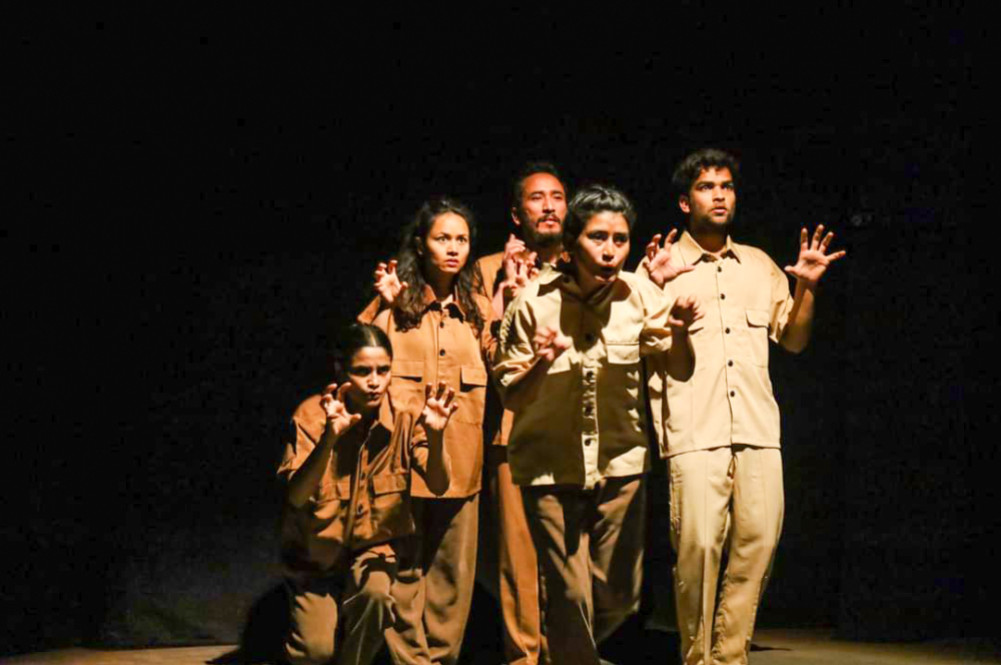
Sometimes the movement of the artist shows the direction of the music and sometimes the rhythm of the music guides the artist
We use Google Cloud Translation Services. Google requires we provide the following disclaimer relating to use of this service:
This service may contain translations powered by Google. Google disclaims all warranties related to the translations, expressed or implied, including any warranties of accuracy, reliability, and any implied warranties of merchantability, fitness for a particular purpose, and noninfringement.
'Zandun, Mandun cheap egosDon't understand anything, hopes are false.'The sentences uttered in the play 'Ubur Ubur Tikki' are like this. In an hour-long play, the actors don't say anything? Not even that.
For an hour, the actors run, jump, shout and cheer but say nothing. They speak only through body movements, they make sounds only with heart touch.
In the play 'Ubur Ubur Tikki', which has been staged since Friday at Kausi Theater in Teku, it is difficult to find the reason in every scene, but it is very easy to grasp the essence.
This play was staged for the first time on February 23 at the South Asian Theater Festival held in Bangladesh. Directed by director Sudam Sike, who prefers to speak less, not only he but also four other actors act without speaking in this play. Although acting without speaking sounds strange and complicated, Sudam likes this style very much. In the past too, plays like Aiya Maya..., Like Let's Abhinaya Khaman..., Panch... have been staged under his direction. This time, Khappis Sudam has brought the artist in front of the screen as an insect to reveal the feelings symbolically rather than giving direct meaning through the dialogue. It is left to the audience to find the meaning in the meaninglessness.
The worms that run after the light seem unstable throughout the play. Ghari leans right, ghari left, ghari climbs on top of each other and ghari moves forward leaning on each other. Sometimes they look like friends and sometimes they look like enemies. They fight too. They also collide. Sometimes they seem to take something out of themselves and sometimes they seem to put something on. But whatever they do, they think that these 5 different worms are not the same worm. They are not five different creatures but one creature. The sweet harmony with the
music is never missing throughout the play. Sometimes it seems that the movement of the artist is showing the direction of the music. Somewhere it may seem that the rhythm of the music is guiding the artist. Naresh Gajurel, who makes the play more effective with music, seems to be diving into many emotions like an artist throughout the play. Even though he is busy with a guitar in his hand, his face seems to be telling a story.
From the beginning of the play, when we see the worms running behind the light, it can be understood that the worms are looking for something. The theme of the play is the fight of self-defense and the journey of the search for existence of the insects who are trapped in confusion after there is no light to show the way. The realistic drama shows that every insect has to win the battle of its life, even if the appearance of the tiny insects doesn't make any difference to anyone. Therefore, this play should not be different from the play of people like Kira. The play has exposed many ups and downs in human life and the happiness after that struggle through physical presentation. At the end of the play, the scene of the insects overcoming many difficulties can be considered as concluding that it is meaningful to take life as a celebration. In the name of
material, only one white board is visible throughout the play. The white board in the hands of every artist may have reflected the emptiness before life was filled with many colors. Similarly, with the help of the white board, the scene is later reflected through the projector, so the image of the white board is the use of technology or the emptiness of life - whatever you consider it to be. In this play, no argument or idea is true, so no one's understanding is considered wrong. The strength of this play that adopts separation is that everyone gets to experience it in their own way. Time will tell if the
drama can keep all kinds of audience tied for an hour or not, but 'Ubur Ubur Tikki' will definitely help to spread the charm of new style in Nepali theater among the audience. The play will be staged till Chait 18.
(Trainee)