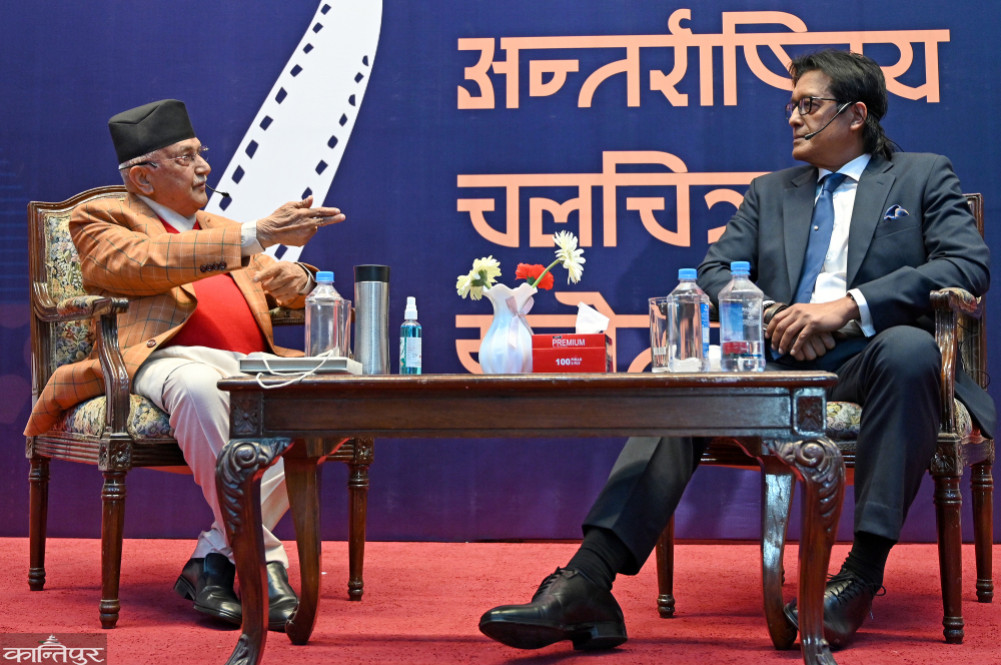
Not only in politics, but also in the fields of sports, information technology and music, Oli, who does not hesitate to make speeches and respond, spoke for two hours in the 'Cinema Samvad' with Rajesh Hamal on Friday.
We use Google Cloud Translation Services. Google requires we provide the following disclaimer relating to use of this service:
This service may contain translations powered by Google. Google disclaims all warranties related to the translations, expressed or implied, including any warranties of accuracy, reliability, and any implied warranties of merchantability, fitness for a particular purpose, and noninfringement.
In terms of activism, former Prime Minister and UML President KP Sharma Oli is far ahead of other contemporary leaders. Not only in politics, not only in sports, but also in the fields of information technology and music, he never hesitates to make a speech and respond. On Friday, during the 7th Nepal International Film Festival, Oli spoke for about two hours in a 'Cinema Dialogue' with actor Rajesh Hamal.
In that sequence, former Prime Minister Oli opined that art is related to human life. But art, he said, was more related to activities for livelihood than to acting and creating. When going from the wild age to agriculture, how do people do agriculture? Learned the art of how to plant crops. Wild animals had to be trained and domesticated for animal husbandry. For that, you need the art of befriending a wild animal," he said. "They need the art of hunting. The meaning and importance of art begins with life, with the desire to live and the will to live.'
Oli believes that presenting something beautifully is an art. Can you make a wooden window, artistic or simple? Can a pillar be made, artistically or simply? Man developed art because he was conscious. This is why culture developed. That's why art, culture and literature came together, Oli says looking at Hamal, 'Art is the beautiful presentation of different aspects of human life.' asked the question. However, Oli forgot to talk about the impact of art on his life while balancing art and life. He got confused in the argument that art is necessary for human life. Art is an important aspect. Humans can only live like cattle. However, human life requires art to live.'
Presenting Oscar Wilde's idea that 'art is unnecessary' in the middle of the dialogue, he questioned connecting art with 'unnecessary needs'. This seems unnecessary. But, looking deeper, there is a dire need for art. If a person has the wisdom to understand the aspect of art in the hustle and bustle of life, his practical life can also be balanced. How much do you agree that art is an unnecessary necessity? While Hamal was reaching the depth of the need of
art, Oli gave a superficial answer. Before Hamal's question could be answered, Oli said, "I don't agree that much." Did a little old man write that?' Oli's quick and humorous answer made the audience in the hall of the National Assembly laugh out loud. Hamal also described Oli's style of answering as artistic. I don't think art is a bit of an unnecessary necessity. Unnecessary means unnecessary, but art is a necessary necessity. We do not consider rice as life like other living beings. Grass and water are life for cattle. But, for people, dal is not life,' Oli said in reply.
After Oli did not answer deeply about the need for art, Hamal asked in the middle, 'The practical side for people is life. Business is life for businessmen, politics is life for politicians. But, can you think that art, literature and film are unnecessary?' Oli could not get to the bottom of why art is necessary in response to Hamal's question. He exemplified the love of youth, motherhood. However, he was confused in response to that answer.
'A mother does not think that only pulse is life. What he finds in his child's smile is the most precious thing in the world. A child's smile doesn't bring the joy of a fur jacket in winter, but that child's smile makes you forget winter. The heat is forgotten,' he tried to explain by giving an example,' therefore, breathing means living or I am alive and breathing. A life lived to breathe. Even plants can breathe. We don't want to live in one place, in one house. We want to live a happy life like nature.' Oli did not try to appear weak when Hamal argued that youth's love and mother's affection are connected with feelings. Before Hamal's question could be completed, he said, 'Life is connected with status and feelings. It is connected with reality and fiction.'
When Oli was confused between the relationship between art and emotion, Hamal connected the dialogue with politics. "Is life connected with emotions or with perceived intelligence?" Oli said, "Life is real, society is real" while expressing his art. The reality is what the situation is. Art is imagination, acting. Life is not about acting. Acting in the movie even if you don't eat it. An act of love even if there is no love. Nalde also fought acting. Acting injured even if not injured. Deadly acting. Life is not like that. It is not like that in life, it is not like that in politics.'
Oli's answer shows that he has not yet understood art as a true depiction. That's why, to explain the same thing, we presented Picasso's famous quote. "When art matures, it begins with a lie. But, this is such a lie that the observer knows the truth within himself,' Hamal looked at Oli and reversed Oli's understanding. Hamal added, 'When watching the film, everyone thinks that it is a lie, a drama. Although it appears to be rich, it may seem that it is poor in real life. But one can bear the feelings shown there. You can laugh, cry, even express your pain by being affected by the scenes of the film, even though you know that it is a lie. This power of visual language cannot be denied, right?' But, Oli said that art is not a true depiction. I don't call films and art lies. Story and acting. You can't tell a lie, it's better than a lie," Oli said, giving the example of Mahabharata, "Art is not a realistic depiction, it is art. It's a story, but not a lie. A story is not a history, so it should be called a hypothesis.'
After a long discussion on the story, Hamal tried to lead Oli to the argument that equality is not possible in practical life. However, Oli stood in favor of making it possible. A long discussion went on between the two. Until the 16th century, man was in a wild state. From that came animal husbandry, something that had never happened before. came to agriculture. By 1903, the Wright brothers were building airplanes. Go to Pokhara now, airplane. Thousands of airplanes around the world. This happened in 120 years. Things are happening that have not happened before,' Oli said, giving an example to show the possibility of change. Before Oli could finish his answer, Hamal asked - did that bring equality?'
If we accept the story that is happening, a new film will not be made. But why make a film that has not been made yet? Have to start today? After Oli answered in the same way, Hamal directly asked Oli an ironic question. If we had the will to start from today, why didn't we start from yesterday? The audience was very entertained by this argument/argument between the two. While discussing the dialogue of the film, Hamal kept presenting the grievances of the people and the disappointment of the ruling party to Oli. Oli tried to prove Hamal's complaint wrong with political definition. There was a good debate between the two on politics under the pretext of discussing various aspects of the film. That's why Oli said, "Now it looks like there is a confrontation between us."
As Oli said, in this debate on the film, if the truth is presented that why the state has not yet understood art, the people's extreme disappointment in Hamal's question, the question of the ruling party.