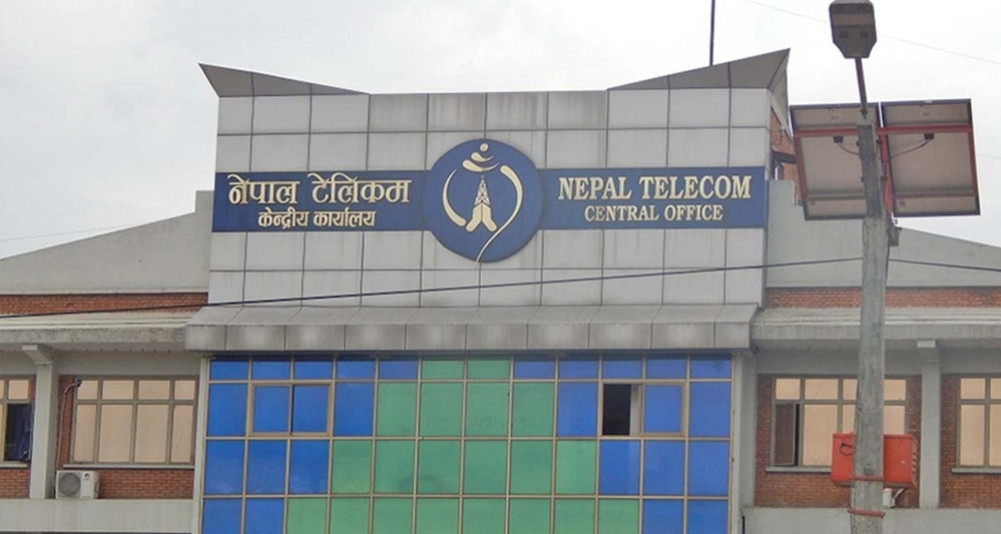
Despite preparations to sell a large stake in Nepal Telecom to the public amid financial challenges, experts are concerned about its long-term impact.
We use Google Cloud Translation Services. Google requires we provide the following disclaimer relating to use of this service:
This service may contain translations powered by Google. Google disclaims all warranties related to the translations, expressed or implied, including any warranties of accuracy, reliability, and any implied warranties of merchantability, fitness for a particular purpose, and noninfringement.
The government has announced that it will reduce its shareholding in Nepal Telecom Company Limited (Nepal Telecom) to 66 percent. The plan to sell the remaining shares to the public by mid-December has been put forward through the budget statement for the upcoming fiscal year 2083/84, while maintaining the federal government's shareholding at 66 percent. Finance Minister Swarnim Wagle said that the proceeds from the share sale will be used to make Nepal a 'tech hub'.
Earlier, there had been discussions about changing the government's shareholding in Telecom and increasing public participation from 25 percent to 34 percent. There had also been discussions from time to time about bringing in foreign strategic partners in Telecom. However, this time the government has taken a clear path to take shares to the public level. Currently, the government owns 91.49 percent of the shares in Telecom, 0.03 percent of the Citizens' Investment Fund, and 8.48 percent of the shares owned by the general public and employees.
Telecom expert Ananda Raj Khanal says that selling an additional 26 percent of shares to the public will mobilize a large amount of capital. ‘The current financial situation of Telecom is not good,’ Khanal said, ‘It has been operating in a loss lately.’ In such a situation, how enthusiastic would the public be to buy shares!’ Pointing out that Telecom has a huge liability to pay license renewal fees of Rs 20 billion within the next five years, Khanal said that it is necessary to resolve the policy related to renewal fees.
‘On 28 Baisakh 2081, Nepal Telecom’s 25-year mobile service license expired, and the 20 billion renewal fee was to be paid only after 10 years, but the Telecommunications Authority gave Telecom a new license for 5 years,’ Khanal said, ‘This has added a huge financial liability of paying another Rs 20 billion for license renewal within 5 years. An additional Rs 40/45 billion is required for the latest technology like 5G.’ Where can the company get money for renovation and infrastructure expansion when income is decreasing and expenses are increasing?''
Khanal, saying that even though the company is operating at a loss, Telecom is distributing 30 percent cash dividend to shareholders by showing profit from interest on bank deposits, has called it a 'strange situation' in the country. 'If this problem of Rs 20 billion is not addressed and dividends are distributed with the money coming from interest, there is a risk of the company closing down in the future,' he said. 'In such a situation, would it be appropriate to float Telecom's shares on the market?''
Efforts have been made to amend the Telecommunications Act to clarify the long-confused provisions on license renewal, share structure, and foreign investment in the telecommunications sector. This time too, Finance Minister Wagle has said that the bill will be presented in Parliament. Although the discussion of amending the act or bringing a new bill has been going on since 2064 BS, Khanal pointed out that it is not easy as many pending and controversial cases of Ncell, Smart Telecom, Nepal Telecom, internet service providers and infrastructure companies are involved in it. 'If someone dares and does not address the current problems properly through this bill, it can cause a bigger accident instead of improving it,' he said.
Nepal Telecom's total operating income as of the third quarter of the current fiscal year was 25.92 billion 16 million rupees and it earned a net profit of 6.27 billion 29 million rupees, according to the company's financial statements. The company's annual earnings per share remained at 46.47, an increase of 9.9 percent compared to the previous year, the statement said. It is said that an increase of Rs 577.4 million (2.76 percent) in GSM revenue and a decrease of Rs 8.46 percent (386.9 million) in depreciation expenses helped increase net profit.