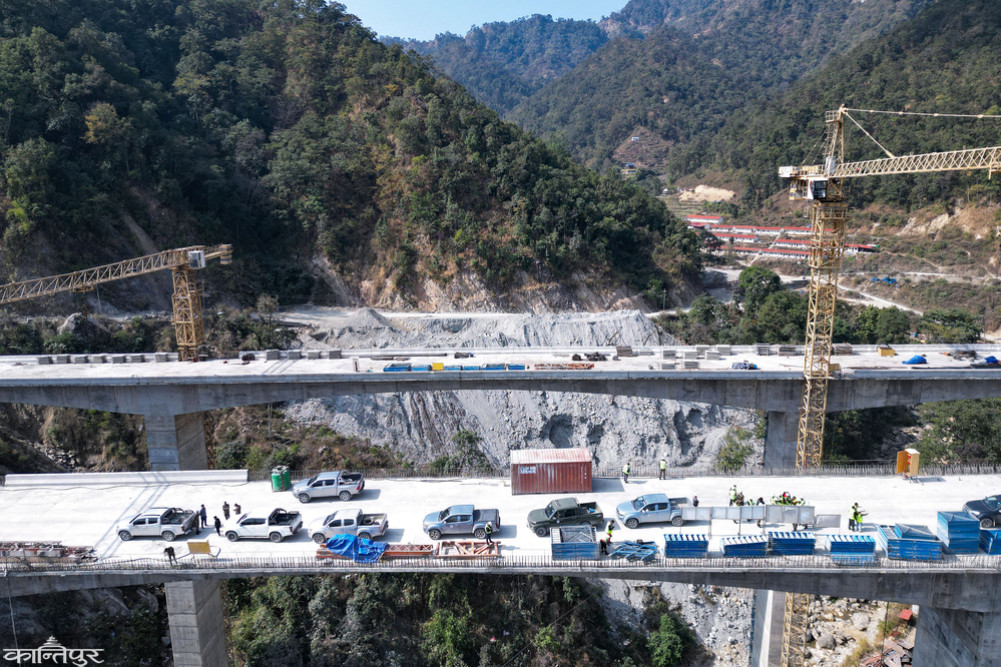
Stakeholders claim that projects of strategic importance could not be completed in 2082, but the work was relatively well done.
We use Google Cloud Translation Services. Google requires we provide the following disclaimer relating to use of this service:
This service may contain translations powered by Google. Google disclaims all warranties related to the translations, expressed or implied, including any warranties of accuracy, reliability, and any implied warranties of merchantability, fitness for a particular purpose, and noninfringement.
Although many infrastructure projects were carried out in 2082 BS, major road infrastructure could not be completed. Work was done on major contracts. But only a few new contracts were awarded. The old contracts continued. Even though the upgrading of roads that receive heavy traffic daily was started, it could not be completed.
The construction of the Nagdhunga-Sisne Khola tunnel, which is of interest to many, has reached the final stage but could not be put into operation. The Road Department was preparing to put it into operation in 2082 BS. But the tunnel could not be put into operation due to the failure to select a service provider to operate it. The construction work is 98 percent complete. Its operation will now be in 2083 BS. It has been four years since the upgrading of the road section from Nagdhunga to Muglin started with a concessional loan from the World Bank, but the work has not been completed.
Upgradation work is underway on the 94.66-kilometer road from Nagdhunga to Muglin. More than 12,000 vehicles ply this road daily. The work is being done by dividing it into three sections, Nagdhunga-Naubise, Naubise-Malekhu and Malekhu-Muglin. So far, the second-stage blacktop work has been completed on the Nagdhunga-Naubise road section. Only the third or final stage of blacktop work is left to be done on the 12.26 kilometers where the upgrade has begun. The work on this section will be completed next year.
The project claims that the work on the Naubise-Malekhu road section will also be completed next year. However, the work on the Malekhu-Muglin road does not seem to be completed. Although the Aanbukhaireni-Pokhara road section was expanded with the concessional loan assistance of the Asian Development Bank (ADB), the work has not been completed. The work on the Aanbukhaireni-Jamune section has been completed. But the road safety work has not been completed. Although the work on the Kakadbhitta-Lauki road expansion is underway, the progress is low.
Even after 7 years of construction, the work on the Narayangadh-Butwal road expansion has not been completed. The 113-kilometer road section currently has problems in the Daunne area. A concrete (slope) road has been constructed as an alternative to blacktop in 14 kilometers of this section. Work has been completed elsewhere. As problems began to increase during the rainy season, the road is being constructed using cement in 11 kilometers of this section. Although the issue of blacktop was mentioned in the initial design, during construction, the slope work was taken forward after it was found that the blacktop was not durable due to the soil in that area, said Chudaraj Dhakal, Project Chief of the Project Directorate (ADB).
‘Work is underway on Daunne,’ said Dhakal, ‘by the coming monsoon, the work on this section will be completed, this time passengers and drivers will not have to face problems like in previous years.’ Apart from this, 99 km of the road has been built with four lanes in rural and forest areas and eight lanes with service lanes on both sides in market areas.
The work on the Kamala-Kanchanpur road expansion has also not gained momentum . Another problem that has been encountered during monsoons for the past few years has been the construction of a contract on the BP Highway. The flood of Asoj 2081 caused more damage to the 30.5 km area under this highway from Bhakundebensi to Nepalthok. Apart from the 3.2 km of the damaged highway, work is underway on a 27.3 km section. Currently, three packages have been prepared and the work has been carried out by making a contract agreement, one towards Kavre and one towards Sindhuli. It is being built on two lanes . More than 4,000 vehicles travel through this highway daily.
Although work has been carried out on the Kanti Highway, which was damaged by the floods and landslides of Asoj 2081, progress is slow. Kulman Ghising, who took over the responsibility of the Ministry of Physical Infrastructure, Energy, Water Resources and Irrigation and Urban Development in the Sushila Karki-led government after the Gen-G movement on 23 and 24 Bhadra, decided to terminate 41 out of 227 contracts on the road side. Similarly, 22 contracts were terminated under the Water Resources and Irrigation Department, where 215 contracts are ongoing, 33 contracts are still problematic.
Only 3 out of 42 sick contracts under the Urban Development and Building Construction Department have been terminated. Some projects have not yet been awarded contracts. The process of new contracts has not been able to proceed because construction entrepreneurs have gone to court for some of the terminated contracts. Similarly, projects of national pride and strategic importance could not get multi-year resource consent. Due to this, the Mid-Hill, Postal Highway, North-South Koshi, Kaligandaki and Karnali Corridor roads of national pride that were under construction were affected.
Kathmandu-Terai/Madhes Expressway (Fast Track), Madan Bhandari Highway and other major road infrastructures also could not get resource consent in 2082 BS. The Road Department has stated that they had to wait until 2083 BS for that. In 2082 BS, only the Nagma-Gamgadhi road connecting Jumla-Mugu, which was under upgrade under the leadership of the interim government's Minister for Physical Infrastructure and Transport, Madhav Choulagain, succeeded in getting a multi-year resource consent.
Although it was said that the work on the remaining section would be started by putting aside the dispute over the 3.2-kilometer section of Khokana in Lalitpur, the starting point of the fast track, further process has not been able to move forward. The Nepal government has cleared the way for the start of work on the Kalanki-Basundhara section under the second section of the Ring Road expansion by deciding to exempt construction taxes. The construction work on the second section of the Ring Road, which is being expanded with the grant of the Chinese government, has not yet begun. Overall, 2082 BS remained average for the infrastructure sector. Only 67.27 percent of the work has been completed in the four years since the construction of the Siddhababa Tunnel in Palpa began.
Shyam Bahadur Khadka, Deputy Director General and Spokesperson of the Road Department, said that the management of broken contracts has not been done. ‘There were few new contracts in 2082,’ he said. ‘As the source agreement was not received on time, new contracts could not be awarded even on the current contracts.’ Work was done on the old current contracts, the old projects reached the completion stage, but he said that new contracts could not be awarded on the ongoing projects because the source agreement was not received on time for the contracts.
Related News: