Although it was expected that political instability would end, economic growth would be prioritized and the economy would become viable after the large party entered the government with a two-thirds majority, the government failed to give that impression in one year.
We use Google Cloud Translation Services. Google requires we provide the following disclaimer relating to use of this service:
This service may contain translations powered by Google. Google disclaims all warranties related to the translations, expressed or implied, including any warranties of accuracy, reliability, and any implied warranties of merchantability, fitness for a particular purpose, and noninfringement.
Although the two-thirds government formed by the coalition of the country's largest parties, Congress and UML, has said that it will give priority to economic growth, the economy has not improved as expected in one year. Compared to the situation when the government was formed, although some indicators are generally positive, there are signs of improvement even though the citizens cannot feel it. The government (Ministry of Finance) is promoting economic reforms as if there is a jump in economic activity.
Experts say that the political instability will end when the major political parties come to the government with a two-thirds majority, although it is expected that economic growth will be prioritized and the economy will run, but the government has not given that impression in one year. Economist and former Executive Director of Nepal Rastra Bank Gopal Bhatt says that there has been no improvement in the economy in a year.
'The real sector of the economy has not improved in indicators such as production, employment, industry and business conditions, investment growth. Most importantly, the confidence of the private sector and the common citizen has eroded. The government did not seem to have done anything to improve it," he said. "In such a situation, marginal growth in the data cannot be said to be an improvement in the economy."
because he says that the signs of improvement are due to the improvement in other economies of the world than ours. The government has made public institutions like the Securities Board, Insurance Committee, Rashtra Bank, etc. a hotbed of corruption and weakened. Nepal's identity is also being lost due to lack of its own production,' he added.
Nepal is becoming known in the world as a country that runs the country through remittances. This is the reason why remittances have increased in recent months and the government is basking in that self-confidence. Improvement of the real sector in the economy has not been prioritized.'
Although there is an opportunity for the government to increase sufficient investment, Bhatt said that the government's attention has not been directed towards it. "The youth do not have faith in the government, they do not want to live here. But the government has no program to stop the youth," he said.
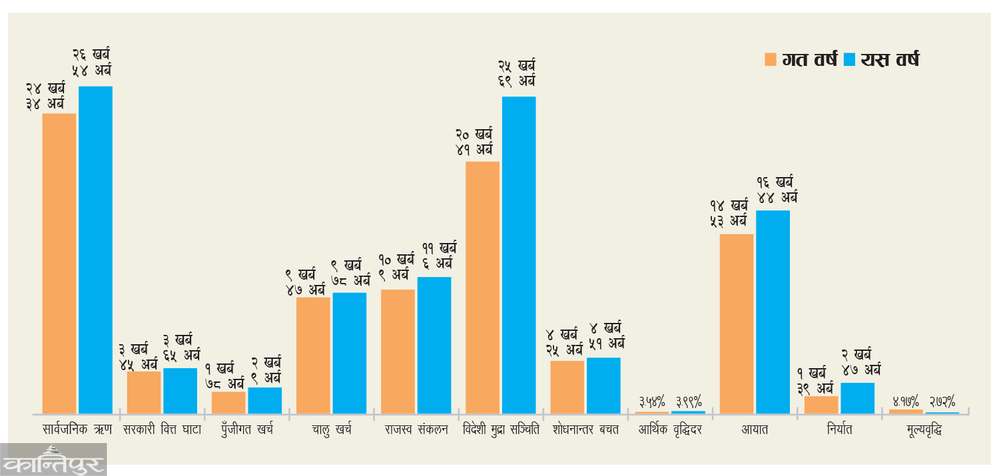
In the last 11 months, public debt has increased by nearly 2 trillion. Now the government treasury is in loss of 3 trillion 65 billion 97 crores. During the same period of last year, such loss was 3 trillion 45 billion 55 million. Similarly, by June 28 of last year, about 59 percent (1 trillion 75 billion) of the annual target has been spent on capital expenditure, and it has reached 59 (2 trillion 9 billion) rupees.
The trend of not being able to spend a large part of the budget allocated under the heading of development expenditure has continued this year as well. In this financial year, the government allocated 3 trillion 52 billion 35 million rupees under the capital heading. With three days left to the end of the current financial year, only 2 trillion 9 billion rupees have been spent. After being unable to spend, the government reduced it to 2 trillion 99 billion 500 million (85 percent of the initial allocation) through the half-yearly review.
Government finance experts say that it is not possible to spend the revised allocation amount based on this. Although the government has given priority to economic development and claims that capital expenditure will increase, the results have not shown the expected improvement. However, compared to the capital expenditure up to June 28 of the last financial year, the expenditure for the same period of this year is slightly higher based on the annual target and amount. Economist and public financier Baburam Subedi said that as the economy is recovering and inflation is decreasing all over the world, its positive effects are also seen in Nepal. At the same time, he says that some improvements have been seen in the investment environment due to the government's efforts.
'If the market demand is created, imports will also increase, economic activity will also increase, investment will expand and its chain effect will have a positive effect on the economy,' said Subedi, 'currently the increase in imports and exports has helped the expansion of the economy. But when remittances and exports are increasing, it seems that due to the large amount of investable funds accumulating in the banks, there is no credit flow as expected.'' is.
Although the improvement seen in the economy is itself (naturally) or is due to the government's efforts to improve the investment environment, he said that it should be found. There is some improvement in revenue collection in one year. According to the Ministry of Finance, the government has collected revenue of 11 trillion 6 billion 52 crores (77.96 percent of the target). Now, due to the increase in imports, revenue collection has also increased somewhat. During the same period last year, the revenue was collected at 10 trillion 9 billion rupees (70.93 percent of the target). This year, the government had set a target of collecting 14 trillion 22 billion in revenue.
Although the revenue collection is on the way to improvement, the Ministry of Finance official admits that the target has not been met. They say that it is impossible to meet the revenue collection target with normal performance. Due to the increased leakages in the tax administration and lax control, there has been a decrease in compliance with the tax laws, so the revenue has not increased as per the target.
During this period, the import and export of soybean oil was good, so the export of oil increased. This is the reason why the total export has increased by 78 percent in the last 11 months and it should be considered positive, said Nar Bahadur Thapa, an economist and former executive director of Rashtra Bank.
Since the said oil is not produced in Nepal, it has to be brought from India, which has also increased the import. As a result, Nepal's international trade has increased by 18 and a half percent. This has increased revenue and activities including bank loans, albeit temporarily. Meanwhile
Remittances have increased by a lot. It should be taken as a reform,'' he said, 'but no work has been done in the utilization of remittances. Due to this reason, remittances have worked like Vanmara to cause unhappiness including increasing wasted liquidity, increasing investment in unproductive sectors.'
He said that the dependence on remittances is increasing and it has destroyed the agriculture and industry sectors, so the government has failed to bring an effective program to save those sectors from this situation. Thapa says that there is no effective arrangement in the financial policy and monetary policy to link remittances with production.
According to the data of Rashtra Bank, in the last 11 months (from July to May), 15 trillion 32 billion 93 crore rupees have been received through remittance. This is an increase of 15.5 percent compared to the same period last financial year. Till May of the last financial year, 13 trillion 27 billion remittances were received and the growth rate was 16.9 percent.
The statistics also show that the remittance flow has also increased due to the increase in youth migration. In the last 11 months, 4 lakh 52 thousand 324 people have taken final work permit (institutional and individual-new) and 3 lakh 8 thousand 67 people have taken work permit again for foreign employment. This is more than last year. In 11 months of the last financial year, 4 lakh 21 thousand 356 people took the final work permit and 2 lakh 61 thousand 2 hundred 10 people took the work permit again.
Although there is no expected improvement in the main sources of foreign exchange earnings including exports, tourism, foreign investment,
remittances have continuously increased, the external sector of the overall economy is becoming stronger. The economic and financial report of Rashtra Bank last May showed that foreign exchange reserves, current account and other external indicators are becoming stronger. Along with remittances, the country's foreign exchange reserves have been making continuous records for the past 33 months. Last May, such reserves reached 25 trillion 69 billion 38 billion rupees. Compared to last June, it has increased by 25.9 percent.
As of last May, the current account is in surplus by 3 trillion 7 billion 31 crores and the current account (balance of payments) is 4 trillion 91 billion 44 crores. During the same period of the last financial year, the current account was in surplus by 2 trillion 38 billion and the current account was in surplus by 4 trillion 25 billion.
In the last 11 months, 11.9 billion foreign direct investment (equity only) has come in. This is an increase compared to the same period last year. Until June 2081, such foreign investment was 8 billion 24 million. The market price increase rate (inflation) of goods purchased by the general public was 2.72 percent on average last May. This growth rate was 4.17 percent in the same month last year. Compared to last May, the rate of price increase has decreased in May.
In the eleven months of the current financial year, deposits in banks and financial institutions have increased by 5 trillion 17 billion 600 million (8 percent). During the same period last year, such deposits increased by 5 trillion 14 billion 57 crores (9 percent). In the last 11 months, loans to the private sector have increased by 4 trillion 7 billion 62 crores (8 percent). According to the monthly report of Rashtra Bank, such loans increased by 2.46 billion 800 crores (5.1 percent) during the same period last year.

