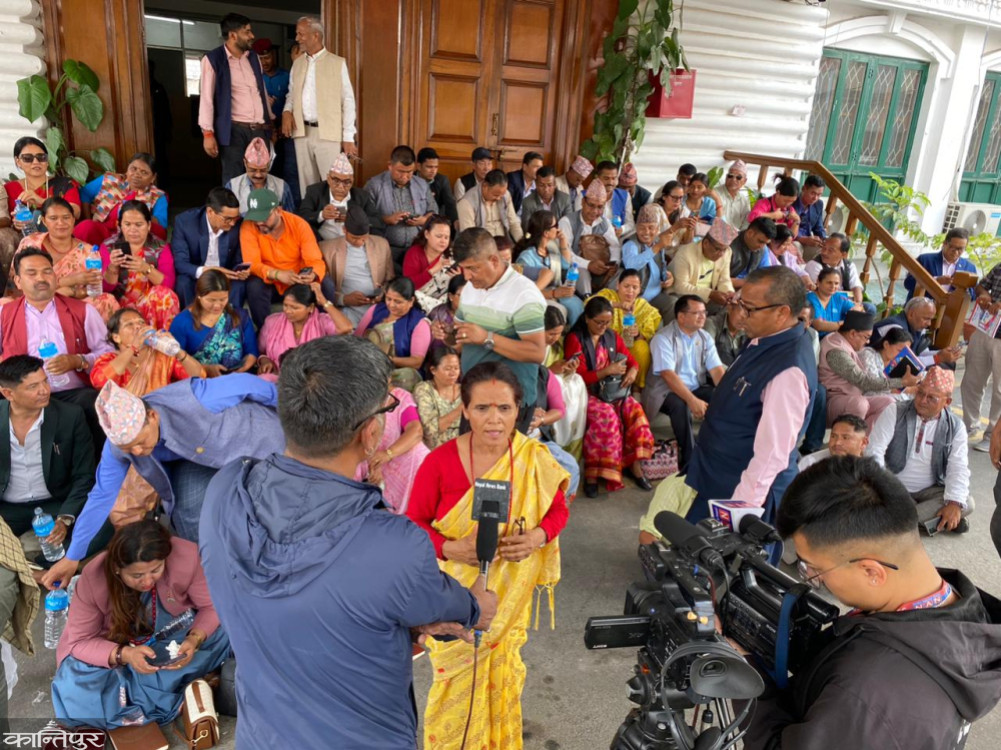
Request to withdraw the decision to cut 24.49 billion for the proposed equalization grant for the current year and release the budget.
We use Google Cloud Translation Services. Google requires we provide the following disclaimer relating to use of this service:
This service may contain translations powered by Google. Google disclaims all warranties related to the translations, expressed or implied, including any warranties of accuracy, reliability, and any implied warranties of merchantability, fitness for a particular purpose, and noninfringement.
People's representatives at the local level staged a sit-in at the Ministry of Finance in protest against the reduction of the equalization grant proposed for the current financial year. Under the leadership of the National Federation of Municipalities and the Association of Municipalities, more than 150 chiefs and deputy chiefs of municipalities staged a sit-in for three hours at the main gate of the Ministry of Finance on Sunday. They have also warned that they will besiege the Singha Darbar if the decision to reduce the subsidy is not reversed.
The Union government had decided to cut the equalization grant by nearly 26 percent in December, halting payments for hundreds of under-construction schemes across the country. The demand of the people's representatives is to release the reduced budget. "The Ministry of Finance plans to surround Singha Durbar without withdrawing the decision to cut the equalization subsidy," said Bhim Dhungana, the chairman of the municipal association, "Cutting the proposed subsidy is a product of the centralized mentality." According to the recommendation of the Natural Resources and Finance Commission, 58.67 billion and 87.35 billion have been allocated to the state and local levels respectively. Out of that, about 24 billion 49 crores of local level has been cut. The government disbursed only 7 percent out of 25 percent under the third installment to be sent to the local level.
Currently, while sending the fourth and final installment, the Comptroller General's Office has asked the Office of the Controller of Funds and Accounts throughout the country to disburse 74.11 percent of the current year's total budget towards equalization grants. Accordingly, 25.89 percent of the budget has been cut in the current year towards the equalization subsidy of the local level. Last January 26, through a correspondence of a similar nature, the Accountant General had asked to disburse 55.73 percent. At that time, it was instructed to cut the amount based on the revenue collection till the end of December. Since the revenue collection is not as per the target, the government has been arguing that it has to cut the budget of all sectors.
Even as the end of the financial year is approaching, Dhungana, the chairman of the municipal association, said that they are planning to protest because the government has neglected to send subsidies. He said that although the Prime Minister and the Finance Minister had promised to release the money that had been cut many times in public, it was not implemented. Adding to the issue of reducing the equalization subsidy and increasing the conditional subsidy every year, he warned that if the demand is not met, he will stop the local level and surround the Singha Durbar.
Among the four types of budget headings that the federal government transfers to the local level are equalization, supplementary, special grants and revenue sharing. It is an equalization grant that the local level can spend at its discretion. "Most of the work done by the municipality is done through equalization grants," Lakshmidevi Pandey, president of the National Association of Rural Villages, said, "The union government determines the grant amount by demanding a 'ceiling' before the budget speech to the local level. The suggestions of the Finance Commission are also taken during the preparation of the union's budget. But the budget given to the local level is being cut.'
The local people's representatives have been proposing plans through the municipality's budget speech in the belief that they will get the budget according to the ceiling. The local people's representative complains that after the implementation of the plan based on the equalization grant, the budget stop letter is received. Tulsakumari Pandey, Deputy Head of Ganeshman Charnath Municipality of Dhanusha asked, 'How will the final payment of the implemented plan be given now?'
People's representatives from critical areas with low internal resources have complained the most about budget cuts. Jawaharlal Yadav, chairman of Sarlahi's Bishnu Rural Municipality, argued that the income of any municipality is not even two to four lakhs and said that the union government has put the local representatives in trouble. He said that since the government has not given up despite repeated requests, there is no option but to protest and get the budget released.
Chairman of Natural Resources and Finance Commission Balanand Paudel said that the commission has been suggesting not to cut the equalization subsidy. He said that the commission had suggested not to cut the subsidy last year as well. Chairman Paudel also suggested that the equalization should be increased by reducing the conditional subsidies.
The government has been increasing the amount of the conditional subsidy to be transferred to the local level every year. However, the people's representatives complained that they were not heard even though they raised their voice that the limit of choosing the scheme was limited by increasing the conditional subsidy. People's representatives are of the opinion that they are trying to paralyze the local level because the center is directing the development program through conditional grants. When sending such grants, the union government chooses its own plan but the responsibility of implementing it falls on the local level, there has been opposition. The experts of federalism are of the opinion that the local level will not be strong since the selection of plans and the allocation of funds will be done from the center.
In a program organized by the National Federation of Rural Municipality and Municipal Association on the budget to be handed over to the local level in Lalitpur on Sunday, Khimlal Devkota, an expert on federal affairs and a former member of the National Assembly, presented the data on the increase of conditional grants in the seven-year budget from the financial year 2075/76 to 2081/82. He said that by increasing the subsidy conditional on the need to increase the equalization subsidy, the financial transfer is contrary to the essence of federalism.
In a program organized with the participation of heads/deputy heads and presidents/vice presidents of municipalities and rural villages, Devkota said that if this situation continues, the federal spirit will weaken. People's representatives participating in the program held the view that the financial transfer was not in accordance with the federal spirit and constitutional provisions. They said that the union has handed over the responsibility to the local level and kept the resources at the center. In the program, Chairman of Indrawati Rural Municipality, Jhamk Nepal, said that the policy of placing the resources at the center and giving the local level only responsibility for work is wrong. He said that the trend of increasing conditional grants and reducing equalization will not strengthen federalism.